Europe’s far right will look at Austria and say: this is how we do it
Recent election results confirm a broader pattern of far-right normalisation in Europe in general, and in Austria in particular, but it should not come as a surprise
Europe’s far right will look at Austria and say: this is how we do it

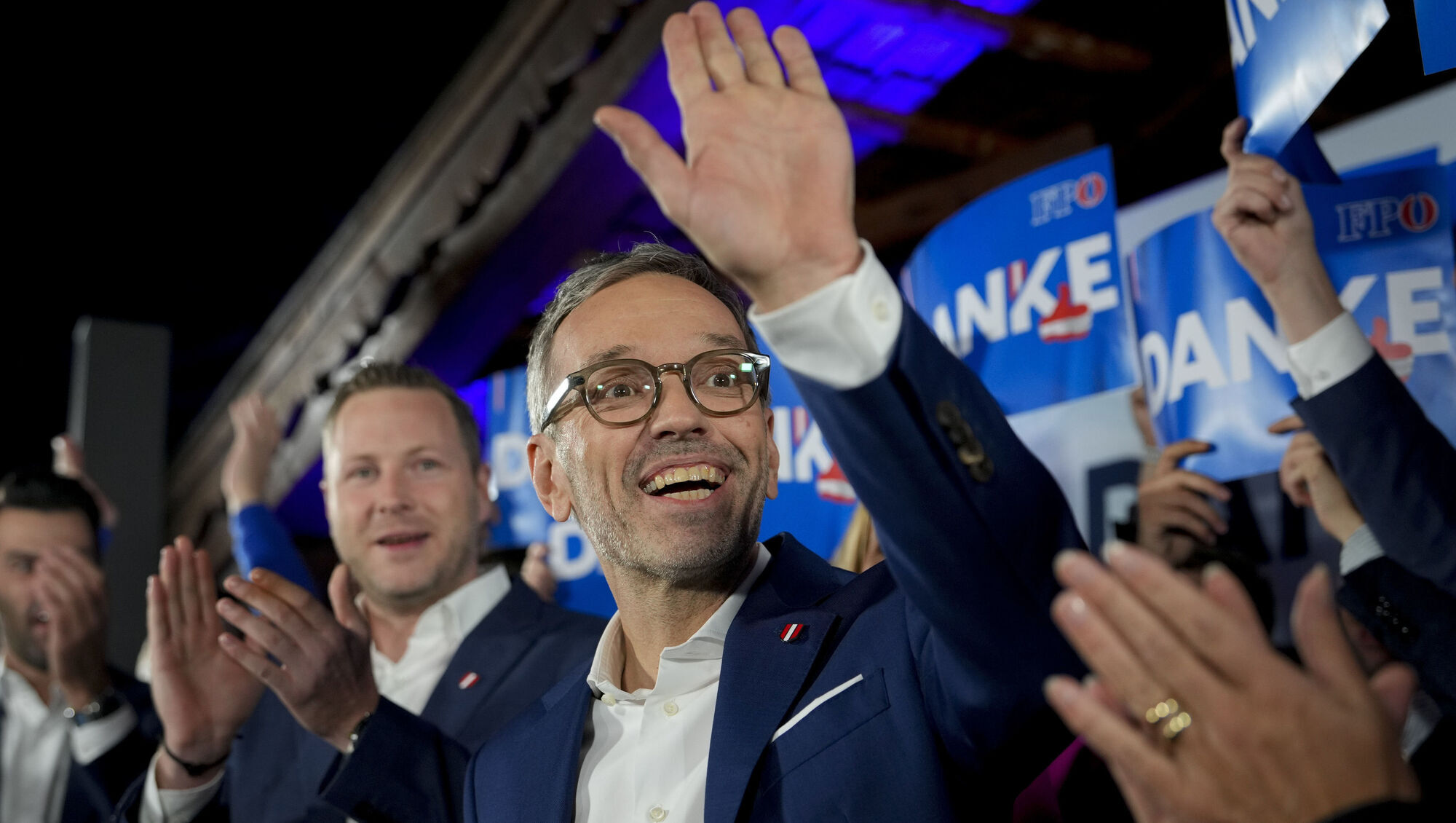
While the far-right party’s leader, Herbert Kickl, heralded the victory of his Austrian Freedom party as the beginning of 'a new era', it is better understood as a seemingly unavoidable progression. Photo: AP/Andreea Alexandru

While Europe may be “sleepwalking into a far-right trap”, Austria is consciously walking straight into it. After all, polls had predicted the most recent electoral success of the Austrian Freedom party (FPÖ) for almost two years. 

While the far-right party’s leader, Herbert Kickl, heralded its victory as the beginning of “a new era”, it is better understood as a seemingly unavoidable progression. If anything, the country’s recent election results confirmed a broader pattern of far-right normalisation in Europe in general and in Austria in particular.


Although 29% was indeed its best result ever in a nationwide election, the FPÖ has consistently achieved results in the double digits since 1990, has been included in the national government multiple times, and currently governs in several states with the conservative Austrian People’s party (ÖVP). 

After the most recent state election in Vorarlberg, the ÖVP is about to form its fourth regional coalition with the FPÖ there. As such, Austria is a perfect example of the dangerous shortsightedness of normalising far-right parties — a process led in the 21st century by, above all, conservative parties.

Herbert Kickl, leader of the Freedom Party of Austria, celebrates with supporters in Vienna in September after polls closed in the country's national election. The FPÖ has consistently achieved results in the double digits since 1990 and has been included in the national government multiple times. Photo: AP/Andreea Alexandru)

It started as a way to strengthen its own power, but the ÖVP’s embrace of the FPÖ and the latter’s repeated inclusion in national government helped make far-right policy positions mainstream, which in turn made the far right more acceptable to the general public — perhaps ultimately helping it win September’s elections. 

Because if the mainstream already parrots the far right, then why not just vote for the “real thing” instead? People prefer the original over the copy, as the far-right French politician Jean-Marie Le Pen once said, and as research confirms.

It had looked as if the ÖVP would probably become the junior party in a coalition with a dominant FPÖ — only for it to emerge yesterday that the ÖVP leader, chancellor Karl Nehammer, had been tasked with forming a government after all other parties refused to work with the FPÖ.

Still, as is the case following recent elections in several other European countries, such as Italy and the Netherlands, the far right is now the largest contingent in the right-wing block. 

Given that many conservative parties have by now worked alongside far-right parties at a national or local level, suddenly questioning their competence and abilities rings hollow and hypocritical, and not just to the far right.

Unsurprisingly, the ÖVP’s normalisation of the far right — linked to its own radicalisation on certain issues, such as Islam and immigration — has created expectations among its own voters. 

Head of the Freedom Party Herbert Kickl, left, waves to supporters beside party colleague Susanne Fuerst after his speech at a final election campaign event at St. Stephen's square in Vienna last September. Its repeated inclusion in national government over the years maybe ultimately helped it win September’s elections. Photo: AP/Heinz-Peter Bader

Today, a substantial share of ÖVP supporters consider the FPÖ to be a better coalition partner than any mainstream party. In a recent poll from before the election, almost half (48%) of ÖVP voters said the party should govern with the “Kickl FPÖ”, while just over a third (34%) of ÖVP voters preferred to govern with the “Babler SPÖ”, meaning the leader of the Social Democrats, Andreas Babler, and his party.

Although the ÖVP was the only mainstream party that had not categorically ruled out governing with the FPÖ before the election, it did declare its leader, Kickl, persona non grata. 

While the ÖVP leader, Karl Nehammer, still holds on to this odd separation — as though Kickl is somehow exceptional — he is already at odds with almost half of his voters. Moreover, Kickl was the minister for the interior in the previous ÖVP-FPÖ government.

Incidentally, during that government, cut short by the infamous Ibiza scandal, the ÖVP chose to ignore the FPÖ’s behaviour: as interior minister, Kickl ordered a police raid of Austria’s own domestic intelligence agency, a move later declared illegal and disproportionate, as the underlying reasons for the search proved to be unfounded. 

Moreover, the ÖVP had also undermined itself in office, as the conviction of the former chancellor Sebastian Kurz for making false statements to a parliamentary inquiry into alleged corruption demonstrated. This suggests that close collaboration with the far right normalises not only its policy stances but also its behaviour. 

Herbert Kickl, leader of the Freedom Party of Austria (FPÖ), leaves a polling station in Purkersdorf, Austria last September after casting his vote in the country's national election. In a recent poll from before the election, almost half (48%) of ÖVP voters said the party should govern with the 'Kickl FPÖ'. Photo: AP/Heinz-Peter Bader

Importantly, Austria is not the only country in western Europe demonstrating this dangerous pattern of far-right normalisation. In both Italy and Sweden, for instance, a far-right party has become the most popular within the right-wing block. 

In the Netherlands, Geert Wilders was normalised to prop up a right-wing coalition led by the conservative People’s party for Freedom and Democracy (VVD). When Wilders’ Freedom party (PVV) unexpectedly won the election, VVD members forced their party leader, Dilan Yeşilgöz, to enter a PVV-dominated coalition, albeit without Wilders as prime minister. 

A similar process will likely follow in Austria — and it won’t stop there.

  • Cas Mudde is the Stanley Wade Shelton UGAF professor of international affairs at the University of Georgia, and author of The Far Right Today. 
  • Gabriela Greilinger is a PhD student at the University of Georgia
x

More in this section

Revoiced

Newsletter

Had a busy week? Sign up for some of the best reads from the week gone by. Selected just for you.

Cookie Policy Privacy Policy Brand Safety FAQ Help Contact Us Terms and Conditions

© Examiner Echo Group Limited