Seen as radical abroad but conservative at home, Ireland stands alone on Gaza
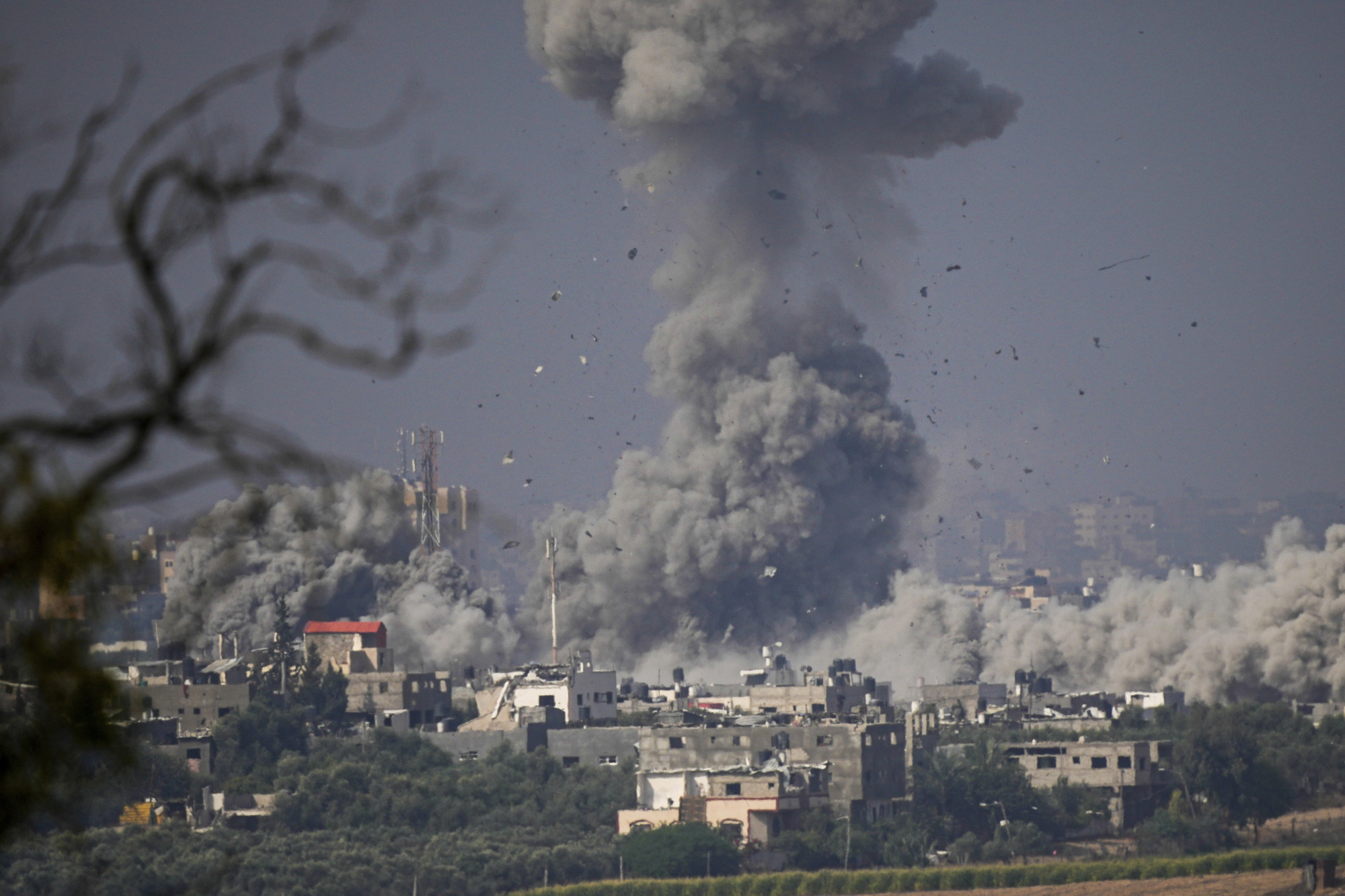
Smoke rises from an Israeli airstrike in the Gaza Strip last month. Since the early days of the Israeli retaliation, Ireland's acceptance of Israel's right to defend itself has been tempered by a caveat that this did not offer Benjamin Netanyahu's government carte blanche to kill civilians. Photo: AP/Ariel Schalit
Ireland, being an island, is used to standing alone, geographically, but we rarely have found ourselves out of step geopolitically in recent times.
We are, after all, a member of the "rules-based order", free marketeers, democratic and outward-looking.
And while Ireland's vote in favour of a UN resolution calling for a ceasefire in Gaza put us in a 120-country majority with just 14 votes to the negative, the Government has become something of an outlier across Europe in its statements on the violence in the region, being the loudest voice in the EU calling for a ceasefire, along with Spain.
Despite what some external columnists want to believe, Ireland's condemnation of Hamas after the October 7 atrocity was swift and unequivocal. Any attempt to contextualise the barbarism meted out came from Irish people, while the Irish government made no such attempts.
However, since the early days of the Israeli retaliation, Ireland's acceptance of Israel's right to defend itself has been tempered by a caveat that this did not offer Benjamin Netanyahu's government carte blanche to kill civilians.
"Israel is under threat. They do have a right to defend themselves, but they don't have the right to breach international humanitarian law," Taoiseach Leo Varadkar said on Prime Time on October 13.
"I believe by targeting civilians and by cutting off civilian infrastructure, that is a breach of international humanitarian law. And I think it's very important for us, as Ireland, to make sure that that voice is brought to the table at European Union level."

Ireland made that case at a European Council meeting in Brussels as Mr Varadkar and other leaders called for "humanitarian pauses", a linguistic fudge aimed at ensuring a united front, but which marked what the Taoiseach called an "evolution" at EU level.
“If you went back to two or three weeks ago, it appeared that the EU was supporting Israel without any equivocation or qualification. That changed a week or so ago to continuing to support Israel’s right to defend itself but emphasising the supremacy of international law, particularly humanitarian law, to yesterday, 27 countries calling for a pause to allow aid to get in and to allow citizens and hostages to get out—so I think you’re seeing an evolving position there.”
Following the explosion at the Al-Ahli Hospital, Tánaiste Micheál Martin called for a ceasefire, notwithstanding uncertainty over the exact cause.
“It really illustrates the enormous toll this war between Israel and Hamas is having on the civilian population in Gaza and, of course, on the civilian population in Israel,” Mr Martin said.
“In respect of any specific incident, it's very difficult for us at this distance to make any judgment call of who is responsible in terms of this attack on the hospital. The takeaway for me though, however, is that we now need a humanitarian ceasefire."

Mr Martin followed that up with a statement this week following the bombing by Israel of the Jabalya refugee camp in Gaza.
"UNRWA said yesterday that more children have been killed in Gaza since 7 October than have been killed in all conflicts globally since 2019. We cannot allow this to continue. This has to stop," he said.
"With the unfolding tragedy in Gaza, the European Union has been calling since last week for humanitarian corridors and pauses for humanitarian needs. We now urgently need a humanitarian ceasefire and a significant scaling up of humanitarian access to get vital supplies to civilians. We cannot wait any longer."
A measured call for an end to some of the worst human suffering seen for many years was met in one UK paper with a dressing down. Writing in the , Ross Clark said that Mr Martin had tried to be "Mother Teresa" before referencing erroneous reports that Ireland had objected to calling Hamas a terrorist organisation.

"On Middle Eastern Affairs, Ireland has long been the EU’s weakest link, trying to persuade it to adopt an unashamedly pro-Palestinian position," he writes before saying—incorrectly—that the Department of Foreign Affairs "stopped tellingly short" of referring to Hamas as terrorists. The DFA statement on October 9 closed with the line "Hamas is listed by the EU as a terrorist organisation, unanimously agreed by all Member States".
Domestically, People Before Profit has hit out at the Government for not imposing sanctions on Israel, which perhaps indicates where this government is. At home, seen as not going far enough, and abroad seen as radicals.
Ireland has long been accused—with some justification—of passivity in the face of western governments, particularly America, on the global stage. But as Enterprise Minister Simon Coveney told the in Korea this week—countries such as Ireland need to speak up for children in Gaza even if it makes for “difficult political interaction".