Rare cosmic coincidence will be spectacular from Ireland
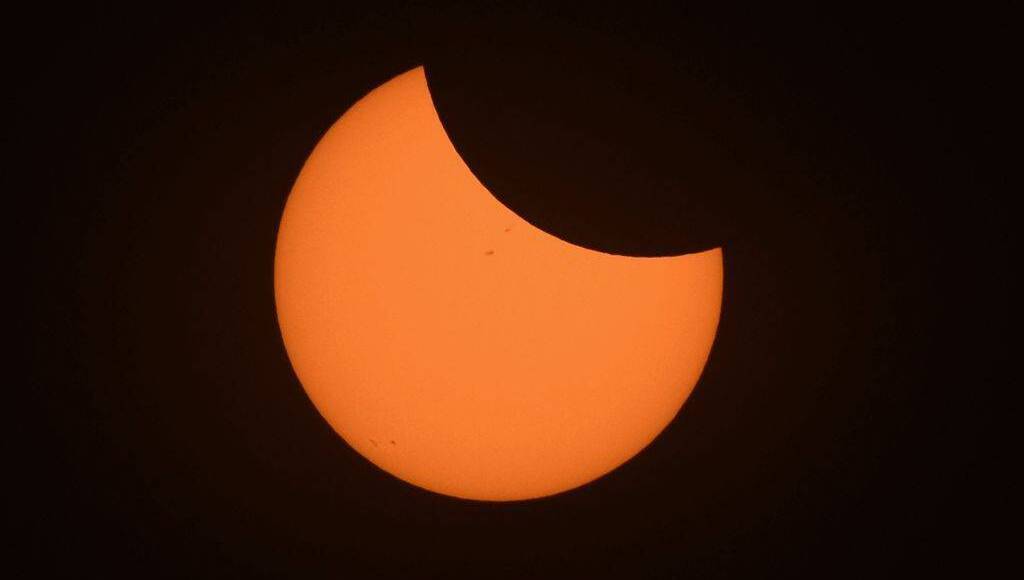
The partially eclipsed Sun photographed from Jackson Hole, Wyoming, USA on August 21, 2017. The Sun will be nearly 98% eclipsed by the Moon from the southwest of Ireland on August 12, 2026. Picture: Peter T. Gallagher (DIAS Dunsink Observatory)
An incredibly rare deep partial solar eclipse will occur on the evening of August 12, 2026, as the shadow of the Moon races across Ireland.
Most of us in Ireland will see more than 90% of the Sun being obscured by the Moon, with some areas of the country, including the west and southwest, seeing the Sun being nearly completely obscured at 97%.
While Ireland will experience several modest partial eclipses in the coming decades, nothing approaching the scale of the August 2026 event will be seen again for generations.
The next total solar eclipse that will be visible from Ireland will not be until 2090 (when this author will be 127!). That alone makes August 12 worth putting in the diary.
The Sun is around 400 times larger than the Moon, yet it is also approximately 400 times farther away.
The result is one of nature's most astonishing pieces of celestial geometry. From Earth, the two objects appear almost exactly the same size. This improbable alignment allows the Moon to cover the Sun with remarkable precision.
No other planet in our Solar System enjoys eclipses quite like ours. So, when can you see it and what can you expect to see?
From Cork, the eclipse starts at 6:14pm and will finish at 8:07pm, with the maximum point reached at 7:12pm, covering 96.4% of the Sun's surface. Valentia in southwest Kerry will see almost 98% of the Sun’s disc blocked by the Moon.
Sunlight will dip during the event so it will appear darker outside with the Sun less than 20 degrees above the western horizon.
The combination of a deeply eclipsed Sun and the low solar elevation should make for particularly dramatic views if Irish skies are clear.
As the Moon progressively covers the Sun, the daylight becomes strangely muted. Colours lose their warmth. Shadows sharpen. Birds often begin their evening chorus early, convinced that dusk has arrived.
Anyone who has witnessed a deep eclipse knows that the experience is unlike anything photographs can convey.
While there will be a lot of interest in this partial eclipse, eye safety is paramount should you plan to take a look, as the fraction of Sun remaining mid-eclipse is still unsafe to stare at directly without taking proper care.
There is a risk of permanent eye damage if you do not take proper precautions.
Certified eclipse glasses have filters made with special material to block the Sun’s dangerous rays, but check for small pinholes by holding them up to a light, and discard if you notice any scratches.
Sunglasses or similar do not offer the same protection and should not be used.
A safe way of observing an eclipse is by looking at the shadows beneath a tree — you should see hundreds of tiny partial solar eclipses between the pinhole shadows of the leaves.
A kitchen colander can also be a safe and fun way of viewing an eclipse, but don’t try looking though it! Look at the shadows it casts onto the ground, or better still, a sheet of white paper.
There are practical and safe ways to watch the partial solar eclipse in an eclipse-viewing booklet compiled by Research Ireland, ESERO Ireland and DIAS Dunsink Observatory at eclipse26.ie.
If in doubt, the astronomical observatories at Armagh, Birr, Dublin and Cork, together with several astronomy clubs, have eclipse viewing events so that members of the public can view the eclipse safely.
August 12 will also be an exciting day for a team of scientists from Ireland and Italy, who will take to the skies to observe the total solar eclipse, which will only be visible about 350km off the west coast of Ireland.
Researchers from the Dublin Institute for Advanced Studies (DIAS), Trinity College Dublin (TCD), Technological University Dublin (TU Dublin) and Italy's National Institute for Astrophysics (INAF) will fly an advanced solar telescope on an Irish Air Corps Airbus C295 marine surveillance aircraft approximately 350 km off the west coast of Ireland to study the Sun's atmosphere during the total solar eclipse.
During the observation, the C295’s bubble window will be opened, giving the telescope a clear view of the eclipsed Sun. This means the instrument can observe without looking through standard aircraft windows, which can distort the images.
The total solar eclipse will give the team a near-unique opportunity to study the Sun’s atmosphere and how the Sun’s magnetic field shapes it.
The Sun produces solar eruptions that can cause the northern lights, but it can also cause faults in navigation and communications systems, satellites and power grids.
The eclipse gives scientists a rare opportunity to study how the Sun’s atmosphere works and will ultimately enable them to better forecast solar eruptions that can adversely impact the technologies on which society depends.
The only other location in Europe to observe the total solar eclipse will be from Spain, but totality will occur when the Sun is very low in the sky, making scientific observations even more challenging.
Members of the public in the south, west and midlands might like to head to Blackrock Castle Observatory in Cork or Birr Castle Demesne in Co. Offaly, while those in the Dublin area can visit events in the Phoenix Park and Maynooth University. DIAS Dunsink Observatory booked out in minutes, so get your tickets soon.
People in Ulster can visit Armagh Observatory & Planetarium to view the eclipse through special solar telescopes and to speak with experts in all things astronomical. Other public events, including a live stream from Valentia, can be found at eclipse26.ie.
On August 12, Ireland has a front-row seat for one of nature's greatest performances. It is free, beautiful, and for most of us it will never be repeated on this scale. If the skies are clear, make sure you step outside and look up.
- Professor Peter Gallagher is Head of Astrophysics at the Dublin Institute for Advanced Studies, based at DIAS Dunsink Observatory.