Presidency proves a glass ceiling too high for Hillary Clinton
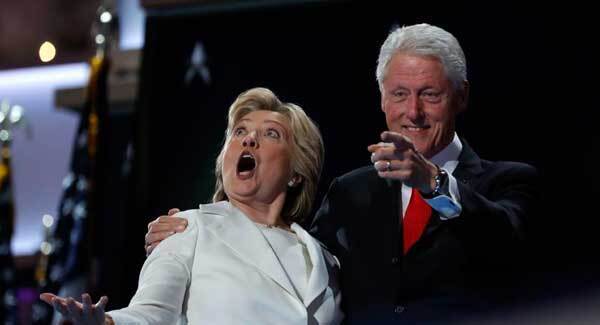
HILLARY Clinton came closer than any other woman to winning the White House but fell short for a second time, a bitter disappointment for a pioneering but polarising American political figure.
Seeking to win election to the office her husband Bill Clinton held from 1993 to 2001, Clinton, 69, lost her battle for the Democratic presidential nomination to Barack Obama in 2008 and lost on Tuesday to Republican Donald Trump, 70.
In 2000, Clinton became the only first lady to win elected office, as a senator from New York. In 2009, she became the third female secretary of state. In July, she became the first woman to claim a major US party’s presidential nomination.
The presidency turned out to be a bridge too far.
Accepting her party’s nomination in July, she embraced the historic nature of her candidacy, saying that “when any barrier falls in America it clears the way for everyone”.
“After all, when there are no ceilings, the sky’s the limit. So let’s keep going. Let’s keep going until every one of the 161m women and girls across America has the opportunity she deserves to have.”
During four decades in public life, Clinton withstood such controversies as an FBI investigation of her use of a private email server as secretary of state, probes into past business dealings, her husband’s infidelity, and an unsuccessful Republican effort to remove him from office.
Two American women, Geraldine Ferraro in 1984 and Sarah Palin in 2008, were nominated by major parties as vice-presidential nominees, but fell short in the general election.
After losing to Obama in the 2008 race, Clinton deferred her White House ambitions, and served as his secretary of state from 2009 to 2013.
Clinton’s admirers consider her a tough, capable, and sometimes inspirational leader who endured unrelenting efforts by political enemies to chop her down.
Her detractors consider her an unscrupulous and power-hungry opportunist. She was detested by many Republicans and conservatives, and in 1998, during her husband’s presidency, bemoaned a “vast right-wing conspiracy”.
Against Trump, she portrayed herself as guarding the country from the threat she said he posed to American democracy.
Last year, when she entered the race for the Democratic presidential nomination, she was considered such a prohibitive favourite that others in her party shied away from challenging her. But she was an establishment figure and a Washington insider at a time when voters were smitten with outsiders.
She secured the Democratic nomination in July only after beating back a surprisingly stout challenge from senator Bernie Sanders, who appealed to young voters and mustered the kind of excitement that Clinton sometimes failed to generate.
Congressional Republicans spent years investigating allegations of state department security lapses related to a 2012 attack by militants in the Libyan city of Benghazi that killed the US ambassador.
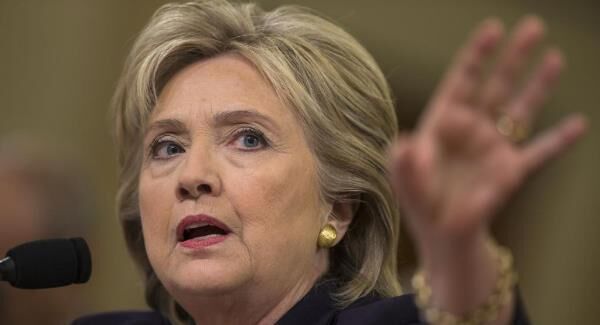
She testified during marathon congressional hearings in January 2013, at the end of her tenure at the department, and in October 2015, while already a candidate for president, facing Republican criticism of her handling of the incident.
Another politically damaging issue came to light during the lengthy congressional investigation into the Benghazi attack: Accusations that she broke the law in her handling of classified information while corresponding through the private email server for her government work as secretary of state.
Trump called her “Crooked Hillary”, said he would seek to put her behind bars if elected, and encouraged his supporters to chant “lock her up”.
Clinton called Trump a racist hate-monger, a sexist, and a tax-dodger enamoured with Russian President Vladimir Putin. She defended her lengthy service in government, dismissing Trump’s contention that she had produced no real accomplishments.
Most Americans were introduced to her during her husband’s bid for the 1992 Democratic presidential nomination. Bill Clinton said voters would get “two for the price of one” if they elected him. She unapologetically said she was not a woman who “stayed home and baked cookies”.
After a woman named Gennifer Flowers accused Bill Clinton during the campaign of a sexual affair, Hillary Clinton appeared on TV with her husband and referred to singer Tammy Wynette’s song, ‘Stand by Your Man’.
“You know, I’m not sitting here, some little woman standing by my man like Tammy Wynette,” she said, adding that she loved and respected her husband.
“And you know, if that’s not enough for people, then heck, don’t vote for him.”
CONSERVATIVE critics painted her as a radical feminist and a threat to traditional family values.
Bill Clinton defeated incumbent Republican president George HW Bush in November 1992. As first lady from 1993 to 2001, unlike many of her predecessors, Hillary Clinton was an active part of policymaking.
Critics assailed her unsuccessful effort to win congressional passage of healthcare reform, deriding it as “Hillarycare”.
She and her husband faced a long investigation into past business dealings but ultimately no criminal charges were brought. A property venture known as Whitewater faced scrutiny, spawning an independent counsel investigation that later encompassed Bill Clinton’s sexual relationship with a White House intern named Monica Lewinsky.
Deputy White House counsel Vince Foster, a figure in the Whitewater controversy and a close friend of the Clintons from Arkansas, was found dead of a gunshot in 1993. His death was ruled a suicide. In a 2003 memoir, Hillary Clinton blasted “conspiracy theorists and investigators trying to prove that Vince was murdered to cover up what he ‘knew about Whitewater’”.
In 2000, the independent counsel investigation concluded there was insufficient evidence to show the Clintons had been involved in any criminal behaviour related to Whitewater.
In December 1998, the Republican-led House of Representatives voted to impeach a president for only the second time in US history, charging Bill Clinton with “high crimes and misdemeanors” for allegedly lying under oath and obstructing justice to cover up his relationship with Lewinsky.
The Republican-led senate acquitted Clinton in February 1999.
Hillary Clinton launched her own bid for elected office and won election in 2000 as a senator.
The 2008 race for the Democratic presidential nomination pitted America’s foremost woman politician against the son of a black Kenyan father and a white Kansan mother. After vanquishing Clinton, Obama made history when he defeated Republican John McCain to become the first black US president.

CONNECT WITH US TODAY



Be the first to know the latest news and updates