Nigerian tragedy must not be ignored
THE hashtag #jesuischarlie trended all over social media in the aftermath of the Paris shootings, in which 17 innocent people tragically lost their lives.
Incredible photo showing use of #JeSuisCharlie - Now most popular hashtag in Twitter's history.
— Richard Morgan (@BBCRichardM) January 9, 2015
Pic: @Telegraph pic.twitter.com/64WmxIMYr0
Reluctantly appendixed to that story was the news that hundreds, if not thousands, of innocents were massacred in northern Nigeria over the course of the last few weeks.
Some sources estimate that killings in the region last year ran as high as 17,000. In yet another example of the hierarchies of lives that are valued and those that aren’t, it is clear that the gravity of what has been happening in Nigeria is only now very slowly being absorbed.
It begs the question, where is the globally trending hashtag for the victims of Nigeria’s deadliest massacre? Why such miserly column inches, and why the slow, undramatic response to this most abominable of events?
It’s important to address the myth that Africa is the centrepoint of all the world’s suffering, making it possible to begin to interrogate the true roots of this crisis, which lie more with an impoverished, disaffected youth than with fundamentalist Imams.
Partly responsible for the glaring lack of outrage is the repetition of one-dimensional, intellectually undemanding images which portray Africa (and Africans) as being in a state of perpetual crisis, put forward by poverty-alleviation agencies.
For decades now we have been exposed to an exaggerated version of what life in Africa looks and feels like. The repetition of images of a heaving, fly-ridden, dystopia portrays life not only as valueless, but unrecognisable; an unrelenting stream of death, despair, and disease, where distressed mothers detach from their own starving infants.
In this world, disasters are not all that surprising; violence and social breakdown are part of the daily routine and Africa appears to be in a permanent state of crisis. As a result of being constantly exposed to these images of helplessness and despair, we are less able to recognise a crisis when one truly occurs, and when it does, less inclined to interrogate the political context.
While there are certainly pockets of conflict and instability, Africa is not actually in a state of perpetual war. In the main, it is vibrant, entrepreneurial, and on the march. Young people know the value of education and there is a sense of democratic zeal, particularly at election time, when people can be seen queuing, sometimes for hours, to cast their vote.
The swampy south, home to the Igbos and referred to as Igboland, is at the epicentre of Nigeria’s booming oil and gas trade, and has itself experienced recent periods of violent unrest.
The central region, a network of large towns and cities, is largely peaceful and includes the heaving metropolises of Lagos and Abuja. Home to the Yoruba people, once favoured by the British colonisers, Yorubaland is now the modern seat of political power in Nigeria.
Up north, the plush tropical savannah fades into the semi-arid Sahel. This is a much less accessible, more traditional place, and home to the Hausa-Fulani. Most of Nigeria’s mainly Sunni Muslim population are concentrated in the north.
The fourth largest exporter of liquefied natural gas in the world, Nigeria is awash with oil dollars that scarcely trickle down to the 70% of people living on less than a dollar a day, nor the 90% living on less than $2.
The north is particularly isolated as the proceeds of the oil business are dispersed mainly among elites living in the central and southern regions, with enormous profits repatriated out of the country via multinationals like Royal Dutch Shell. Rather than being at war with everything, it considers un-Islamic, Boko Haram’s true enemy is the ineffective Nigerian state.
Decades of neglect have led to the north being perceived as a particularly impoverished place. Twelve northern states currently operate under full or partial Sharia law, and three of them — Borno, Adamawa, and Yobe — have been in an official state of emergency since May 2013.
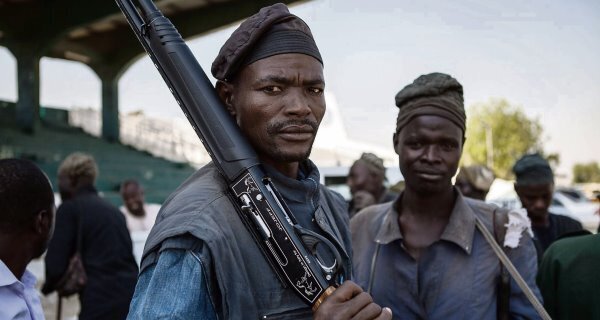
Communications networks have been destroyed by insurgents and journalists tend not to go there. Known as the Nigerian Taliban, Boko Haram are said to be well trained and have links with al-Shabaab and al-Qaeda. Their stated aim is to institute Sharia law in all 37 of Nigeria’s federal regions, effectively making Nigeria an Islamic state.
They recruit unemployed men already vulnerable to radicalisation; often starkly illiterate youths with weak family structures, and refugees from neighbouring war-torn nations. Barely one in five Muslims in the north are literate, compared to 80% in the southern, mostly Christian region. Young men with post-secondary school qualifications struggle to find work to complement their hard-won education, often displacing the less educated by taking on unskilled, informal work as hawkers or load carriers.
According to Kate Meagher, writing for NOREF, the Norwegian Peacebuilding Resource Centre, “this has unleashed significant resentment against the failure of Western education to deliver on the promise of dignified work as well as anger over the incursion of Western graduates into the little informal work available for the poor”.
Thus the meaning of Boko Haram’s name, Western education is a sin, is less a declaration of war against Western values than a statement of defiance against the political, infrastructural, and economic isolation of the northern region. There is little trust in either the military or the police force, who are notorious for extra-judicial killings and ongoing abuses, such as arresting family members of Boko Haram, and destroying their homes.
Interestingly, Boko Haram did not start out with violent insurgency in mind, and the sect’s founder, Mohammed Yusuf, initially espoused much more admirable principles. Meagher says “Boko Haram offered one meal a day, arranged low-cost marriages, and provided loans for petty commercial activities, thus offering basic social dignity to the poor”.
According to Mohammed Aly Sergie and Toni Johnson of the Council on Foreign Relations, unrest broke out in 2009 when heavy-handed police tactics were used against Boko Haram members who refused to adhere to motorbike helmet laws, setting off a spate of armed uprisings in the north. They were suppressed by the army, leaving more than 800 dead.
The extra-judicial executions of Yusuf, his father in law, and other members of the sect were rather cruelly televised, and, under a splintered leadership, Boko Haram began carrying out bombings and assassinations under the greater influence by al Qaeda in the Islamic Maghreb.
It is important to separate Boko Haram from the broader Islamic State phenomenon because its roots lie not with religious fundamentalism, but with entrenched poverty, violence, and inequality, to which the Nigerian state has not only turned a blind eye for decades, but has arguably fuelled.
The images of war, crisis, and despair have dulled the brain so that analysis of the conflict is often insufficient, decontextualised, and easily misunderstood, images that do more damage to the reputation of Africa than the news of any war can.
This is not a clash of civilisations, but a violent uprising against the ineffective Nigerian state. Misunderstanding this conflict as simply copycatting Islamic fundamentalism elsewhere means the response of the international community will ultimately be inadequate.
CONNECT WITH US TODAY



Be the first to know the latest news and updates