Warning over dangers of linking Muslims with terrorists
Firebombs and pig heads thrown into mosques. Veiled women subjected to crude insults in the street. The internet awash with threats against Muslims, who are feeling the heat of a fierce backlash following the terror attack on French satirical magazine Charlie Hebdo.
A climate of fear is taking hold in Europe, as ordinary people increasingly heed rightist rhetoric equating the millions of peaceful Muslims with the few plotting murder and mayhem.
Abdallah Zekri, head of the National Observatory Against Islamophobia, said in a 48-hour period after the massacre at Charlie Hebdo, 16 places of worship around France were attacked by firebombs, gunshots or pig heads — a major insult to Muslims who don’t eat pork.
The three-day terror spree in Paris claimed the lives of 17 victims, and traumatised a continent already brimming with anti-immigrant sentiment.
Brothers Cherif and Said Kouachi — the al-Qaida-linked suspects in the magazine attack — were killed in a shootout at a printing plant north of Paris; their apparent accomplice Amedy Coulibaly was shot dead in a raid at a Jewish market, where he had holed up with hostages, killing four.
French authorities are warning the nation against linking French Muslims with terrorists.
“The terrorists’ religion is not Islam, which they are betraying,” Foreign Minister Laurent Fabius said last week. “It’s barbarity.”
Concerns about a backlash against Muslims were discussed on Monday during a counter-terrorism meeting at the interior ministry.
“We said above all, pretty unanimously, that in France there are 5 or 6 million Muslims. These (terrorist) issues concern 1,000 individuals,” said Socialist lawmaker Patrick Mennucci. “We should be careful not to stigmatise anyone.”
Coulibaly’s mother and daughters, presenting condolences to the victims, issued a plea in a statement delivered to the French press “that there will be no amalgam between these odious acts and the Muslim religion”.
Yet Muslims and some experts said it was inevitable Muslims would fall under suspicion after the attacks, despite a unity march on Sunday — described as the largest in French history — in which throngs of Muslims participated.
The rising far-right in France and other European countries has been driven by an anti-immigration, anti-Islam message.
National Front leader Marine Le Pen seized upon the Charlie Hebdo attack just hours after it happened, suggesting it was a vindication of her party’s xenophobic stance.
Extreme-right groups across Europe have increasingly been striking a chord with ordinary citizens voicing fears their culture is being uprooted by an alien civilisation.
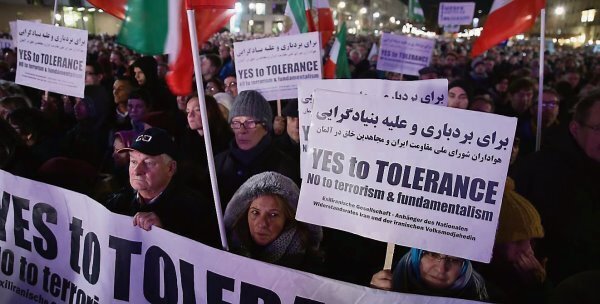
The fledgling German group that calls itself Patriotic Europeans Against the Islamisation of the West, or PEGIDA, drew its largest crowd ever on Monday night — a reported 40,000 — at its weekly rally in Dresden, after organisers declared it a tribute to the victims of the French attacks. No anti- Islamic acts have been reported in Germany since the terror.
French Muslims were already facing a backlash triggered by terror acts by French radicals twisting their religion — particularly since the rampage in southern France in 2012 in which Mohamed Merah killed three children at a Jewish school, a rabbi and three paratroopers. Anti-Islam sentiment spread further after the killing of four people by a French Muslim at the Brussels Jewish Museum in May.
Anti-Muslim and anti-Jewish incidents rose throughout 2014 in France, which has Europe’s largest communities of both religions.
“For Muslims, the shock is grave in this climate of Islamophobia, of aggressions against places of worship,” read a statement by Dalil Boubakeur, of the French Council for the Muslim Faith.
France’s state of high alert after the Charlie Hebdo rampage — with 10,000 soldiers deployed in the streets — may deepen a sense of siege within the Muslim population.
French authorities have long warned France is a preferred target of Islamic extremists. France routed al-Qaida from northern Mali — two years ago to the day before Coulibaly attacked the Jewish market — and is now carrying out airstrikes in Iraq against the Islamic State group. Both al-Qaida and IS have threatened France.
But the attacks have had an effect outside France, too. In the Netherlands, Muslim groups and the government met and said they plan to register anti-Muslim incidents. A burning object was thrown at a mosque in Vlaardingen, on the outskirts of Rotterdam.
“Everyone has this uncomfortable feeling, a sense of being threatened — Muslims because they are afraid to be stigmatised and that they will be attacked too,” said Imade Annouri, a Green parliamentarian of Belgium’s regional legislature of Flanders and an expert on integration issues.
TellMAMA, a British group that tracks anti-Muslim attacks, reported 50-60 cases of specific online threats to individuals over the weekend.
“The sheer volume is unbelievable,” said the organisation’s director, Fiyaz Mughal, who fears virtual assaults could spur real ones in the street. Mughal said after the slaying of British soldier Lee Rigby in London, the group was able to gauge how on Twitter and Facebook translated directly into attacks on individuals or mosques.
Mohamed Ali Adraoui, of the European University Institute, suggested hatred of Islam could morph into an assault on a mosque, in France or elsewhere. “If you can do that in Charlie Hebdo offices, you can do it in a mosque,” he said.
CONNECT WITH US TODAY



Be the first to know the latest news and updates