Theresa Reidy: By-election results will be troubling for Fianna Fáil and Sinn Féin
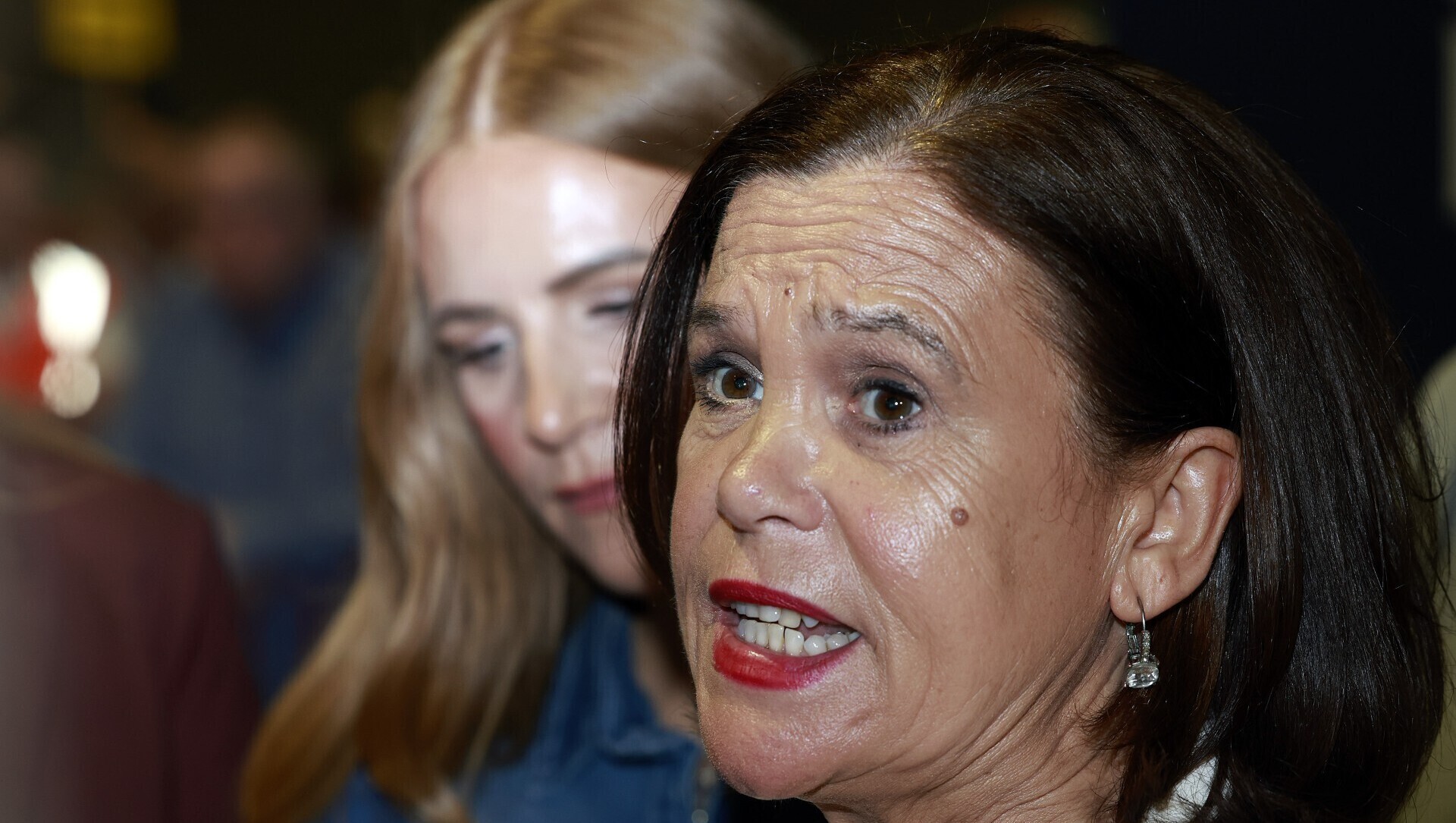
Sinn Féin has been positioning itself to lead a left government after the next general election. On these results, the party will be some way off the running. Pictured: Sinn Féin leader Mary Lou McDonald speaking to the media during the count for the Dublin Central by-election at the RDS. Picture: Conor Ó Mearain/PA
The Social Democrats celebrated a resounding victory in Dublin Central late on Saturday night. Daniel Ennis topped the poll and developed a commanding lead over the day of counting. The party’s candidate in Galway, although off the running for a seat, got a good vote, and overall the party is riding a wave of national popularity.
More generally, parties from the soft left will be able to highlight good candidate performances and solid positioning for the next general election.
Janet Horner from the Greens is a long-standing councillor and got a strong first-preference vote, finishing third and well situated to be a future contender.
In Galway West, Helen Ogbu can lay claim to an even stronger situation, having placed third on the first count; outside the main contest, but very well placed to take a seat next time out, and reclaim the Labour Party seat held by Michael D Higgins for decades.
The soft-left parties also grew their overall vote shares but the importance of candidate choice is starkly evident in their results.
First time candidates face huge challenges in general elections. Building a political team, managing a campaign, and meeting as many voters as possible across a large Dáil constituency, all at the same time, is a political Everest. The serious contender candidates from the soft-left parties at the by-elections were all sitting councillors, with political records that they could point to and political organisations already in place.
Read More
The larger parties also had their candidate challenges.
The Sinn Féin result in both constituencies is troubling for the party and especially for the leadership of Mary Lou McDonald. It was widely known that Janice Boylan wasn’t the preferred candidate of the party leader. Nevertheless, Sinn Féin put in a huge effort, there were TDs out canvassing with Ms Boylan every day, and significant resources were invested in her campaign.
Boylan got a good first-preference vote but the party has long struggled with transfers as counts progress. Sinn Féin is polarising; it has deep pockets of support but there are sections of the electorate that will not vote for it or give it a lower preference.
In Galway-West, Mark Lohan, a former Sinn Féin councillor, never seemed to get his candidacy off the ground. A minor controversy about his fluency in Irish followed him through the campaign and he got just 7% of the first-preference vote.
Sinn Féin has been positioning itself to lead a left government after the next general election. Any party leader seeking to become taoiseach would be expected to bring in a running mate and the party would need to be taking two seats in constituencies across the country. On these results, the party will be some way off the running.
But a cautionary note, the results also confirm another feature of Sinn Féin’s electoral record: Its variability.
Sinn Féin can be effective at reading the public mood. It realised the depths of the housing crisis before the other main parties, it detected the stresses of the cost-of-living crisis early, and it often surges in opinion polls and performs well in elections, such as the 2019 Dublin by-election and general election in 2020.
But the party doesn’t hold these voters consistently. The connections that it forms are temporary. This is its major challenge. It can connect with voters but it struggles to keep them. And it is an open question now whether McDonald is the leader to address this vexing dilemma for the party.
The only consolation for Sinn Féin was that it could point out that Fianna Fáil had an even worse day, securing some of its worst electoral results ever.
Neither of the Fianna Fáil candidates in the two electoral areas reached double-digit support on the first count, and throughout the campaign were never seen as serious challengers.
For the largest party of Government, it is a damning position. The terrible outcome has different implications within Fianna Fáil though. The bad result is baked into expectations about the party leadership.
Micheál Martin’s time at the top is coming to a close. He will take up the presidency of the EU Council in a month. It will be the zenith of his career but it will also be the beginning of the end. Leadership change is expected in the first half of 2027.
In a contrast with Sinn Féin, Fianna Fáil voters are quite loyal but they are ageing and the party is not connecting well with new generations of voters. Further decline is inevitable if that party cannot reverse its demographic malaise.
Candidate choice matters here too. In tough by-elections, the party had inexperienced, low-key candidates that struggled to make an impact. In some ways, it was the inverse of what happened at the 2024 general election where good, experienced candidates meant Fianna Fáil picked up many more seats than its Fine Gael rival with only a small difference in vote share.
Fine Gael had the candidate advantage in the by-elections. Ray McAdam put in a good run in Dublin Central. He was never expected to retain the seat vacated by Paschal Donohoe but he got a respectable vote, raised his profile, and will surely be the party candidate at the next election when he will be in with a reasonable chance of taking a seat.
The outcome is Galway West will delight Fine Gael. The party has defied the by-election hex that government candidates can’t win by-elections. Kyne was a good candidate, a former TD, well known, used to the organisation, and pressure of elections. He was transfer friendly and that was the key to his success.
The big questions about how Fine Gael will position itself on the ideological spectrum in future, how it will manage renewal after close to two decades in government, won’t go away but victory in a by-election will push them into the weeds for a while longer.
Prof Theresa Reidy is a political scientist at University College Cork
CONNECT WITH US TODAY



Be the first to know the latest news and updates