Are GAA players the Dallas Cowboys Cheerleaders of Ireland?
Although they are dedicated, committed, and  train as hard as many professional athletes, cheerleaders and GAA players are both staggeringly underpaid
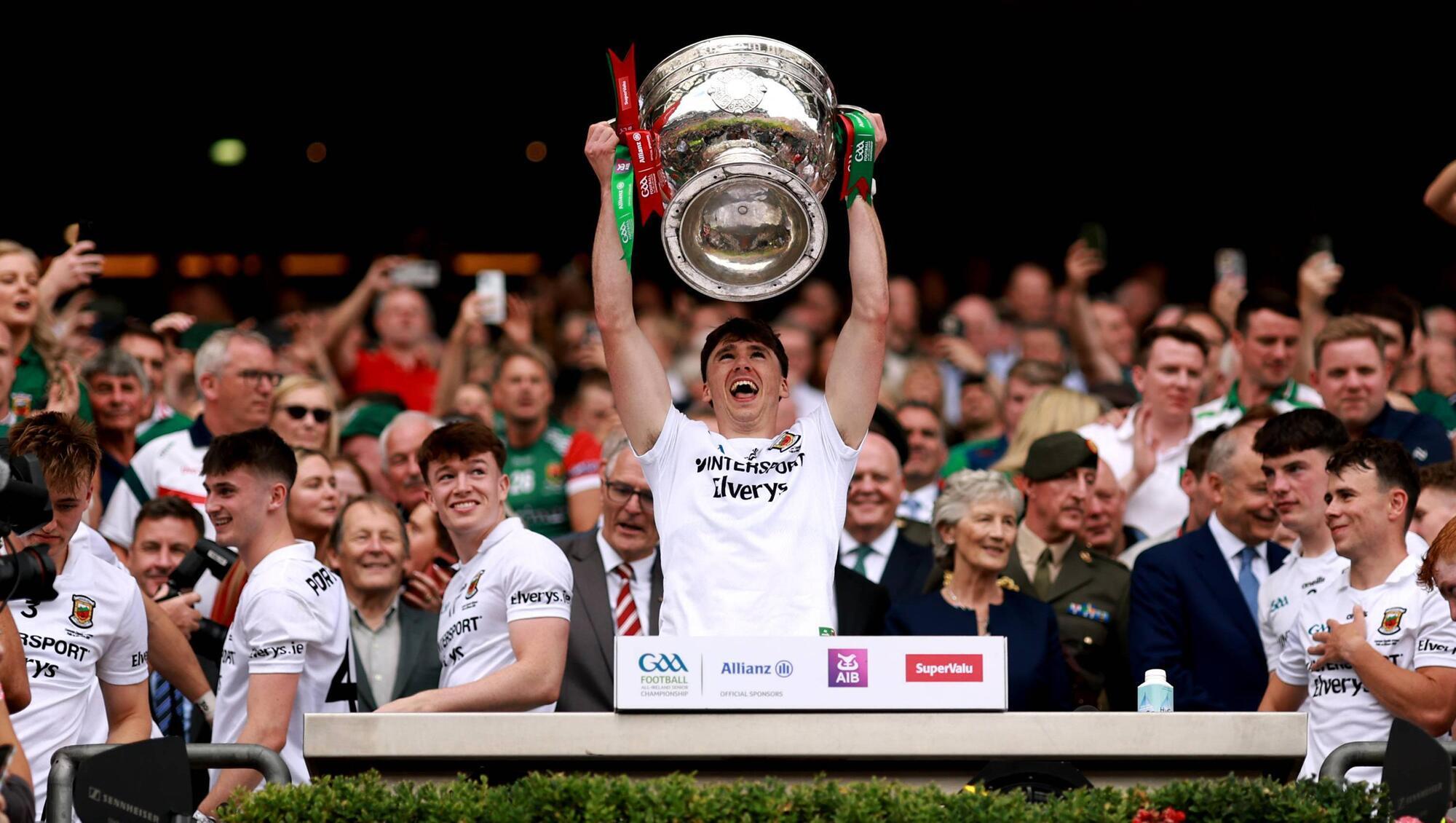
Mayo’s Sam Callinan lifts the Sam Maguire after his team’s victory in the All-Ireland SFC final in Croke Park on Sunday. Picture: James Crombie/Inpho

Mayo’s Sam Callinan lifts the Sam Maguire after his team’s victory in the All-Ireland SFC final in Croke Park on Sunday. Picture: James Crombie/Inpho

We have witnessed history. Mayo strode out onto Croke Park’s luscious (despite the heatwave) green and defeated the curse that followed them since 1951

While I watched the lads celebrate their historic victory I was struck with a queer realisation. A thought really. A, dare I say it, notion.

Are our inter-county GAA players the Dallas Cowboys Cheerleaders of Ireland?

The Dallas Cowboys Cheerleaders (DCC) are an American institution. The Dallas Cowboys are one of the biggest, and richest, American football franchises in the world. 

The DCC is their official elite cheer squad. Much of Ireland fell in love with the DCC stars through their smash hit Netflix docu-series America’s Sweethearts, whose third season went straight to the top 10 most watched TV shows in Ireland earlier this summer.

At first glance, a globally recognised American football cheerleading squad synonymous with Texas opulence and an indigenous Irish sporting organisation rooted in parish identity appear to share little common ground. 

But when you dig in a little, they are practically mirror images.

Both cohorts operate at the pinnacle of human physical achievement.

Both generate eye-watering sums of money for their respective overlords.

Both put up with a lot because they are doing it for ‘the love of the game’ or the social clout that comes with the gig.

People often sideline both the GAA and DCC because of their amateur status. 

These critics dismiss the elite cardiovascular endurance, muscular strength, and high injury rates that match traditional athletics.

It is a job of work to get a slot as either a DCC or to ‘make county’. 

Always with an eye on the proverbial prize

On either side of the Atlantic these burgeoning athletes train from childhood through early adulthood with devotion, always one eye on the proverbial prize.

While there is no fixed number of years a GAA player trains before getting picked for county, it takes many years of sacrifice. 

Most if not all start some sort of training around age four and don’t get to don the county colours until their early- to mid-20s.

Similarly, the average Dallas Cowboys Cheerleader has to put in years of unrelenting grind, training in dance and cheerleading; competing at every stage from primary school age and through to their adulthood.

Selection for GAA players and DCC stars depends entirely on individual performance. 

Both county and DCC cycle annually. They have to try out for their spot every year to see if they make the cut, whether they were the star of the squad the year before or not.

Both need to treat their training as a job. They can’t choose to not go if they’re not feeling it on the day. They have to commit fully or risk being unceremoniously cut from the team.

Like all athletes, both their careers peak early.

You could, of course, make these arguments about any sport and dance really. So what makes these two more aligned than say ballet and swimming?

Well they are, crucially, both staggeringly underpaid.

The Dallas Cowboys Cheerleaders in a scene from the Netflix docu-series, ‘America’s Sweethearts’. Picture: Netflix

Senior inter-county players spend about 31 hours a week on their sporting commitments. 

They dedicate hours to sports conditioning, tactical analysis, recovery, and drinking whole crates of Avonmore protein milk in various hues to maintain their elite form all while holding down full-time jobs.

Meanwhile, the Dallas Cowboys Cheerleaders practice upwards of 40 hours a week to perfect the jump-split, burning 3,700 calories during their half time performances while trying to juggle up to as many as four part-time jobs.

GAA players and DCC stars both generate massive, quantifiable economic value for their respective organisations. 

Yet, because of the veil of amateurism in Ireland and the part-time independent contractor status in America, these supreme athletes are treated like hobbyists.

As former cheerleader Kat Puryear pointed out, it was a full-time commitment for part-time, substitute-teacher pay.

The GAA is a commercial juggernaut, a €591m industry. The Dallas Cowboys are a franchise worth around $13bn. I am far from the first person to point this out.

Cheerleaders are paid $8 an hour

In Dallas, it took a lawsuit from Erica Wilkins to expose the scarlet-inducing fact that Rowdy, the oversized Dallas Cowboy mascot, was making $65,000 a year while the cheerleaders were on $8 an hour. The absolute neck of it.

But at least they were getting an hourly wage, not an €1,800 grant they must apply for through the GPA like the lads whose All-Ireland victory launched a thousand TikToks. 

And that is before we dig into the realities of playing county as a woman, which would make you weep into your pint.

If NFL cheerleading is structurally diminished by male-dominated front offices, the Ladies Gaelic Football Association and Camogie players are treated like second-class citizens. 

The GPA showed in their 2023 State of Play report that nearly half of female inter-county players were paying hundreds of euro out of pocket just to see a physio. 

The system has the audacity to demand professional standards and returns nothing but unlined pitches and out-of-pocket travel expenses.

From Texas to Dublin, boardrooms have used the exact same psychological weapon to keep wages at zero: Prestige.

Monetising emotional prestige

This model brilliantly monetises emotional prestige to offset missing financial capital. 

But you cannot pay your sky-high, housing-crisis-induced rent with the local parish’s grá, nor fund an eventual hip replacement with meas. 

So why do people keep signing up? Unpaid athletic labour remains baffling to punters like me, until you consider the complex social realities.

Ostensibly both the DCCs and the GAA heads are in it for ‘the love’ of it, but in reality, it is heavily tied to social clout. 

Some say, being able to say ‘I play county’ in Coppers yields its own rewards. Or, that being able to perform Thunderstruck in your finery is what the gig is about. 

The opportunity to wear the sacred county colours, or DCCs star spangled uniform, is framed as the honour of a lifetime. 

It is basic human psychology, that desire for status. The perk that comes from playing county and making squad in DCC is getting to say that you play county and are a DCC. 

It’s the impressed look you get from whoever you’re chatting to. That is how they are informally paid.

Passion does not pay the bills

As the commercial value of these games continues to skyrocket, the shiny veneer of prestige, however, is starting to look increasingly thin. 

Whether you are fielding a ball in Croke Park or nailing a jump-split in Arlington, passion does not pay the bills. Nor does the nodding admiration of strangers in the pub.

Many an Irish player has up and moved to Australia simply because they can make a legitimate career there out of their athleticism. 

In fact, Kobe McDonald, who on Sunday helped break a curse that has been haunting Mayo since 1951, is now reportedly packing his bags for Melbourne having been offered a Category B Rookie deal with St Kilda.

Aussie clubs swooping in to poach our elite homegrown talent is nothing new. Mayo lost Oisín Mullin to AFL not too long ago. 

Players’ willingness to uproot their lives and move to the other side of the world highlights that playing GAA is a legitimate, full-time professional career, even if not in this country.

It is high time the boards and billionaires stop cashing in on the devotion of the very athletes who built their empires and start paying them exactly what they are worth, before they lose them to the diaspora.

Maybe if the intercounty lads teamed up with the DCC stars they could make a wave of change worth riding? Now that Mayo has brought home Sam, truly anything is possible.

  • Shamim de Brún is a digital journalist at the Irish Examiner

x

More in this section

Revoiced

Newsletter

Had a busy week? Sign up for some of the best reads from the week gone by. Selected just for you.

Cookie Policy Privacy Policy Brand Safety FAQ Help Contact Us Terms and Conditions

© Examiner Echo Group Limited