Michael Moynihan: We must congratulate ourselves on our non-defecating pets
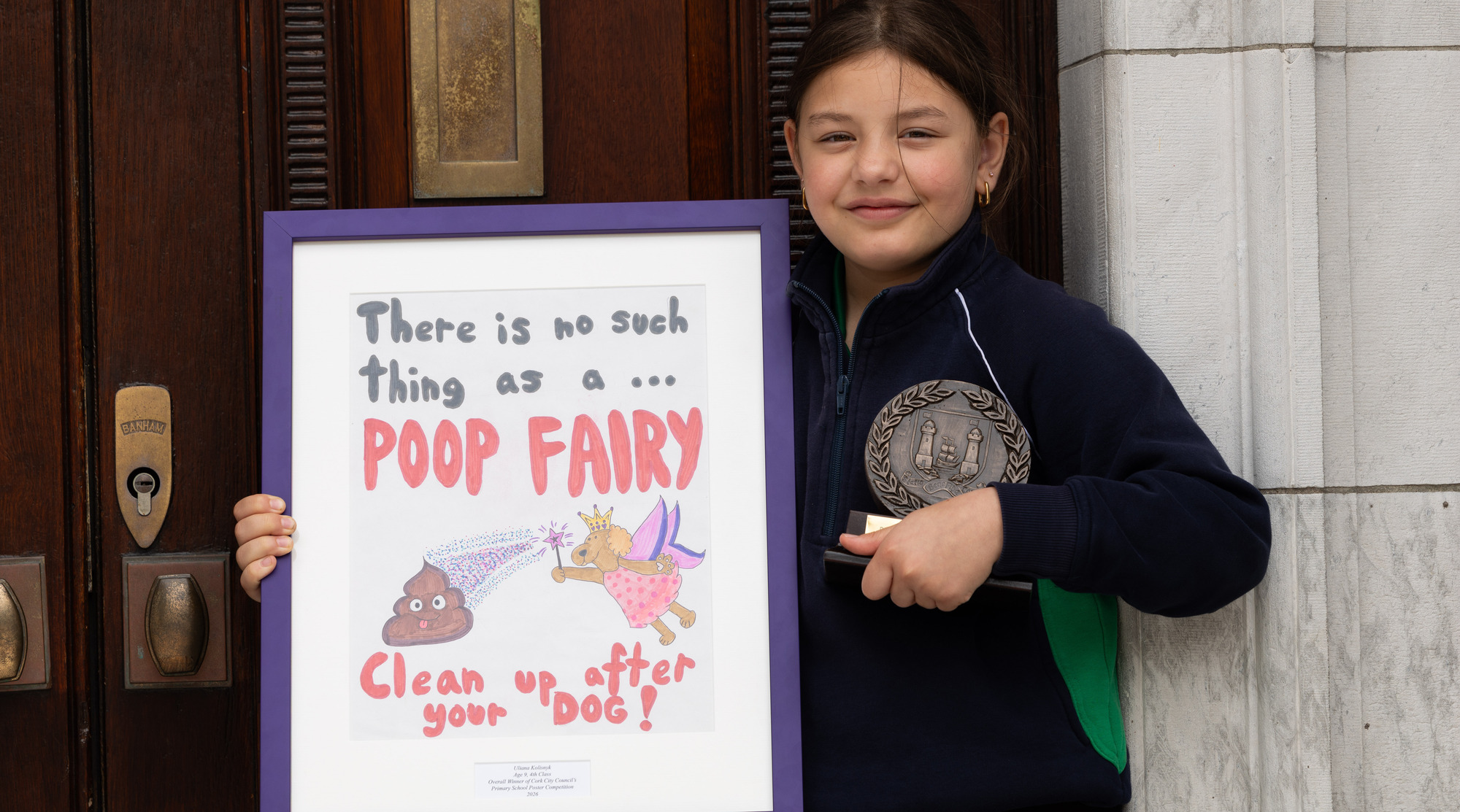
Overall winner of the anti-dog fouling schools poster competition Uliana Kolisnyk, age 9, from 4th class in Bunscoil Chrìost Rì. Photo: Darragh Kane

A few weeks ago I wrote about a proposal from the National Transport Authority (NTA), one which would allow pets to accompany their owners on public transport.
I tried to be helpful, teasing out its implications, and along the way I noted that pets are animals, in fact, and not passengers.
Suffice to say the response was immediate. A couple of pals helpfully pointed out that the reaction online from some people was . . . charged, with observers not shy about pointing out my faults.
On the one hand, I can only say that when it comes to criticism, well take a number. I’ll get to you in due course.
On the other, I remain undaunted in my pursuit of the obvious. That public transport is not a place for dogs, turtles, horses, miniature pigs, full-sized pigs, budgies, cats, and every other inhabitant of Noah’s Ark.
Undaunted, I say!
Part of my argument was based on common sense. Namely, that pets, lovable rogues that they are, can be unpredictable. No matter how sweet-tempered, no matter how well trained, your pet remains an animal. Not human.
And the possibility remains, therefore, that even your little fur (or feathered, or scaled) darling can have an accident.
By which I mean urine, faeces, or both. Sorry for introducing bodily functions so early in the day, but here we are.
My argument leaned into this aspect of the new dispensation, envisaging a nightmare scenario where you might step in cat waste on the Luas, for instance. And yes, I am aware that cat waste may not even be in the top three objectionable materials to be found underfoot on the Luas, to judge by a quick visit to the capital last weekend.
The counter-argument was that this was nonsense, how dare you, my pet would never etc., etc., so the discussion could never really be resolved because apparently millennia of first-hand experience of animals in every culture imaginable is not proof against the legendary restraint and personal charm of Spot, Tyson, Rex et al.
Now, however, I must admit the error of my ways. I am writing while wearing sackcloth and crowned with ashes. Wrong, wrong, wrong.
I refer you to a report by Amy Campbell in the this week.
“Cork City Council has not issued a single dog fouling fine in three years, despite continued complaints — including from visually-impaired pedestrians — about the dangers posed by dog waste,” wrote Amy.
“Figures released by Vision Ireland show the city council issued no fines in 2025, while Cork County Council issued just one, down from 11 the previous year.” (Side note: how does the one person in all of Cork to receive a dog fouling fine last year feel? This is the person who should really get a platform here.)
Anyway, my point is that the complaints mentioned in my recent piece are clearly ill-founded, because the argument made by people about their pets’ incredible self-control is borne out by the evidence.
If the second largest city in the country, home to 300,000 people in the greater metropolitan area, has not had to issue a dog fouling fine in three years, then surely our footpaths are fit to eat from.
I acknowledge, therefore, the error of my ways, and throw my arms open to welcome an actual menagerie onto the buses and trains of the country.
If the evidence of the streets of Cork is anything to go by, we have nothing to fear. And certainly nothing to step in.
Right?
Untrue, of course.
The absence of fines for dog fouling is not, of course, evidence of an absence of dog fouling. If anything...
The Vision Ireland research cited above by Amy gives an idea of the extent of the problem, and illustrates precisely how it can affect people.
“ . . . a survey of 220 people who were blind or vision-impaired explored the issue of footpath obstacles.
"Not only does dog fouling present a slipping hazard, but it can also be a major problem for long cane users whose canes are dirtied by faeces. When folded up, this poses a hygiene and health risk.”
This is not an abstract notion. Amy Campbell spoke to Aisling Kane for her piece. Aisling, who lives in Cork and is visually impaired, said that dog fouling is a constant issue for her.
“I walk down Blarney St more or less every day, and it’s very bad for dog fouling," she said. “When I come home, I take my shoes off outside the front door because I don’t know if I’ve stood in it or not.
"There was one very bad situation two years ago; I slipped on dog poo on Castle Street and went down completely onto the footpath. My hip and back would still be at me every now and then because of it.”
This is the reality. Despite the lack of dog fouling fines, you could say we are fine for dog fouling.
There’s no shortage of the stuff on our streets, a clear example of the belief prevalent among the self-important that their needs are more important than anyone else’s.
Letting your dog void its bowels on the street and turning your back on the resulting mess is a decent test of citizenship, or maybe failing that test, to be more precise. It reveals to others the extent of your commitment to playing your part in society: it’s non-existent.
If you’re happy to let others clean up after you then it illustrates your character. If the discomfort or threat of infection facing others as a result of your selfishness doesn’t cost you a moment’s thought, then many thanks for revealing yourself.
In my own part of Cork I often see a person strolling the streets with animals now referred to by my research assistants as the Incredible Sitting Dogs, though the spelling of one of those words may not be 100% accurate.
The dogs leave their calling cards all over the area, if by calling cards you mean heaping lumps of (mental image well established, thank you — ed.), the accompanying human blithely walking on with nary a backward glance.

Two things can be true here, of course. The Council should be issuing more fouling fines (God knows it could not issue fewer, literally) for the sake of everyone’s health, and the health of those who are visually impaired in particular.
It’s hardly a hidden offence, after all. To detect the evidence you need only a nose, and possibly strong soles on your shoes.
But the real culprits here are of course the owners. The people who are in charge of the pets in question. They’re the ones who should be taking responsibility.
Quite obviously the blame can’t fall on the animals involved because —see above, at length — they’re animals.
But are they the real animals here?


CONNECT WITH US TODAY



Be the first to know the latest news and updates