Colin Sheridan: Why America’s politics keeps forcing us to confront power and accountability

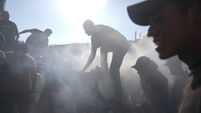
Rescue workers and residents search through the rubble in the aftermath of an Israeli-US strike on a girls' elementary school in Minab, Iran, in February. Among the children killed was six-year-old Fatemeh Yazdanpanah whose father, a poet, had chosen the school because she memorised his poems and he wanted an education worthy of her gifts. File photo: Abbas Zakeri/Mehr News Agency via AP

I'm trying. I promise I'm trying.
I'm trying not to write every second column about America being the Great Satan, capitalism being a cancer, or the suspicion that our grotesque inequalities have something to do with the avarice of people who already own everything.
I'm trying to believe that people enter politics to serve, and that power doesn't invariably attract self-interest like a porch light attracts moths.
Perhaps next week I'll write about the last cut of grass in October. That brief, glorious window before the lawn becomes a wetland. Or sea swimming. Or the innocent beauty of a child's Halloween.
But Jesus, they don't make it easy.
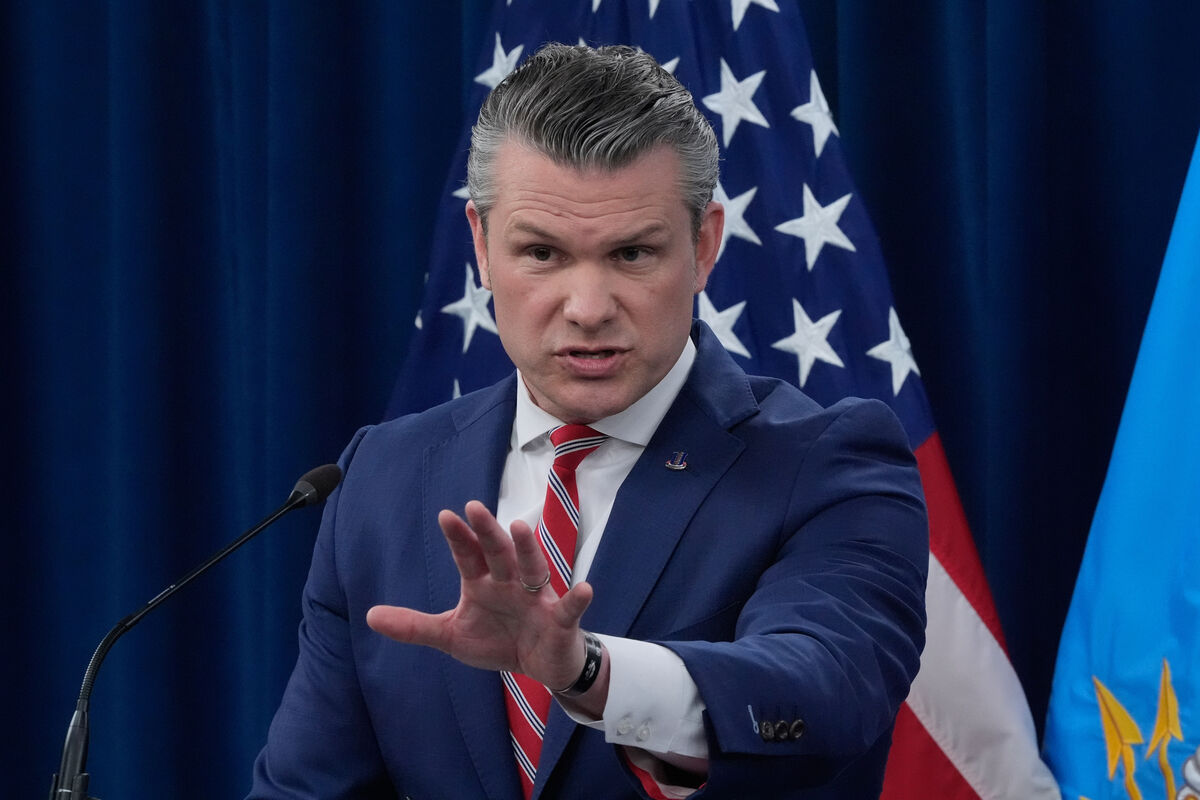
Where do you start with America this week? With the man running its military, addressing service personnel as though he were auditioning to become the world's most heavily testosteroned PE teacher?
“No fatties, no trannies, no beardos, no weirdos, no wimps, no radicals.” That was Pete Hegseth. The defence secretary. A man with access to rather more consequential equipment than a whistle and a bag of bibs.
I spent most of my adult life in uniform. Fitness matters. Discipline matters. So does emotional intelligence and the ability to recognise that leadership involves something more demanding than humiliating people who cannot answer you back.
Hegseth also announced an Office of Religious Affairs, reporting directly to him. The Pentagon says it will favour no particular faith. He introduced it by invoking the “full armour of God” and declaring that the real battle was spiritual.
For decades, America has justified military campaigns by invoking the danger of religious extremism. Now its own military leadership speaks about war in the language of divine purpose. Apparently fundamentalism becomes considerably less alarming when the preacher has an American flag behind him.
Separately, Elon Musk, Palmer Luckey and Newt Gingrich have been enlisted for Project Meridian, advising on the future of warfare. Musk and Luckey have businesses with obvious interests in that future.
I would like someone to explain how advising the purchaser sits comfortably alongside interests in selling the product. Preferably without using the word innovation.
Then there is the other American tradition: Discovering, after leaving office, how terribly troubled you were by the things you continued to facilitate while in it.
Brett McGurk, Joe Biden's former Middle East adviser, has described how close Biden came to cutting military support for Israel in spring 2024. Close. Think of the consolation that word offers Palestinian families. Somewhere in Washington, somebody almost did something.
Private anguish is a remarkably convenient currency. You can spend it indefinitely without interrupting a weapons shipment. The dead, meanwhile, cannot contribute a chapter to the memoir.
Earlier in September, broadcast the story of an American airman rescued from Iran. The weapons systems officer said professionals estimated he hit the ground at between 70 and 100 miles an hour. He called his survival a “modern-day miracle”.
The man in question looks like a browbeaten accountant. Apparently they make American airmen out of the same material as the aircraft. Put the sequence in a satire, and somebody would tell you to dial it back.
Meanwhile, Jeremy Scahill, Murtaza Hussain, and Reza Sayah have published an investigation for into the bombing of the Shajareh Tayyebeh school in Minab, Iran, on February 28. They report at least 156 people killed, including 120 children.
Minab’s fire chief, Mehran Zakeri, described recovering the remains:
Read that again. Fingernails.
Among the children killed was six-year-old Fatemeh Yazdanpanah. Her father, a poet, had chosen the school because she memorised his poems and he wanted an education worthy of her gifts.
An American survives, and they produce a television epic. Iranian children die, and their families have to fight to remain in the story. I wonder how many people who watched the airman will ever hear Fatemeh’s name.
Scahill is American too. His reporting is a reminder that America contains people determined to confront the things done in its name. We should be paying attention to them.
Back in Washington, Republican senator Eric Schmitt tried to discredit former special counsel Jack Smith with an alleged visit to an Atlanta Hawks basketball game. Gotcha! Smith had attended a University of Iowa Hawkeyes game. Different team. Different city. The insinuation of a clandestine meeting collapsed.
The accusation reaches its audience before the correction does. Smith investigated Trump; that is sufficient to make Smith the accused. Accountability becomes a weapon to use against anybody attempting to enforce it.
Then Cornell. A woman alleges in a civil lawsuit that seven fraternity members drugged and sexually assaulted her in 2024. Prosecutors have reopened the investigation.
Cornell says it investigated, imposed sanctions (in the form of giving the accused essays to write), and closed the fraternity chapter.

Reporting also raises questions about whether the initial police summary adequately recorded her account. Those questions require answers, however uncomfortable they make a phenomenally wealthy institution accustomed to advertising excellence.
There is no joke here. There is a young woman, an allegation of the most appalling sexual violence, and the question of whose distress an institution treats as urgent. Ireland has no standing to observe that question from a position of moral superiority.
And that is why I keep returning to America. Not because every wrong originates there. America still produces extraordinary artists, thinkers, and voices for good.
But we consume its politics as readily as its culture. We import the grievances, the vocabulary, the permission to be cruel. Sometimes we settle for the lite version. The principle survives the journey.
Our response? ’Twas ever thus. What can we do? It’s not our problem. We’ll outlast Trump.
One Trump breeds another Trump. One Biden breeds another Biden. The next man inherits the weapons, the money, and the convenient conviction that his intentions excuse the consequences. They will also inherit our ambivalence.
Waiting for a change of personnel is no answer. We can demand answers from our own government about its dealings with theirs. We can support the journalism that names the dead. We can insist that the rules we invoke against our enemies apply to our friends.
That is my problem with the shrug. It leaves everything in place. Yesterday’s disgrace becomes tomorrow’s policy, and we congratulate ourselves on having noticed.
So, apologies. Again. I wanted to write something cheerful. Next week, the grass. Assuming nobody has appointed a billionaire to advise God on mowing it.
CONNECT WITH US TODAY



Be the first to know the latest news and updates