The Domino scheme is a rare good news story in maternity services — don't gut it
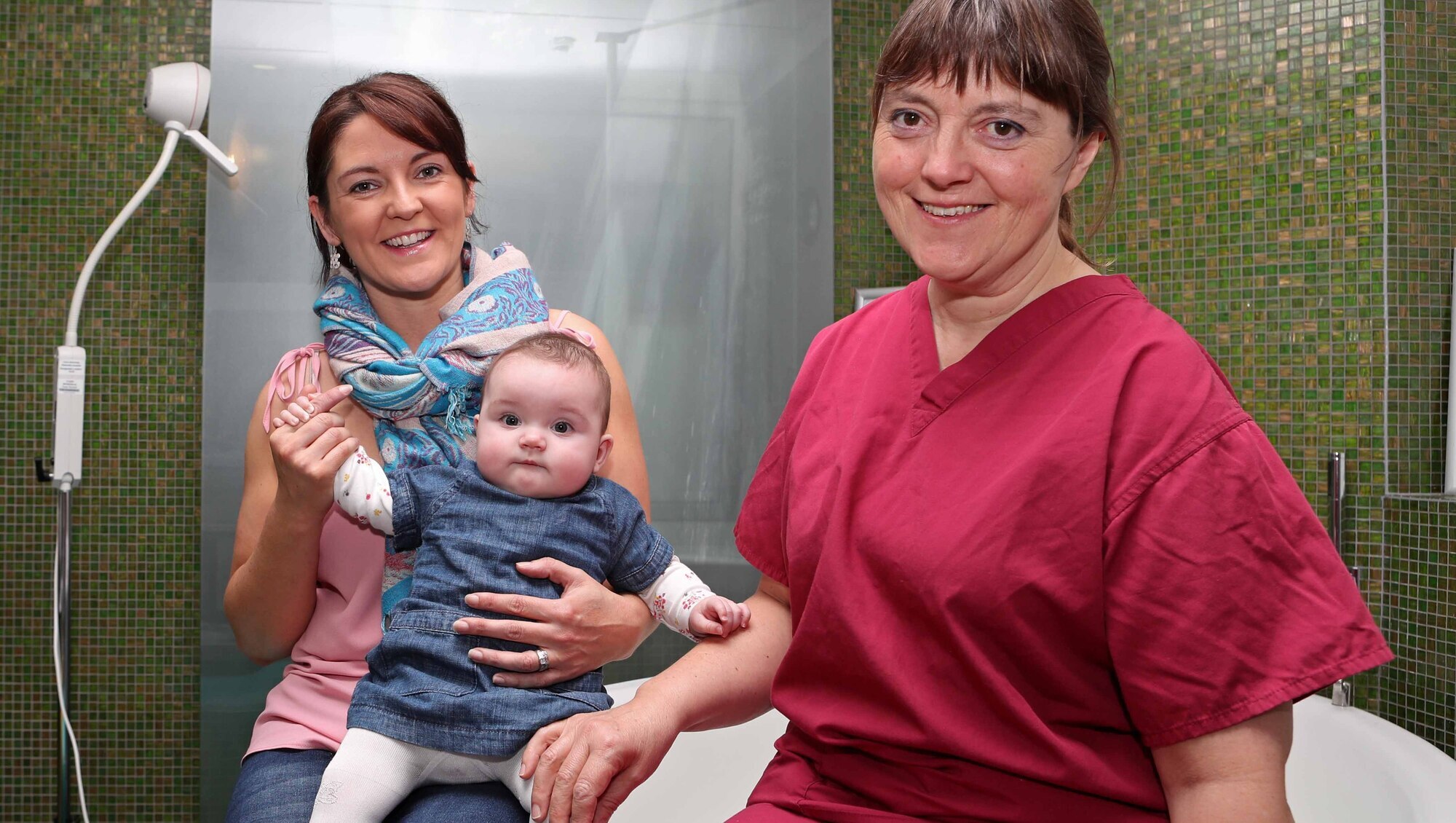
Mary and Lily Rose McGahern, from Douglas, with Lynda Moore, Domino midwife, in the Pool Room, at Cork University Maternity Hospital. Picture: Jim Coughlan
The lights are dimmed, there is a gentle scent of lavender in the air, the shower has been running for hours, and from the speakers an unusual mix of the Rolling Stones, John Grant and Destiny's Child is playing.
Exhausted yet determined, I hear an encouraging voice: "You're doing great, Sarah."
The year is 2021. The setting is Cork University Maternity Hospital. I am 37 hours into labour with my first child and, with me in the room are Naomi, a Domino scheme midwife, a student midwife and my husband.
Moments before, the two midwives have massaged my thighs, cracked open some essential oils to give me renewed strength for the final push, and reassured the doctor doing her rounds that everything is under control. Despite the long labour, I need no further intervention.
In the world outside, people are wearing masks and keeping their distance. Covid-19 is still everywhere, bringing fear, uncertainty and restrictions within hospital settings. On the ward above, nurses are recording details with pen and paper because a recent cyberattack has taken down the HSE's IT systems.
I am oblivious to it all. I feel safe.
After 38 hours, my son finally arrives. Ten fingers, ten toes. A caul birth, I'm told.
Ninety minutes later, having had my tea and toast (the thick slices), my newborn son and I are brought upstairs, and my husband is told to go home. He won't see us again until we are discharged two days later.
Read More
The following morning, I hear her excited voice before I see her. "Where's my Domino girl?" Mairéad, another Domino midwife, finds me. We've met several times at antenatal appointments in St Mary's in the weeks leading up to my labour and I am relieved to see a familiar face. In a ward full of strangers, she is the only person I know.
She checks on me, checks on the baby, answers my questions, shows me different feeding positions and reassures me my milk is producing exactly what my newborn needs. While she is with me, she calls over a student nurse and takes the time to show her how to check that milk has come in and different latch techniques.
Back home again, Mairéad, Martina D and Lynda call to the house over the following days. They carry out heel-prick tests, monitor my son's weight gain, check my stitches and keep an eye on our physical and mental wellbeing.
They care for us in the community, exactly as Government policy says they should.
It works.
Despite the madness of the world around us in June 2021, I leave CUMH with a positive birth experience. I avoided medical intervention despite a long labour, and the support I received with breastfeeding helped me continue feeding until my son turned one.
So, when I became pregnant again two years later, I chose the Domino scheme once more.
My positive experience is shared with many other women in Cork who have availed of the Domino service. That is why reports this week the service is being curtailed have caused such concern.
For those with low-risk pregnancies, Domino offers something different. It is midwife-led care delivered by an experienced team who encourage natural birth where possible, provide antenatal care in the community, and continue supporting women after birth.
From a patient's perspective, it means getting to know the people caring for you. It means not having to explain yourself over and over again to different faces. It means building trust in your body and confidence in the process.
It also offers women a genuine choice within the public system.
According to reporting this week, about 400 women availed of the service in Cork in 2024. The HSE has said the scheme will continue, but from October changes will be made to how the service operates, including postnatal care arrangements and labour ward coverage.
Women attending antenatal appointments this week have already been informed of those changes. Word spread quickly, as it always does, through waiting rooms, WhatsApp groups and social media. Women who thought they knew what their maternity care would look like suddenly found themselves wondering what happens next.
The reason given is staffing. The Irish Nurses and Midwives Organisation says there are now more than 80 nursing and midwifery vacancies at CUMH and has linked the changes to ongoing difficulties filling posts.
Nobody disputes that CUMH is under enormous pressure. Anyone who has spent time there in recent years can see that. Midwives and nurses are working extraordinarily hard in difficult circumstances.
At a time when maternity services are supposed to be providing more choice, more care in the community and more support closer to home, it feels counterintuitive that one of the few services delivering exactly that should end up on the chopping block.
The Domino scheme is an established service with a proven track record and a loyal following among women who have experienced it.
And there is a reason women speak so highly of it. When you are pregnant, particularly for the first time, there are few periods in life when you feel more vulnerable. You spend months wondering whether everything is progressing as it should. You question every symptom, every scan result and every unfamiliar sensation. You’re worried about the actual delivery and how it will go.
Knowing the people caring for you makes a difference. Seeing familiar faces makes a difference. Being cared for by midwives who know your history makes a difference.
Five years later, I can still remember the names of the midwives who cared for me. Naomi. Mairéad. Martina. Lynda. Mags. I remember them not because they delivered a service but because they made one of the most overwhelming, exhausting and important moments in my life a positive experience.
The Domino scheme is a good news story. Nobody is suggesting the staffing crisis at CUMH should be ignored. Quite the opposite: it needs urgent attention.
But the answer cannot be to chip away at one of the most sought-after maternity services available to Cork women. The service works. Women value it, it gives them choice, and it keeps care in the community.
Cork is lucky to have it. We should be fighting to expand it, to protect it, and not see it reduced.


CONNECT WITH US TODAY



Be the first to know the latest news and updates