Paul Hosford: When disease treatment comes down to value for money, the system is broken

A company has created a product that can help sick people and it costs as much as a modest home in some counties — every single year
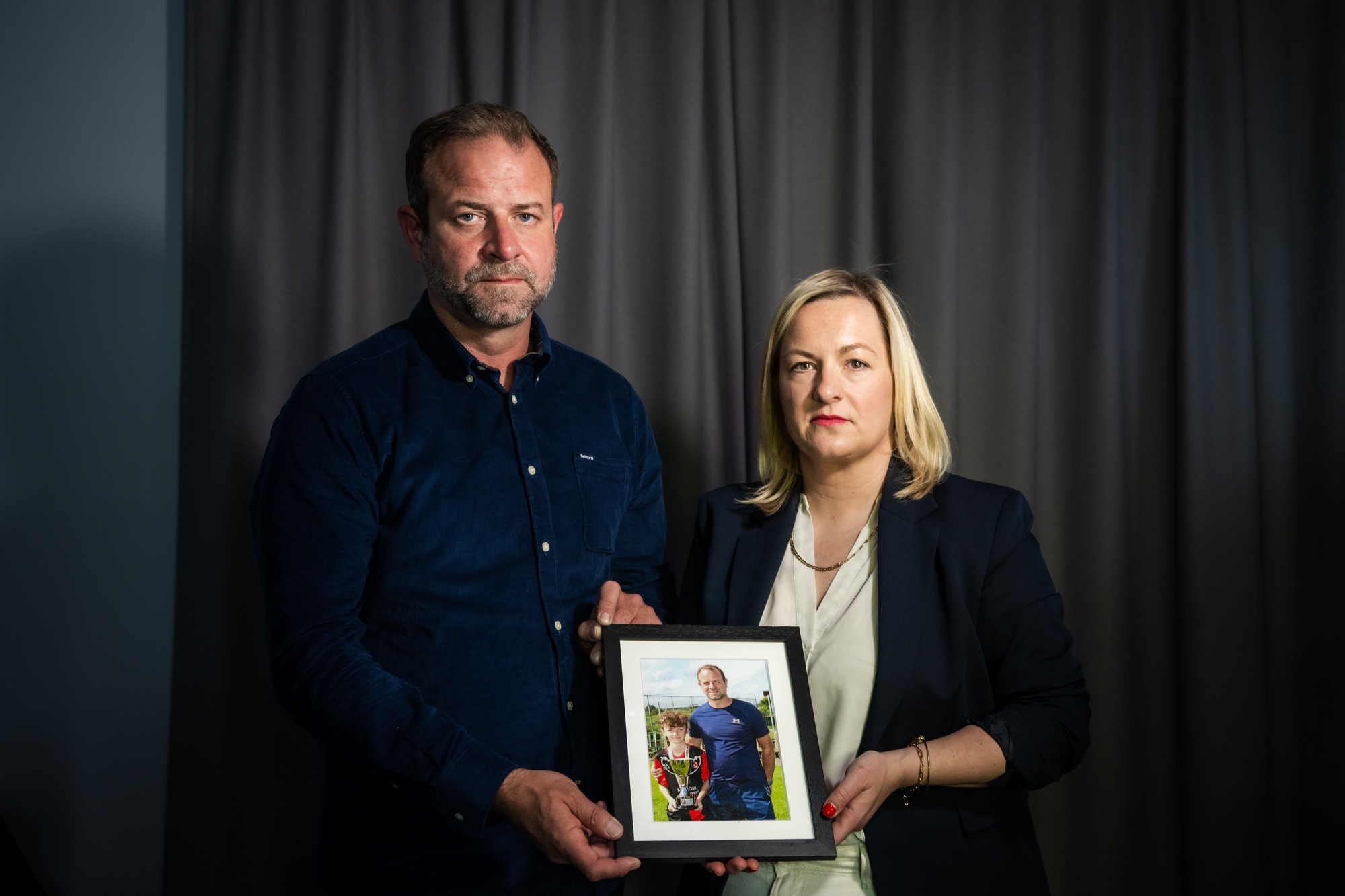
Craig Coady holds a photograph of himself and his late son Rory as Deirdre O’Shaughnessy listens during the recording of an Irish Examiner podcast. Picture: Chani Anderson

Craig Coady holds a photograph of himself and his late son Rory as Deirdre O’Shaughnessy listens during the recording of an Irish Examiner podcast. Picture: Chani Anderson

If you’re reading this column, there’s a good chance that you know what Skyclarys is. There’s an even better chance you know Craig Coady’s story.

It doesn’t feel like you should know either.

Skyclarys is a drug used to treat a rare genetic disorder called Friedreich’s ataxia (FA) which like many rare diseases is a cruel invader that causes progressive damage to the nervous system and can lead to heart complications.

The average life expectancy for people living with FA is 37 years.

There are around 200 people in Ireland who suffer from Friedreich’s. At the current price, it would cost around €280,000 per patient per year for the HSE to fund the use of Skyclarys, with a budget impact of around €130 million over five years.

In late 2025, a four-year study of 149 FA patients revealed that four years of daily treatment with Skyclarys continued to slow the progression of FA compared to what would be expected in patients without treatment. The study also found that the therapy maintained upper-limb co-ordination and bulbar (the part of the brainstem which controls swallowing, speaking, chewing, and protecting the airway) function in 149 patients with FA.

“Because steady decline has long been the expectation in FA, these findings raise real hope that targeted therapies could alter the course of the disease,” Liana Rosenthal, MD, PhD, associate professor of neurology at Johns Hopkins University School of Medicine in Maryland, said in a press release.

“Taken together, these findings mark real progress.”

Despite this, the National Centre for Pharmacoeconomics (NCPE) said in December that it would not recommend that the HSE provide it because it was “poor value for money”, and it was “unsure based on the available clinical evidence” of the “meaningful improvements” it could have.

A report from the Rare Diseases Technology Review Group published this summer supported the introduction of Skyclarys, prompting the HSE Drugs Group to discuss it once again this week. It opted against a recommendation that the drug be covered, a decision which will go to HSE senior management in 10 days.

If that seems technical, well, it is a bit. But there’s a human side.

Craig Coady lost his son Rory, left, age 13, last September to Friedreich’s ataxia. His older son Paudie, 16, also has the condition.

Craig Coady, who lives in Buttevant, lost his son Rory, age 13, last September to Friedreich’s ataxia.

His older son Paudie, 16, also has the condition and his health is starting to deteriorate.

Craig’s wife is in Dublin receiving treatment for Huntington’s disease.

Skyclarys is the first and only approved treatment for Friedreich’s ataxia, which cruelly took Craig’s younger son and threatens his older boy.

It is impossible to imagine how he feels. Even speaking to him in the aftermath of the decision, hearing the devastation and desperation, only gives you an insight, because few will have true comparators.

In the minutes following the decision, Mr Coady said he hoped the Taoiseach would intervene.

I’ve already lost one son. What do they not get? If it’s down to money, shame on them. I’m a reasonable guy, and if I thought the drug wasn’t working, I’d accept it. But we have to continue to fight.

Continue to fight. It’s not enough that Craig Coady buried a son, has a sick wife, and has another son fighting the same illness that took Rory. But he feels that he needs to fight. As if he hasn’t fought enough.

For families in Ireland, the State is supposed to be a source of protection, support, and security.

Yet for families dealing with disability, illness, or complex needs, it can sometimes feel like the State has become another obstacle to overcome. Instead of receiving services as a right, parents can find themselves making phone calls, filling out forms, appealing decisions, contacting politicians, and, in the most
extreme cases, taking the State to court simply to secure what their children need.

This is not to criticise the members of the Drug Group or even the NCPE. They are clinicians tasked with a job and if they have to make decisions that are most akin to a real-life hospital trolley problem, that’s a position I’m glad I don’t find myself in.

Those on that group have to weigh up using money in one place against using it in another. It is an unenviable burden.

Likewise, this isn’t even truly a criticism of the members of Government.

They have to be guided by experts in these fields and they too know that any penny spent here is a penny not spent elsewhere.

Surely, however, when we are discussing the quality of life of a small number of people in terms of value for money, something has gone wrong.

Here we have a cohort of people suffering from a rare disease. We have a drug which appears to give them a better quality of life. This should be straightforward.

Yet because a pharma company has a price to be met for its investment, it’s not.

Fianna Fáil politicians who wrote to the Taoiseach, Tánaiste, minister for health, and the HSE on Thursday said that the case showed the issues with Ireland’s drug reimbursement scheme and that it “highlights our concern with Ireland’s process, and raises serious questions as to why Irish patients are being left behind their European counterparts on a treatment for a rare, progressive, and life-limiting condition”.

They said the current process “was never designed to give patients with rare and progressive conditions a fair hearing within a reasonable timeframe, and this case is further proof of that”.

There is no doubt that they are right.

Some in Fianna Fáil — in particular Pádraig O’Sullivan, Anne Rabbitte, and Theresa Costello — have advocated fiercely on this issue and the wider cause of rare diseases.

Their work is admirable and good. But surely at some point we have to stop and consider why questions of rare disease treatment come down to value for money.

What is the inherent value of a life? Of a son, or a daughter, or a mother, or a father, or a friend?

Is it €279,999 a year? Is €280,000 the tipping point?

There will be people who read this and scoff at the naivety of questioning the market.

They will say this is just how it is: Companies must be reimbursed for the time and expertise they have put into saving lives. They must make back their money, even if it means people suffer in the interim.

That is just the way the world is, they will say, but only because they’ve never stopped and asked why.

Why should the profits of an already profitable company matter more than sick people? What kind of value system is that?

I am not deluded. I do not believe that this case will prompt reform of late-stage capitalism.

I do not even believe that it will change anything in the Irish system. But when we’re focusing our criticism on clinicians, or politicians, or even each other, we must surely ask if this is the best it can be.

A company has created a product that can help sick people and it costs as much as a modest home in some counties, every single year.

The market isn’t working, in that case.

The move on Thursday by 47 members of the Fianna Fáil parliamentary party to call for Government and HSE leaders to reject the HSE Drugs Group’s recommendation is significant and may give the political impetus for a solution to be found here.

However, without examining how these situations happen, how we get to know the names of people like Craig Coady so often, it will be only a matter of time until we’re learning of another harrowing case.

More in this section

Revoiced

Newsletter

Had a busy week? Sign up for some of the best reads from the week gone by. Selected just for you.

Cookie Policy Privacy Policy Brand Safety FAQ Help Contact Us Terms and Conditions

© Examiner Echo Group Limited