Government urged to establish private CHI investigation
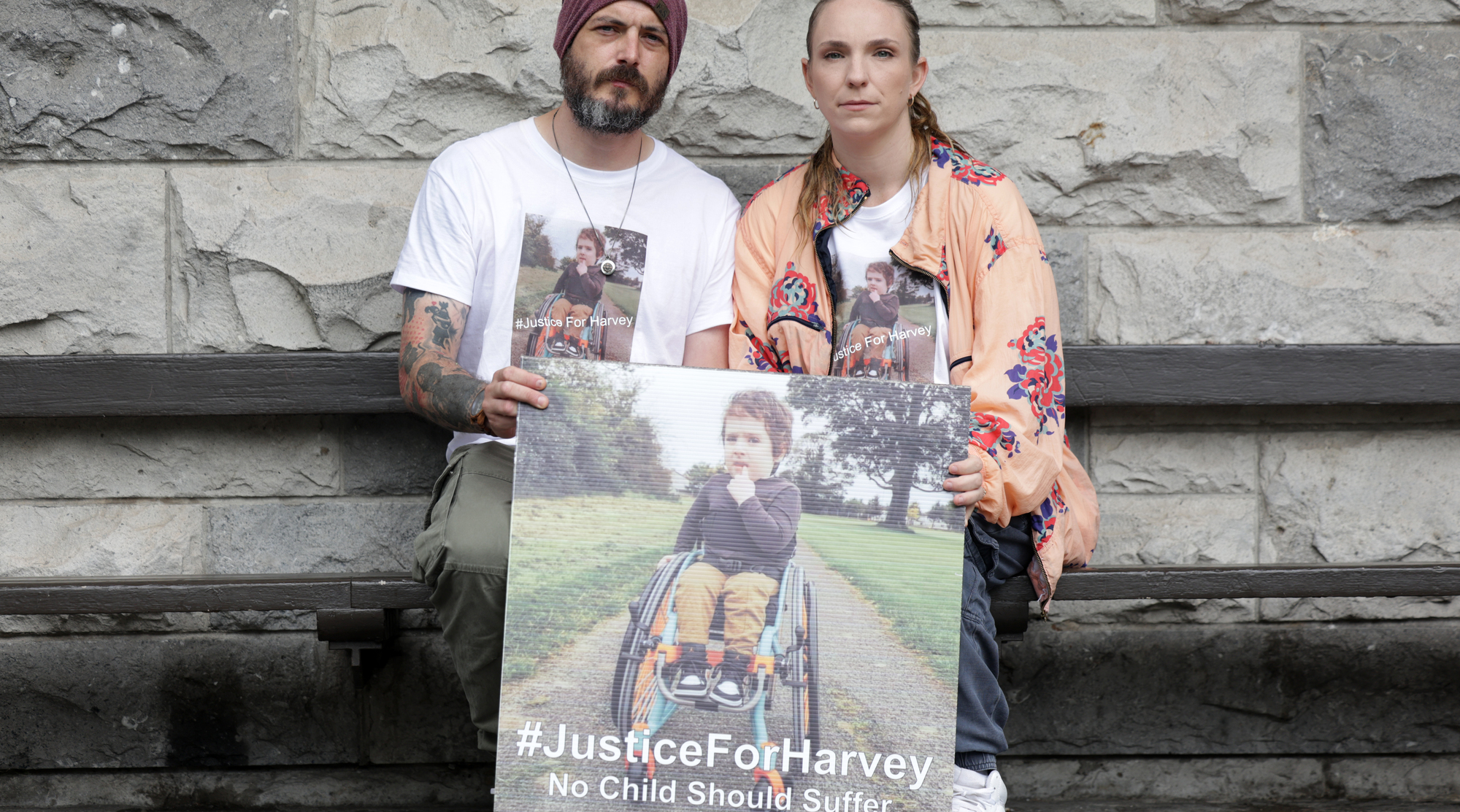
Harvey Morrison Sherratt's parents Gillian Sherratt and Stephen Morrison at a protest in 2025 for better rights and access to timely healthcare for children with disabilities. Nine-year-old Harvey, who suffered from scoliosis, died three weeks ago in July after spending years awaiting scoliosis surgery. The scoping report was published on Monday and came in response to Harvey's death. File photo: Leah Farrell/© RollingNews.ie
An inquiry into a series of “very distressing” issues affecting children treated by Children’s Health Ireland (CHI) should be conducted by a Commission of Investigation and held in private, the Government has been advised.
A scoping exercise led by barrister Remy Farrell SC recommended that the inquiry examine four areas relating to the care of children with scoliosis, spina bifida and hip dysplasia.
It recommended the examination of:
- Waiting lists delays and communication with parents;
- Spinal surgery, including who in CHI knew about the plan to implant springs into some children;
- Hip dysplasia care in CHI at Temple Street and Cappagh hospitals;
- The treatment of the so-called Crumlin Orphans, who received what the report described as a "considerably lower degree of care" than children with similar conditions at Temple Street.
The inquiry would cover the period from 2019 to 2025, although the examination of the Crumlin Orphans issue would extend back to 2008.
The scoping report was published on Monday and came in response to the death of Harvey Morrison Sherratt.
Mr Farrell advised that a single-member commission be established to examine the issues, saying it would most likely be headed by a judge or former judge. The Government accepted the recommendations in full.
Health minister Jennifer Carroll MacNeill said: “I am grateful to the parents, families, and advocacy groups for their collaboration with Mr Farrell throughout the process.
“The difficult experiences of families are evident throughout the report, and their insights have informed its recommendations.”
Mr Farrell said in his 136-page report that the choice was between a public tribunal or private commission. Both are statutory inquiries with similar powers including compellability of witnesses.
He chose a commission largely because so much data concerns children’s health. The risk of identifying children is high, he said.
Mr Farrell said: “The stark reality is that it is not the function of a statutory inquiry to offer solutions.
“All it can do is attempt to establish what has happened in the past and based on this make what will be at best fairly broad recommendations.”
He said this led to “significant disappointment” among families.
The HSE, CHI, and the health minister are responsible for solutions, he said.
In his opinion, solutions should not wait on the commission to finish as “this would inevitably have the effect of putting off those decisions for some time”.
He also noted some advocacy groups withdrew from the process in frustration because key reports were not shared with them by CHI.
Mr Farrell saw these reports but could not share them for legal reasons.
Many families raised communication issues, saying without advocacy groups they would not know what is happening.
Parents said dealing with CHI is “exhausting, opaque” and they have to “shout loudly” to get timely care.
Mr Farrell recommended a module hearing from patients and families seen between January 1, 2019, and December 31, 2025.
The inquiry should investigate “CHI's response to waiting time delays and waiting list management issues during the same period", he said.
He recommended investigating issues around funding for five urology clinics.
This relates to an unpublished report widely covered in the media last year around use of National Treatment Purchase Fund monies.
Some €19m was allocated to CHI in 2022 to reduce waiting times for spinal surgery. Mr Farrell recommended investigating how this was actually spent.
Mr Farrell recommended further investigation on use of non-medical devices in spinal surgery following a Hiqa report last year.
This should cover “whether CHI management was aware of the use or intended use of the non-CE marked springs at Temple Street between 2020 and 2022”.
Parents whose children have hip dysplasia told Mr Farrell they felt “pressured or manipulated into agreeing to surgery” at CHI at Temple Street and Cappagh Orthopaedic hospital.
One mother was told her daughter might not be able to carry a pregnancy to term unless she had surgery.
He recommended the inquiry look at the eligibility threshold used.
This should be after a separate external panel review finishes.
Mr Farrell recommended investigating why “several dozen” children had less access to care for spina bifida and scoliosis in CHI at Crumlin compared to children transferred to CHI at Temple St after 2008.
“It would appear that the level of service that was available in Crumlin to this group decreased over time largely as a result of staff either retiring or moving on and not being replaced,” he said.
Children’s Health Ireland said it will work with the Government and its staff to ensure “an efficient, fair and child-centred outcome” from the inquiry.
“We will be seeking more information on the terms of reference, planned processes, procedures and timelines so that staff can be prepared and adequately supported during this process while also minimising disruption to the delivery of clinical services,” a spokeswoman said on Monday.
She also said: “CHI acknowledges the courage of the children, young people and families who have shared their experiences.
"Their voices must be heard, and where failings have been identified, they will be acknowledged, addressed and learned from.”
CONNECT WITH US TODAY



Be the first to know the latest news and updates