Clodagh Finn: The women who helped win independence led lives of quiet desperation in the new Ireland
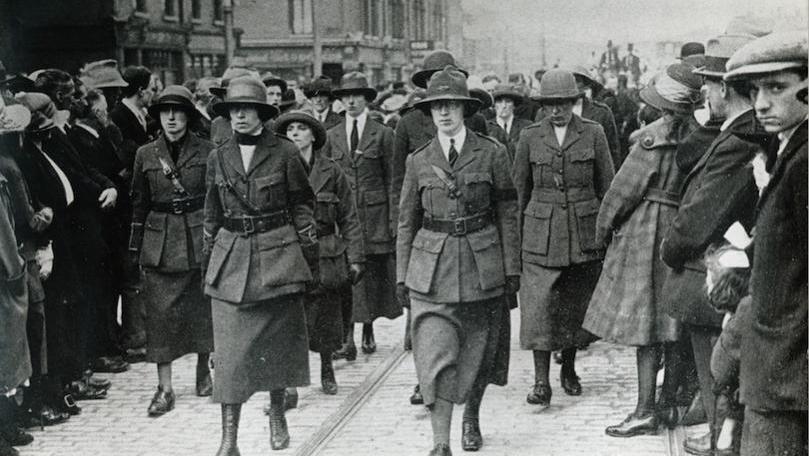
Some members of Cumann na mBan who carried out vital work to help Ireland gain independence.
I have been haunted by her words all week. In 1956, Mary MacCarthy, a former Cumann na mBan member from Bantry, Co Cork, wrote a short note to the Department of Defence to acknowledge her special allowance: “Thank you so much [I’m] very grateful. I was often hungry lately.”
![When former Cumann na mBan member Mary MacCarthy of Bantry was granted a special allowance in 1956, she wrote to thank the Department of Defence, mentioning almost in passing that she didn't have enough to eat: '[I'm] very grateful. I was often hungry lately.' Courtesy of the Military Archives/ Military Service Pensions Collection When former Cumann na mBan member Mary MacCarthy of Bantry was granted a special allowance in 1956, she wrote to thank the Department of Defence, mentioning almost in passing that she didn't have enough to eat: '[I'm] very grateful. I was often hungry lately.' Courtesy of the Military Archives/ Military Service Pensions Collection](/cms_media/module_img/10386/5193232_1_articleinline_clodagh_20letter.jpg)
That will tell you just how inadequate the paltry E-grade military pension she received for her service during the War of Independence and Civil War had been.
And she had to fight to get that. She was finally granted a pension in 1942, but there were months when she had to write again to say it had not been paid.
A decade later, she was forced to apply for a special allowance on the grounds of poverty, and seemed to mention in passing that she was “often hungry”.
You’ll find that heart-rending detail in an excellent journal article by Leeann Lane, associate Professor in History at Dublin City University, which had me fuming from title quote to the very last line.
The quote reads: “I hope now you will do something for her, as she is a great burden to me.”
Those words came from the pen of the brother of a single woman, aged 52, who had served with the 3rd Cork Brigade in Ballinadee, Upton. By 1953, though, this woman who had imagined a very different future had no pension, was jobless and dependent on him.
He resented it, as did so many other family members who begrudged supporting single activist women who, in the cruellest irony, found themselves outside the central structure of the very state they had helped bring into being.
The nuclear family was at the inviolate centre of a newly independent Ireland and there was no natural place for the one in four single women living within in.
In the Irish Free State of 1926, the number of unmarried women was 50% greater than in England and three times greater than in the US. That was partly due to a continuation of landholding and marriage patterns that emerged after the Famine, with one son inheriting the farm and one daughter a dowry.
While it is true to say that all female activists had difficulty persuading the pensions board that their service had been important, the lack of financial support was felt particularly acutely by single women.

Mary Doyle, of Bandon and Cork City and a former member of the 3rd Cork Brigade, received a pittance for her service and in 1952 wrote to the pensions board to say that she didn’t want to be a burden on her brother. “If you don’t give me a pension that I can live on, I will go to the Co [county] home,” she wrote.
Her file in the Military Service Pensions Collection (militaryarchives.ie), mentioned here last week as an unrivalled source, outlines what she did between 1918 and 1923.
Here is a small example of it: “The applicant states in the 1918-19 period that she helped to manufacture equipment, ammunition and field-dressings.”
And a little sample from 1920: “Supplied IRA men on-the-run with food, shelter and clothing… putting up an IRA organiser from Dublin named O’Connor in her home for six months; assisting six IRA men to escape from Sheehan’s barn loft in Kilmore during a round-up; tending to IRA Brigade Commander Charles Hurley … who was fatally wounded at Upton train ambush…”
Whatever you think of the conflict of the time, here was a fearless woman doing what she believed would lead to a fair, independent Ireland.
But like so many other women who suspended their own lives and chances of a career or were jailed and went on hunger strike, Mary Doyle led a life of poverty and quiet desperation in the new state that she helped to create.
There is justified anger and defiance in some of the exchanges between female revolutionaries and the authorities.
When Mary Cotter, Fermoy branch Cumann na mBan, was told she did not qualify for a pension under the Military Service Pensions Act, 1934, she shot off this great retort: “I qualified when there was work to be done and qualified when arrested at Rathcormac and kept ...under a gun for hours and my bicycle taken from me and qualified again when arrested in Watergrasshill.”
Sheila and Nora Wallace, now hailed for their vital intelligence work at their newsagents on Brunswick Street (St Augustine Street) in Cork, were also bitterly disappointed.
“Your board did not do me justice. The work which we did during the whole period could never be repaid,” Sheila Wallace wrote.
Part of the reason for that was outlined by Annie Walsh, sister-in-law of Cork Lord Mayor, Tomás MacCurtain, murdered by the RIC in 1920. She pinpointed an issue that endures to this every day:
Indeed.
Despite the expressions of injustice, what comes through these forgotten and disrespected women’s words is that aforementioned sense of quiet desperation.
In 1943, for instance, Nora Martin wrote a reference for Eileen Barry, explaining how she had given up school and sacrificed her future employment prospects “in order to devote whole time to National work”.
She was part of a family very active during the revolutionary period; three of her brothers and two sisters were imprisoned for anti-Treaty activities.
By 1947, however, Eileen was forced to apply for a special allowance on the grounds of poverty. In later life, she was living alone in poor health at 5 Windsor Cottages, St Luke’s, Cork, in a two-room dwelling that had been designated third-class in the 1911 census.
There is a flash of anger, though tempered by resignation, in a letter from Mary Kate O’Leary, Fermoy branch, Cumann na mBan, to the pensions board in 1948. She reminded them that those who had a service medal were promised they would not starve. “Well,” she wrote, “I am almost starving.”
Later that year, the board’s medical officer Dr JC Saunders described O’Leary’s appalling living conditions: “I have gone into her social conditions and am forced to the conclusion that she has been existing at bare subsistence level (that is of semi-starvation).”
O’Leary wrote: “I have no one belonging to me.”

And here’s a short extract from her file: “Subject was awarded a Service (1917-1921) Medal in 1942… The applicant claims that she was engaged in fundraising; meetings; storing ammunition; first-aid training and procuring 200 rounds of ammunition from [British Army] Sergeant Major.”
The file doesn’t elaborate on how she got those rounds but there’s a film in it, I’m sure.
A film may yet come because at least now the experiences of these women are finally coming to light thanks to this pioneering research from Leeann Lane, and the work of other historians.
As she says: “This research seeks to restore their visibility: to identify them, to name them and to rescue them from their status as ‘unproductive’ deadweight existing on the margins of the families created by married siblings or relatives.
“The very act of their writing to the Military Service Pension Board draws attention to a set of distinct lived experiences in the post-revolutionary Irish State that should be acknowledged.”
The eye-opening exhibition researched by Leeann Lane, ‘Cork Afterlives: Single Women and the New Irish State’, recently at the Boole library at UCC, is due to go to Cork Library. In the meantime, log on to militaryarchives.ie to fill in some of history’s many blanks.