Colin Sheridan: Where is the line between welcoming investment and surrendering identity?
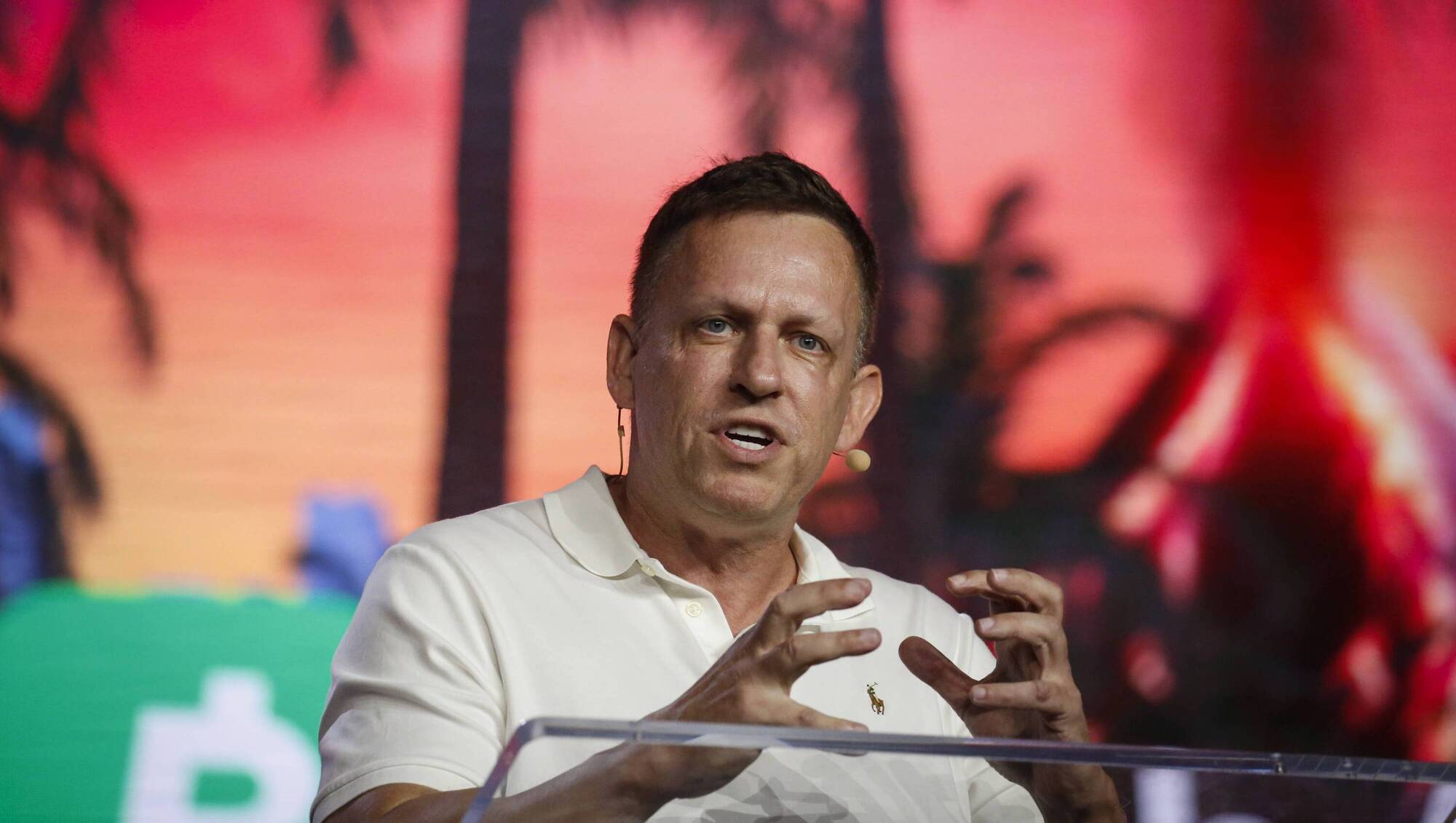
Who are we hosting? Why are we hosting them? What do they represent? And what does their presence say about us, asks Colin Sheridan
Co-founder of PayPal and Palantir, Peter Thiel is planning a retreat this summer in Dublin with an elite network of over 220 tech, financial and political figures. Picture: Getty Images

Co-founder of PayPal and Palantir, Peter Thiel is planning a retreat this summer in Dublin with an elite network of over 220 tech, financial and political figures. Picture: Getty Images

Nothing says Irish begrudgery quite like a bunch of “leftie loons” taking issue with billionaire Bond villains hosting secret society gatherings on an old landlord’s estate in Wicklow. They’re never, ever happy, are they? If they’re not protesting the slaughter of children in the Holy Land, they’re standing up for minorities being targeted by neo-fascist agitators in Belfast.

They are never not at it. These are open-toe-sandal-wearing, placard-waving Arts graduates with nothing better to do on a Saturday afternoon than shame anyone who sticks up for the 1%. Those commie bastards are just bitter they didn’t get in on the ground floor of Palantir, the anthropologically “not-for-profit” death star which serves as an on-ramp to almost everything anti-humanity. We are talking about weaponised AI, predictive targeting, deep surveillance, and the kind of high-tech tracking that feels less like innovation and more like a Philip K Dick novel brought to vivid, terrifying life.

I wonder if the ghosts of the Irish revolutionary generation spend most of their time wandering around modern Ireland in a state of complete bewilderment

Imagine James Connolly emerging from Glasnevin Cemetery, stopping for a quick one in the Gravediggers before making his way towards a luxury estate in the Garden of Ireland. Inside, a gathering of billionaires, oligarchs, technology executives, defence strategists, venture capitalists, and the assorted architects of the future are sipping smoothies behind closed doors.

Connolly pauses at the gate. A security guard approaches, looking crisp in a high-vis vest that screams “private security.”

“Can I help you, sir?”

“I’m looking for the republic,” Connolly says, eyes scanning the manicured lawns.

The guard checks a clipboard. “Is that a startup? With Palantir or one of the venture capital firms?”

Connolly blinks. “Sorry?”

“The republic. Is that before or after the panel discussion on Bye Bye Baby, the new ultrasound technology that identifies terrorists in the womb and neutralises them?”

At which point, Connolly would surely look at the horizon and wonder: for what died the sons of Róisín?

This week, we learned that Ireland is preparing to host a gathering associated with billionaire investor Peter Thiel and a network of technology, political, defence, and financial elites whose interests could loosely be described as flagrantly and immorally capitalist.

Only in modern Ireland could a sentence like that fail to sound entirely ridiculous. Ireland, a country currently unable to build enough houses for its own citizens — a country in the grip of a generational housing crisis — is apparently capable of hosting high-level conversations about the future of humanity. 

We cannot decide where to put a cycle lane without a protracted planning battle, but we can host discussions about weaponised artificial intelligence, geopolitical competition, and the shape of the coming century

Peter Thiel himself is one of those figures who feels barely believable as a person. He co-founded a company, Palantir, that he named after a magical, all-seeing surveillance device from Lord of the Rings. This is a company whose software is used by militaries, intelligence agencies, and governments around the world. It is a company championed by the Israeli Defence Forces in their genocidal campaigns in Gaza and Lebanon. Yet, a look at Thiel’s LinkedIn profile would tell you he is merely “fascinated by technology, longevity, civilization, disruption, and the future.”

A century ago, power was visible. Power sat in parliaments and led armies. Today, power arrives in a quarter-zip fleece, carrying a reusable water bottle, talking about “disruption,” “innovation,” and “optimisation.” But what they mean is something much, much worse. It insists it is changing the world for the better while quietly acquiring more of it. And Ireland has become extraordinarily comfortable inviting it in.

This is where the ghosts begin to gather. One imagines Patrick Pearse appearing alongside Connolly.

“Who are these people, James?”

“Billionaires.”

“Doing what?”

“Discussing the future of civilisation.”

“How much civilisation do they currently own?”

“Quite a lot, apparently.”

Then comes Jim Larkin. He surveys the gathering. “Workers?”

“Not many.”

“Trade unions?”

“No.”

“Housing activists?”

“Unlikely.”

The issue is not that these individuals are moustache-twirling villains. There are always villains. The issue is that enormous influence increasingly resides in private networks that exist beyond meaningful public scrutiny. The boundaries between technology, politics, finance, and defence have become integrated, and all for profit. Companies once built software; now they shape wars. Investors once allocated capital; now they influence public policy. Technology executives once sold products; now they speak openly about the future of targeting.

And perhaps nowhere is this tension more visible than in Ireland. For generations, we told ourselves a story about what kind of country we were: a small republic, shaped by anti-colonialism, instinctively suspicious of concentrated power. A people who understood, through painful experience, what happened when wealth and influence accumulated in too few hands.

Yet, modern Ireland increasingly finds itself eager to host precisely those concentrations of power. The language is always familiar: Investment. Innovation. Opportunity. Growth. And perhaps much of that is true. But every nation eventually has to decide where the line exists between welcoming investment and surrendering identity.

Not every dollar is morally neutral. Not every investment is without consequence. Not every powerful guest arrives carrying values we necessarily wish to celebrate

 That does not mean building walls around ourselves, nor does it mean rejecting engagement with the wider world. It means asking questions. Who are we hosting? Why are we hosting them? What do they represent? And what does their presence say about us?

The irony is that Peter Thiel and his fellow attendees may leave Wicklow believing they have spent a productive weekend discussing the future. Perhaps they will. But the more interesting question concerns the country hosting them. Because long after the private jets depart and the conference rooms empty, Ireland will still be here.

We will still be wrestling with housing. Still debating the nuances of our neutrality. Still arguing about inequality. Still trying to determine what kind of republic we actually wish to become. And somewhere in the distance, one suspects, the ghosts of Connolly, Pearse, Larkin, will continue their conversation.

“Is this what we had in mind?” asks Pearse.

Connolly takes a long drag on his cigarette. “No,” he replies. “But somebody’s getting rich from it .”

And perhaps that is the most contemporary Irish conclusion of all. The republic survives. The ghosts remain unconvinced. And the billionaires boast of progress.

More in this section

Revoiced

Newsletter

Had a busy week? Sign up for some of the best reads from the week gone by. Selected just for you.

Cookie Policy Privacy Policy Brand Safety FAQ Help Contact Us Terms and Conditions

© Examiner Echo Group Limited