John Gibbons: It was always a high risk strategy to entrust Cop28 to a petro-state
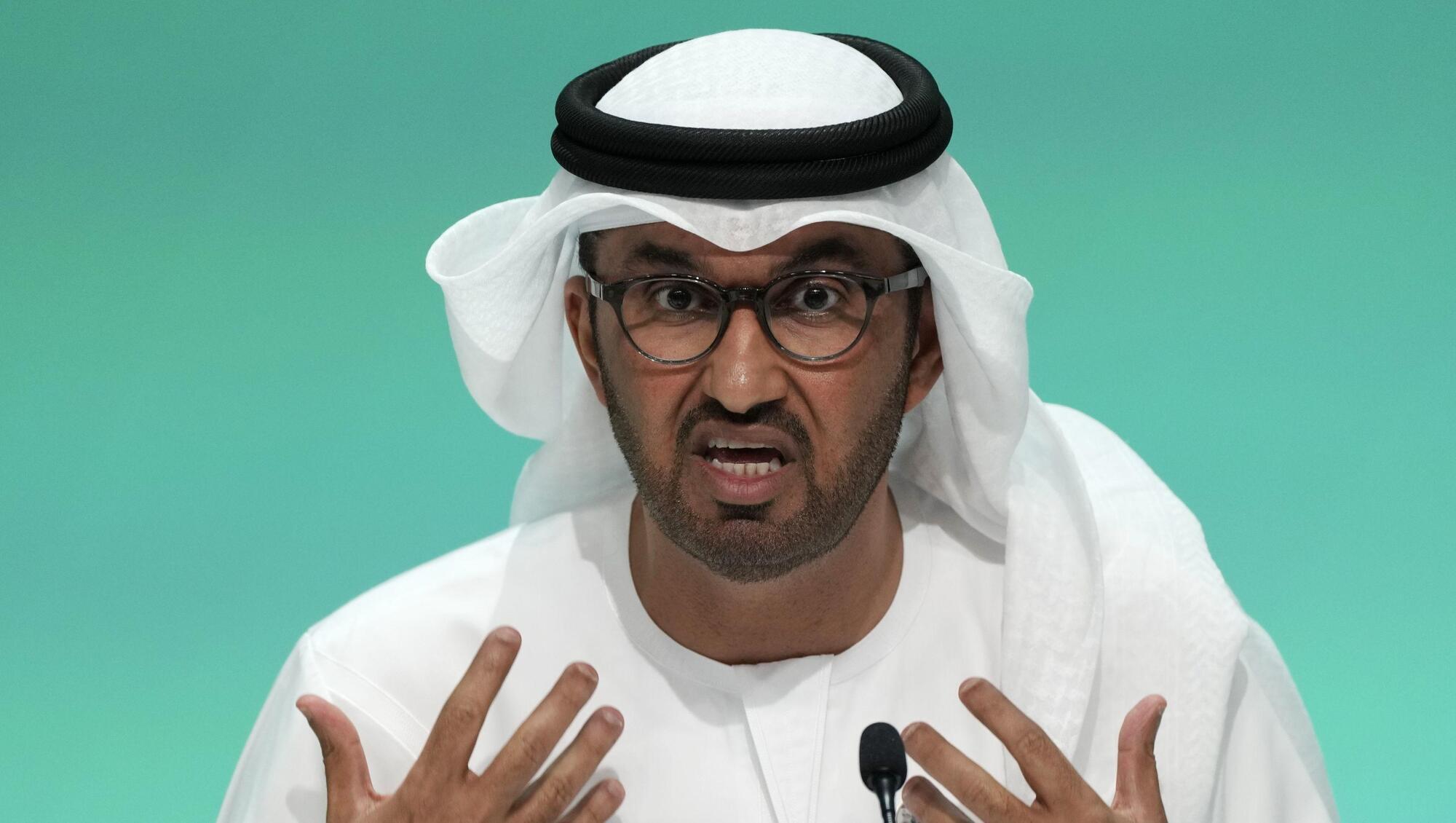
Cop28 President Sultan al-Jaber. Picture: AP
It was always a high risk strategy to entrust the running of the crucial intergovernmental climate negotiations to a petro-state, and then to appoint the boss of its national oil company as president of Cop28. And so it has transpired.
In a bad-tempered zoom call a week before the Cop28 conference kicked off in Dubai, Sultan Al Jaber claimed there was “no science” supporting the view that a phase-out of fossil fuels is needed to avoid dangerous climate change.
Former Irish president and UN climate envoy, Mary Robinson pressed Al Jaber hard on the conference call, stating: “We’re in an absolute crisis that is hurting women and children more than anyone … and it’s because we have not yet committed to phasing out fossil fuel.”
When Al Jaber brushed off her comments as “alarmist”, Robinson, a lawyer by training, went in for the kill: “I read that your company is investing in a lot more fossil fuel in the future.”
The now-flailing Cop28 president retorted that her information was from “your own media, which is biased and wrong. I am telling you I am the man in charge and it is wrong. You need to listen to me, ma’am…you guys write a lie and you believe it … I’m sorry, get your facts straight, ma’am”
A flustered Al Jaber then fell back on the laziest of climate denier tropes of her “wanting to take the world back into caves.”
Al Jaber gave the distinct impression of not being remotely comfortable at being challenged, least of all by a woman. To say this was an inauspicious lead-in to the Cop28 climate negotiations would be quite the understatement.
At an unscheduled press conference, Al Jaber made a lacklustre attempt to walk back his own comments, while also stating that the “phase-out of fossil fuels is inevitable, in fact it is essential”. He once again inferred the real problem was how they were reported in the media.
His mood was unlikely to have been improved by the recent revelation that the United Arab Emirates was planning to use the Cop28 meeting to conduct negotiations for oil and gas. The line between tragedy and farce is being blurred on a daily basis.
The arrival of Taoiseach Leo Varadkar in Dubai from the outset of the conference appeared to set the tone for Ireland’s engagement with the process at the highest level. However, Varadkar pointedly made his first engagement in Dubai a visit to a large dairy farm.
While not doing any media around the visit, a statement from the Taoiseach said the Al Ain farm is “keen to learn more from Ireland’s expertise in sustainability”. This appears to be an unsubtle political signal to Ireland’s high-emissions livestock sector that they have little to fear from the Cop28 process.
While the UAE hosts were clearly discombobulated by Mary Robinson’s line of questioning, they will have been relieved to hear Leo Varadkar fudge on the need to phase out fossil fuels. At the weekend, he said: “If it’s the case that there are technologies, like carbon capture and storage (CCS) that can be developed … then that achieves the objective”.
The techno-fixes that Varadkar (and climate minister Eamon Ryan) appears to be betting on simply do not exist anywhere on Earth, and for good reason. Adding CCS to any existing fossil fuel facility, such as a power station, is hugely expensive and would make it uneconomic to operate. Oil companies know this because they have already tried.
While CCS is at least possible in theory on a power station, it’s simply impossible to capture carbon from a car’s tailpipe or a central heating system.
Also over the weekend, the fossil fuel industry pledged to cut methane leaks from their pipelines. Methane is a potent greenhouse gas, now responsible for around a third of all global warming. UN Secretary-General António Guterres described the industry’s commitments as “clearly falling short of what is required”.
Ireland, meanwhile, is an oversized producer of methane through our expanded and intensified livestock herd, but is not expected to bring any significant proposals to the Cop conference on reducing methane emissions.
Agriculture minister Charlie McConalogue issued a statement outlining what he called the “strong progress of agriculture in meeting climate targets”, yet nowhere in his statement could I find any actual data to support this claim of “strong progress”. Bizarrely, McConalogue refers to “whole-of-economy 51% reduction in emissions by 2030” that are, according to the Environmental Protection Agency, already completely off the table.
This underlines the radical disconnect between the reality of the climate emergency and the anodyne statements by politicians protecting their patch.
What is touted as the biggest win of Cop28 to date is the agreement on a ‘loss and damage’ fund to help poorer countries cope with climate impacts. Commitments to date amount to around €400 million, including €25 million from Ireland. This is barely 0.1% of the estimated annual climate losses topping €400 billion currently hammering the global south.
Little done, lots more to do at Cop28.

CLIMATE & SUSTAINABILITY HUB
CONNECT WITH US TODAY



Be the first to know the latest news and updates