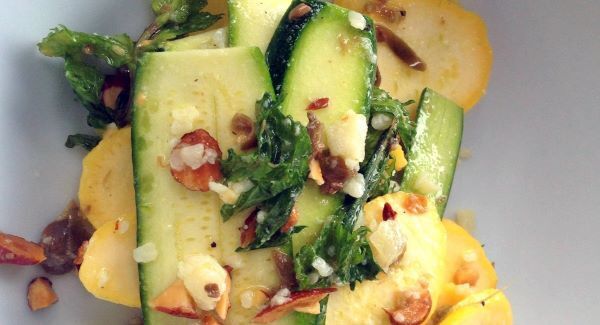
Zucchini with Capers, Crumbled Pecorino, Toasted Almonds and Mint
This cronut, which has been sending New Yorkers into a frenzy, is a hybrid of a deep-fried croissant and doughnut.
It is 7.35am and it’s pelting rain. Beside me there is a Japanese lady from Boston and a chap from UBS who has just come off a night shift, the line now stretches all along Sullivan Street, and it’s made up of mostly young people, hipster types — “They’ll be onto something new next week — that’s New York for you, everyone’s looking out for the next big thing,” says the cool lycra-clad girl in a baseball hat beside me.
She has run from the other side of Central Park but her work doesn’t start till 11.30. At the edge of the sidewalk a white van from the Avon Foundation for Women, emblazoned with “God’s Love We Deliver” is collecting food parcels to deliver to the needy. The irony is not lost on us.
The sleepy guy beside me tells me he’s a student doing an MBA in business and he’s only doing this because he’s in the ‘dog house’ with his girlfriend, He’s hoping to get two cronuts as a surprise for her, I don’t like to ask why.
Dominique Ansel has trademarked the cronut, the demand is insane and so the challenge of copying it and coming up with a new name is exercising bakers all over New York and beyond. There are already some knock offs called ‘doissants’ and ‘croughnuts.’
I’ve been sitting at a little table by the window watching the action for several hours now; I ate my precious ‘cronut’ with a cup of coffee, it turned out to be a deep fried doughnut-shaped ring, tender yet light and crunchy, with a circle of lemon maple icing.
It was definitely good, but certainly on the sweet side, the DKA (Dominique’s Kouign Amann) is also delicious.
When I met Dominique he was so kind and gracious despite the queue of food writers and TV crews wanting a piece of him.
He was invited Daniel Boulud to New York. While he was pastry chef at Daniel they were awarded three Michelin stars and four stars in the New York Times.
Just a year and half ago he started his own bakery in a tiny premises on Spring Street.
The cronut came about almost by accident — he had been experimenting with various versions and when they got an A from their health inspector, he made this confection and celebrated with his staff. They thought it should be the new fun summer item.
Dominique Ansel was recently presented with a James Beard award. Well deserved.
18 razor clams or less if they are very large
Cucumber and Mustard Seed Pickle (see recipe)
Chervil sprigs or micro greens and wild garlic flowers
Cucumber and Mustard Seed Pickle:
For this recipe I like to dice the cucumber very fine and put it into the pickle.
Serves 18
3½ lbs (1.6kg) cucumbers, thinly sliced
1lb (450g) onions, thinly sliced
1 tbsp salt
10oz (285g) sugar
1½ oz (45g) mustard seed
1 tsp turmeric
A pinch mace
1 pint (600ml) white wine vinegar
First make the pickle. Put the thinly sliced onion and the cucumbers into a bowl, add the salt, and mix well.
Put all the ingredients for the pickle into a saucepan. Bring to the boil for 2 minutes.
Pour over the cucumbers and onions. Stir well, allow to get cold. Fill into sterilised jars. Cover and seal.
Heat the grill pan. Wash the razor clams, put onto the hot grill cook for 3 — 4 minutes, depending on size, as soon as they open and change from transparent to opaque. Remove and cool. Fill a small pasta bowl with crushed ice.
Lay 3 razor clam shells on top, slice the razor clams into thin slices across the grain. Toss in some of the pickle juice.
Fill onto each shell with a little pickle on top and some tiny micro greens or sprigs of chervil and wild garlic flowers.
This is a classic take on the Ligurian salsa maro, which is made of crushed fava beans, mint, Pecorino and a little bit of garlic and a squeeze of lemon to brighten to the whole thing up. A mortar and pestle works beautifully here — you get a nice variation of texture, with some bigger pieces and smaller bits as well.
1 fat garlic clove, thinly sliced
¼ tsp of pure salt, plus a large pinch
900g (2lb) peeled fava beans (see Andrew’s note below)
12 mint leaves, torn
4 tsp coarsely grated Pecorino Romano
2½ tbsp extra virgin olive oil, plus more for drizzling
freshly cracked black pepper
1/8tsp fresh lemon juice
8 x 1cm (½ inch) thick slices Italian long bread
In a mortar, combine the garlic and a pinch of salt and pound together briefly with the pestle to break up the garlic. Add the fava beans and mint and pound until the mixture has a spreadable consistency.
Stir in the Pecorino Romano and olive oil. Season with the ¼ teaspoon salt, pepper to taste and the lemon juice.
Preheat the grill. Drizzle one side of the break slices with olive oil.
Toast, oiled side up, until golden and crisp, 1 — 2 minutes. Spread the hot toasts with the fava mixture. Drizzle with more olive oil and serve.
Top tip: If you want to use the food processor for this go ahead but be careful to pulse the favas to get different sizes.
Andrew’s Note: To prepare fava beans, shell about 1 pound of them in the pod. Cook in 1.8l (3 pints) boiling water seasoned with ¼ cup kosher salt until tender, 1 – 2 minutes, depending on size. Drain and immediately plunge the favas into 850ml (1½ pints 2floz) of ice water seasoned with 2 tablespoons salt. Drain the beans; they should now slip easily from their skins.
Young zucchini, 2 green and 2 gold 2 x 2 (if available) slice one type lengthwise 5mm (¼ inch) thick and the other into rounds of a similar thickness
35 – 50g (1½ -2oz) crumbled Pecorino
1 dstsp of tiny capers
1 tbsp almonds, unpeeled, sliced lengthwise and toasted
Fresh mint sprigs
3 tbsp extra virgin olive oil
1 tbsp freshly squeezed lemon juice
Salt and freshly ground black pepper
Slice the zucchini lengthwise and into rounds.
Put into a wide bowl, add a few tiny capers, some fresh mint sprigs and crumbled Pecorino.
Whisk the extra virgin olive oil with the freshly squeezed lemon juice.
Season with sea salt and freshly ground pepper.
Drizzle over the salad, toss and taste, correct seasoning and serve.
Lovage is one of our favourite herbs. It’s fresh and a little grassy, but with a pronounced sweetness.
Fleshy, fragrant melons at the peak of their season need very little help — it’s hard to improve upon their ambrosial qualities.
But a dash of lovage syrup does just that, adding a layer on wild celery flavour.
If you can find them, buy an assortment of different melons and let them ripen on the counter until they are intensely aromatic.
Sliced, tossed with the syrup and chilled, then arranged on a platter, they make a gorgeous, unusual dessert that comes together in minutes.
About 445g (1 ¼lb) ripe summer melon (preferably a mix of varieties and colours) rind removed, seeded and sliced ¼ inch thick.
225ml (8floz) lovage syrup (see recipe)
2 tbsp thinly sliced mint leaves
In a large bowl, toss the melon with the lovage syrup. Marinate, refrigerated for at least 3 hours, and up to 36 hours.
Toss the marinated melon with the mint leaves. Divide among four plates and serve immediately.
Franny’s Lovage Syrup
Makes 300ml (10fl oz)
225ml (8fl oz) sugar
225ml (8fl oz) water
25g (1oz) lovage leaves
In a small saucepan, combine the sugar and water and bring to the boil, stirring until the sugar dissolves.
Turn off the heat, add the lovage leaves, and allow to infuse for 3 hours.
Strain the syrup; discard the lovage. Store in the fridge, in a tightly sealed jar, for up to 3 months.
Budding bakers everywhere are invited to submit entries for the Come Home for your Cake competition on Sunday, Jul 7, at the Kinsale Arts Festival.
The cakes will be judged by Darina and Rachel Allen. Join them both for afternoon tea at The Mill at 4pm. Email submissions@kinsaleartsfestival.com with the subject ‘Cake’ to register your interest.
Visit www.kinsaleartsfestival.com for competition criteria.
Cookery Book of the Week: Franny’s in Brooklyn, New York, is one of my favourite restaurants in the world, delicious food so beautiful in its simplicity, incredible pizzas, pasta, nothing eccentric or exotic here, just lovely spanking fresh ingredients carefully and thoughtfully cooked and now at last there’s the book.
Franny’s: Simple Seasonal Italian was recently published by Artisan Books by Andrew Feinberg, Francine Stephens and Melissa Clark.
The four-day Carlingford Oyster Festival is on Aug 8-11, in County Louth — www.carlingford.ie
Ballymaloe pop up boutique wine shop has just opened in Brown Thomas, Cork, stocking a selection of wines from the Ballymaloe wine cellar.
Call in and get some expert advice from the Ballymaloe team. Email colm@ballymaloe.ie.
Date for your diary: The Irish Craft Beer Festival returns to RDS, Dublin, Sept 6-8. A celebration of Irish craft brewing, live music and artisan food stalls.