Michael Moynihan: Is the work at Madden’s Buildings a slippery slope for Cork’s social heritage?
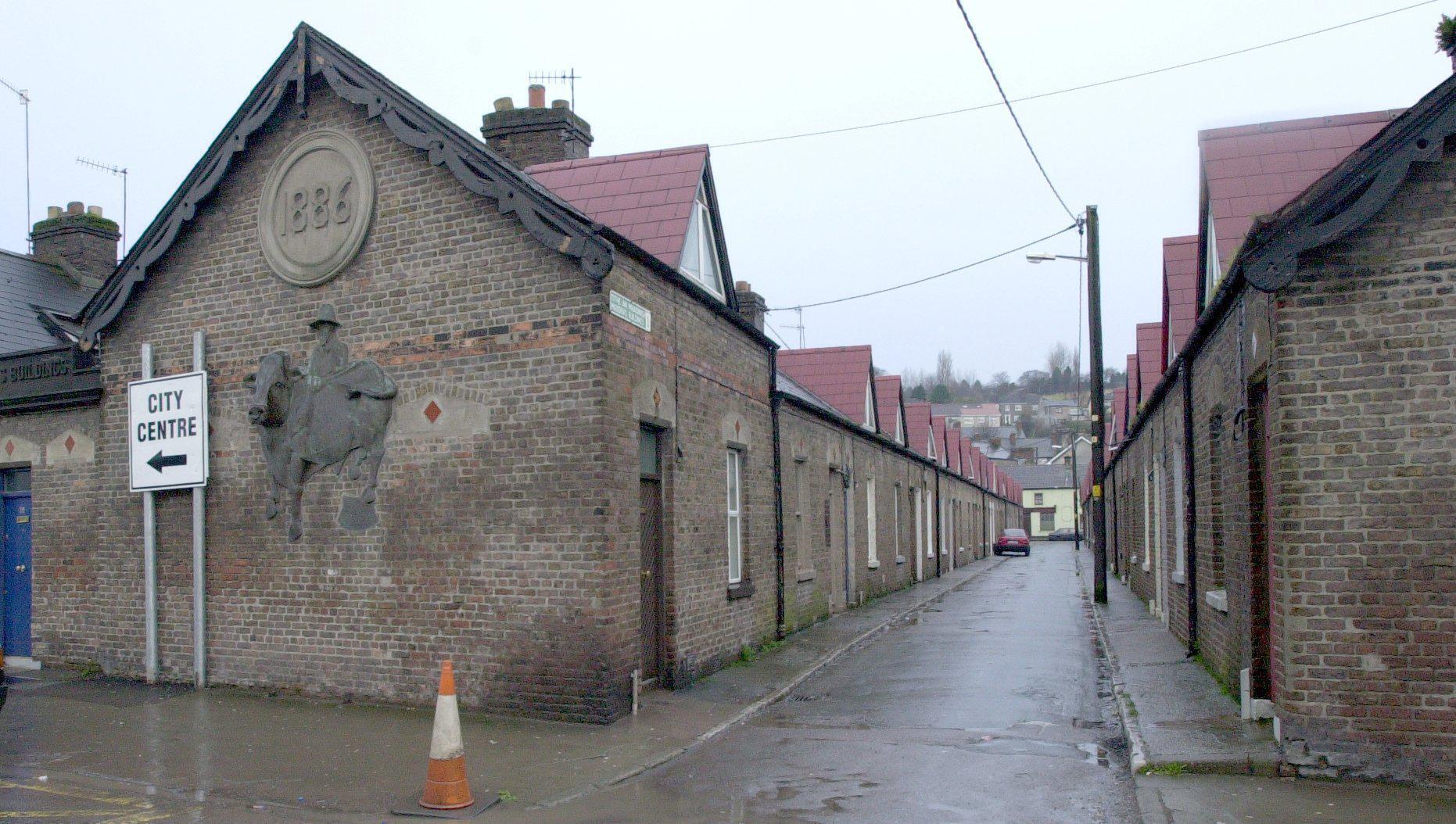
Madden’s Buildings are part of the National Inventory of Architectural Heritage, qualifying under the following categories of special interest: Architectural, Artistic, Historical, Social. So, why were the limestone kerbstones removed and where have they gone? File picture: Richard Mills
Greetings from the morning after the night before, or maybe a couple of mornings after.
I hope all readers enjoyed Culture Night last Friday: my own highlight included the Fleischmann Choir’s rendition of some Cork classics in the School of Music, an admirable display of ecumenism given the non-Leeside origins of at least one of the choristers well known to me.
One event I was sorry I missed — can’t be everywhere at once — was a walking tour of Blackpool conducted by a good friend of this column, Diarmuid O’Donovan.
Among the highlights was a stop at Madden’s Buildings, where due recognition was given to one of that area’s most famous sons — Denis Coughlan, who passed away recently. One of the greatest Gaelic games stars of all time and a gentleman to his fingertips, Coughlan grew up in Madden’s Buildings and its footpaths and roadways were well known to him.
He might have been unimpressed with recent developments there, however. Many thanks to the reader who got in touch to point out that the footpaths on one of the roadways have been ripped out and replaced.
There is absolutely a world in which such work would meet with most people’s approval. The quality of the city’s walkways is variable, to put it no stronger than that, and any development which would improve accessibility for all, and particularly those with mobility challenges, would be welcome.
It is difficult to see if that is the case with the work being done here — the new footpath looks no more accessible than what it has replaced — but that’s not the most important point. The footpaths which were removed were eye-catching holdovers from the old days.
That’s no exaggeration. Madden’s Buildings are part of the National Inventory of Architectural Heritage: registration no. 20862041 in the regional section, qualifying under the following categories of special interest: Architectural, Artistic, Historical, Social.
The full citation can be found on buildingsofireland.ie, but I’m happy to give you a flavour of it. Not so much the detail of when it was built and how much it cost (1886 and £5,846, respectively), but the reasons for its inclusion bear repeating here:
The descriptions focus on the dwellings themselves, naturally enough, but if you think that the footpaths are not part of the “detailing” or of the “original fabric or form”, think again.
Along with the citation’s reference to “pitched slate roofs with terracotta ridge tiles, red-brick corbelled chimneystacks and cast-iron gutters” we find: “Street-fronted with concrete footpath having limestone kerbstones”.
Now the limestone is gone from the footpaths which have been renovated.
This is not the only appearance in official records of Madden’s Buildings, by the way.
If you consult the Cork City Council document Built Heritage Objectives Part 1: Architectural Conservation Areas Draft Cork City Development Plan 2022-2028 you’ll also find Madden’s Buildings specifically named in the section headed ‘Existing Architectural Conservation Areas: Blackpool’.
This states: “The first example of modern social housing in Cork is found on the eastern side of the road in the form of Madden’s Buildings, which were built by Cork Corporation in 1886. These are an important part of Cork’s social heritage.”
Well, when we say "important" . . .
In the same draft plan, under ‘Elements of Built Heritage which contribute to the identity and sense of place’, I note the following: “Many non-structural elements such as curtilage features, historic gardens, stone walls, historic ironwork, plaques and street furniture (post boxes, horse troughs, mooring bollards and quayside features, historic ironwork, etc.) form an integral part of the urban landscape or provide significant historic references which contribute to the identity of the city and its hinterland. Cork City Council will seek to protect important elements of the built heritage and their settings as appropriate.”
Elements like limestone kerbstones, say?
The obvious question to ask here is this: why were those limestone kerbstones removed and where have they gone? They were in place up to recently and now they appear to have vanished, and the new footpaths don’t have anything similar in their place.
Hopefully the kerbstones are being kept in storage for reinstatement, though not in the same place where, say, the Fireman’s Rest was stored.
If so we could be waiting for over two decades before they see the light of day again, and that’s without mentioning an eye-watering bill to get them put back in place. Which includes a bill for filming that process, as in the case of the Rest.
The less obvious question is this: why take them out to begin with when they form a specific part of the citation in our National Inventory of Architectural Heritage?
I acknowledge here that I don’t live in Madden’s Buildings. Those using the footpaths on an everyday basis may have been looking for more user-friendly pavements on an ongoing basis for years. Time marches on and changes have to be made.
To this unpracticed eye the new footpath looks no better for walkers than the old one, but I acknowledge I am not an expert.
Is this a slippery slope, though? If they come for our kerbstones this week, is it the terracotta ridge tiles or the red brick corbelled chimney stacks next week?
Far be it from this architectural ignoramus to channel his inner Frank Lloyd Wright — or his outer F. L. W., come to that — but surely the whole point of having a register of historic buildings, or designating an architectural conservation area, is to be mindful of “attractive detailing” as well as the broader canvas.
If the peripheral parts can be removed so casually, it isn’t long before all the parts become peripheral. Or there isn’t anything left at all to remove.
I don’t like to bring it up — correction, I to bring it up — but it’s not so long since this specific part of the city lost one of the last green spaces nearby, one that backed on to Madden’s Buildings: the trees and grassy area in front of the old fire brigade substation that is right next to the two rows of houses.
On that occasion it was apparently impossible to save the trees so they were removed; whatever afflicted them was so potent that grass, weeds, flowers, turf, and mud all had to go as well.
Perhaps something similar affected the kerbstones. Maybe they were in such a bad way that they, too, had to be whisked away.
I recall at the time a statement from the city council outlining the great work done with trees in other parts of the city. Maybe that’s the answer: leave Blackpool, go to the vast tree plantations of Killeens and Tramore Valley Park.
While you’re there admire the limestone kerbstones stored nearby, and then go home again.

CONNECT WITH US TODAY



Be the first to know the latest news and updates