'There is a very real possibility that she could be put out to tender after we die'
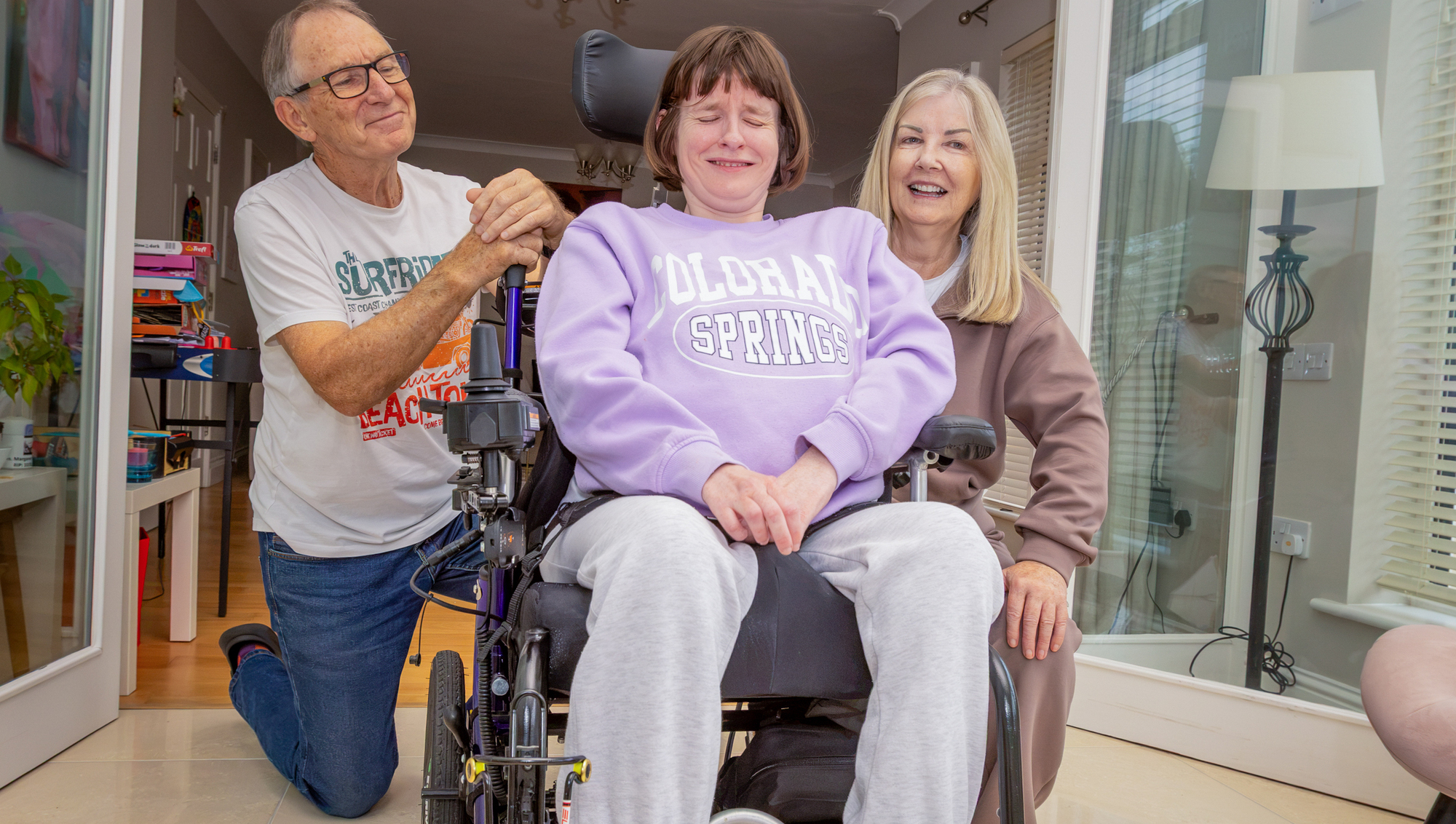
Before We Die campaign members Gerard and Catherine Hennessy with their 38-year-old daughter Kelly, at their specially adapted home in Midleton, Co Cork. Picture: Neil Michael.
Gerard Hennessy from Midleton sees joining Before We Die as a good way to put pressure on the Government to finance a plan for the future of residential care for adults with intellectual disabilities, like his daughter Kelly.
It also gives him a sense of solidarity with thousands of other parents like him around the country who worry what will happen to their children after they die.
But the 72-year-old retired teacher, and blood cancer survivor, admits there is a downside.
“As carers, we can be accused of putting our heads in the sand,” he says.
“I see it differently, as a certain amount of denial was probably necessary, to survive.
“If we had fully confronted everything that was happening to our family at the time, I am not sure we would have been able to put one foot in front of the other.
“Being involved with the BWD campaign has had mixed feelings for me.
“I think I'm normally hardnosed and pragmatic but I have found myself getting quite emotional recently and it seems to come out of the blue.
“I've discovered I'm not the only one. Facing reality can be liberating, but it can also be painful.
Of the struggles he and his wife Catherine, 68, have had over the years, he is reluctant to dwell on them.
At best, he says there have been “occasions where we have had to tell each other to just get it together”.
“Our lives now are all about strategising, if you call it that. Any going or coming when Kelly is not here has to be done in four hours.
“Timing is foremost — we always ask ourselves: how long can we stay wherever we might need to be?
“We could be invited to a family gathering, but we will ask ourselves how long we can be there?”
Read More
Kelly, who is the youngest of the couple’s two daughters, was born 10 years after they married in 1978.
A few months later, she was diagnosed with cerebral palsy. Gerard remembers that day well.
He was building what is today their family home, but they were staying in another property nearby as the work was being carried out.
“When we came back from the doctor that day with the diagnosis, I came down here to work and to be honest about it, I spent I don't know how many hours — I can't remember now — just sitting,” he recalls.
“I know the same spot. It's in the hallway here. There's a radiator there now.
“I sat there on the ground with my back against the wall, and I honestly don't know what actually was going through my head.
“I spent hours sitting there but I eventually just got up and, you know? I just had to get on with it.”
He adds: “But no matter how normal you think you can play it to the outside world, it's only really in the last few years of talking about it that I can say — no, things haven’t been ‘normal’.”
He describes the death of his teenage son Stephen — Kelly’s older brother — as being the hardest thing he has ever had to deal with in his life.
Like Kelly, Stephen was diagnosed with cerebral palsy a few months after he was born in 1982.
Gerard recalls: “We probably had suspicions at around eight months.
“You know, when you go for those checks, and he wasn't making those early milestones.”
His death at 17 from skin cancer was unrelated to his diagnosis.
“He had a very rare form of melanoma, which meant it went undiagnosed for quite a while, and it was eventually diagnosed.
“It started in his back, his shoulder blade, like a little black spot.
“But it very quickly metastasised, and he had it in his liver and in his lungs. They gave him 12 months at best, and he lived for 13 months.”
He adds: “It doesn't matter whether they have disabilities or anything. They are your child, your flesh and blood.
“When we think about it, we still see it as the worst experience of our lives.”
He and Catherine decided to join BWD after they heard about a couple who could no longer care for their adult child with intellectual disabilities and they put them into a nursing home.
“Hearing that shocked us,” he says. “We would never want Kelly to be put into a nursing home after we die.
“So, we asked what would happen if either one or both of us were no longer able to care for her.
“My understanding is that what gets picked is the cheapest bid, and it could be anywhere in the country.”
Catherine, whose care of her daughter Kelly and Stephen has led to debilitating and agonising spinal and neck injuries, says she also finds the process “insulting and disrespectful” to parents as well as their children.
“Everybody knows we're not going to be here forever and plans have to be put in place,” she says.
“We're dealing with vulnerable people that will need to transition from a home in an environment where they have friends and associations they have had all their lives.”
Gerard says: “You can't just decide, no matter what plan you've got, to just pluck them out of where they have lived all their lives and put them somewhere else.
“It has to be in their community, and places where they're used to going around and meeting. Kelly knows she's very well known in the area.
“She likes going for a cup of coffee and a cup of tea, and she likes going to the pub on a Sunday afternoon.
“If the plan was right, she would need at some stage to move from here to a place where her friends are.
“There'd be very little trauma involved in it.”
He pauses, and then adds: “When we were younger, we worked away, we struggled at times, but other times we had a great life.
“But now, I'm afraid I'm a little bit preoccupied with what's coming down the road fairly soon. There is a very real possibility that she could, in effect, be put out to tender after we die.
“This is possibly her future if something goes wrong here in the house.
“Catherine and I are of an age now where these things are staring us in the face. You just think differently when you get to our age.”
CONNECT WITH US TODAY



Be the first to know the latest news and updates