Linda Kelly: New ASTI chief warns teachers’ voices cannot be ignored as strike looms

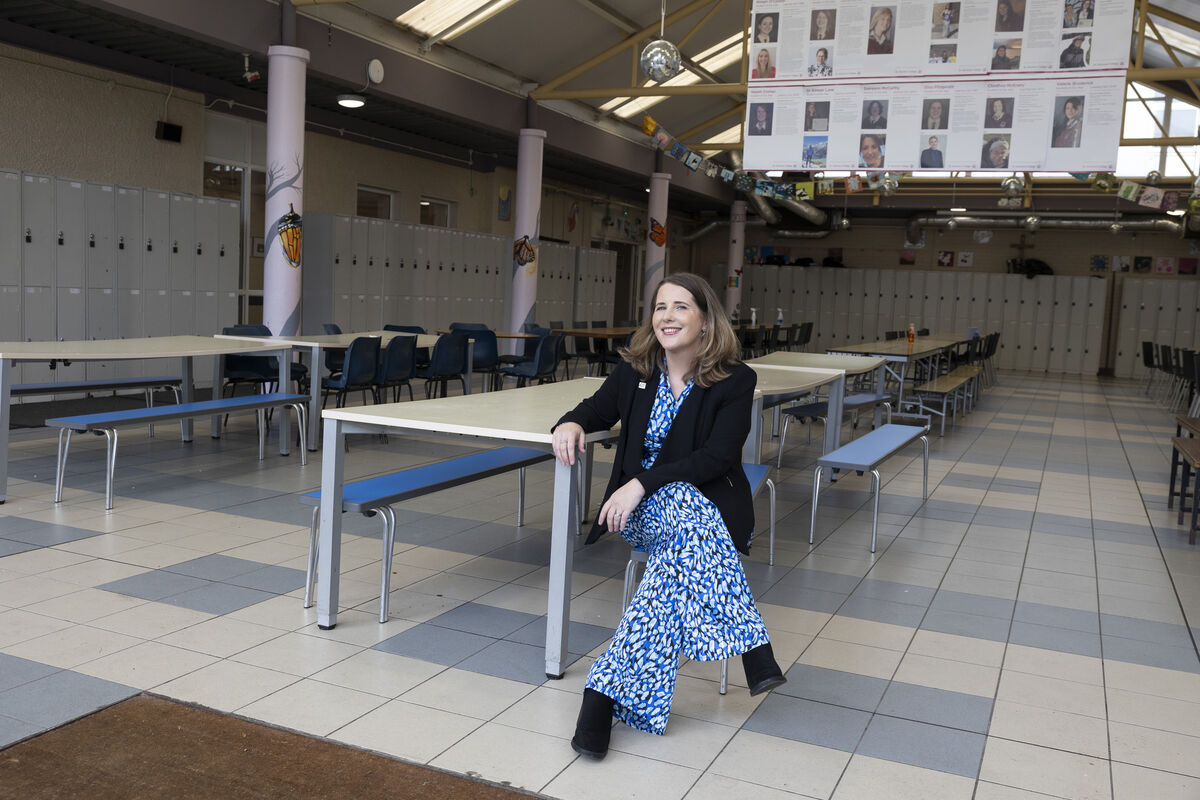
ASTI general secretary Linda Kelly, second left, addressing teachers at her former secondary school, St Aloysius College in Carrigtwohill, Cork, on Monday. Pictures: Clare Keogh
The last time Linda Kelly visited her secondary school in Carrigtwohill, it was to collect her Leaving Cert results.
She returned this week, 22 years later, having taken up one of the most powerful roles in Irish education, and with teachers on the cusp of major industrial action.
At St Aloysius’ College, Carrigtwohill, the new general secretary of the Association of Secondary Teachers Ireland (ASTI) met students and teachers, many of them members of the union she now leads.
Ms Kelly, from Banduff Road, graduated from St Als in 2004. She takes up the role at the helm of the ASTI following the retirement of Kieran Christie, who served as the union's general secretary for more than a decade.
Ms Kelly is also one of the youngest women in Irish history to lead a major trade union, and she begins to do so at a crucial juncture, not just for teaching but for the entire public service.
Her visit to the school on Monday marked World Teachers' Day.
It also came as the ASTI began its campaign of industrial action with a work-to-rule, joining 100,000 public sector workers in an ongoing dispute on pay.
Later in the week, as part of Budget 2027, public expenditure minister Jack Chambers would announce €1.2bn has been allocated for a new public sector pay deal.
He called on unions affiliated with the Irish Congress of Trade Unions (Ictu) to re-engage in pay talks “as a matter of urgency” and stand down industrial action.
Of its 19 affiliated unions, 17 are poised for strike this Wednesday, including the ASTI, the Irish National Teachers' Organisation (INTO), and the Teachers' Union of Ireland (TUI).
On Thursday, Ms Kelly told the ASTI’s 20,000 members the €1.2bn allocation “does not suggest the Government is prepared to negotiate a deal that teachers could consider credible in current circumstances”.
Read More
Pickets are currently planned to be placed outside schools for two days this month, October 14 and October 21.
Having studied speech and language therapy at University College Cork (UCC), before joining the Union of Students Ireland (now AMLE), Ms Kelly does not come from a teaching background.
It’s not unusual in the history of the ASTI as a union, but it is a change from more recent times. She joins from Fórsa, where she co-led the union’s health and welfare division, representing 34,000 union members across 33 branches countrywide.
In 2022, she was named among the ’s ‘100 Women Changing Ireland’ in recognition of her work highlighting the impact of covid-19 restrictions on maternity services during the pandemic.
“It’s definitely a trip down memory lane,” she says of her visit back to her former school.
“I feel really, really grateful for the education I got in this school. I was the first in my family to go to college, and that was really down to my mom’s influence. My mom really valued education, but also the education I received in this school, and the personal development as well.”
However, she believes we run the risk of becoming complacent about the value of education in society.
“It’s not being paid enough attention in terms of investment from Government, across all levels, but particularly at second level,” she says.
“I think there is this idea that because so many people go to college, everything must be okay. It’s a metric, and it’s a valuable metric, but we also need to be looking at the quality of education and the impact that education is having.”
Ireland may still be doing really well in international tests, but we have still seen a dip.
Recent results from the Programme for International Student Assessment (Pisa) found Irish teenagers are achieving significantly lower scores in reading and maths than a decade ago, even though they remain among the best in the world at reading, and comparatively strong in maths.
This is an achievement Ireland held on to despite lower test scores and an overall drastic drop internationally.
Ms Kelly says: "We haven’t fallen as far as other countries, but we have fallen compared to our own standard, and we should ask questions about that.
"Certainly, the feedback from our members who are in schools every day is that it's initiative overload, it's change all the time. I think there does need to be a focus on that.”
One of three key issues she will be focusing on through her time with the ASTI is ensuring the voice of teachers is "given the focus that it is due" in discussions around curriculum reform, redevelopment, and in the development of other major policies.
"Ultimately, our teachers are making up the bones of the education system, and you can see from the results coming through from PISA and the OECD, they are doing an incredible job despite under-resourcing, despite a lack of investment, they are getting incredible results for the country and for our society.
"If I could do anything, really, over anything else, I’d like us to get back to a point of remembering that education is a core public service, that it deserves that status, and particularly at second-level.
It's so transformative to the development of young people, into the people they are going to be. That recognition and status have fallen away from second-level education, in particular, and from education as a whole.
As previously reported by the Irish Examiner, major changes to Leaving Cert maths and English have been delayed until at least 2028.
It comes after concerns about the reform process were highlighted by expert members who resigned from subject redevelopment groups, led by the National Council for Curriculum and Assessment (NCCA).
But those who follow developments in Irish education closely will know this was not the first time concerns have been raised about the Leaving Cert reform process.
Second-level teachers have been raising concerns about aspects of this major overhaul consistently, and ASTI members have voiced concerns about the redevelopment process as far back as 2021.
When asked about this, Ms Kelly says: “I do think there is a dynamic where a teacher's voice isn’t taken as seriously, and I do think there’s a dynamic at play whereby people dismiss the ASTI concerns as you know ‘well that union is always complaining’ and I think both of those are really unfair.
“There is a need for reflection on the part of the Department [of Education] and the NCCA around their attitude to that.
"When the ASTI speaks, they are speaking on behalf of a significant majority of teachers. They are doing so through the representative structures, and that is coming directly from teachers on the ground.
"What we see now is that when issues are coming through, people are looking at it and going ‘well, actually the ASTI said that a couple of months ago’ and until it's amplified by someone else, it’s not necessarily given the due importance it deserves.
"That’s certainly something in terms of my tenure that I’ll be ensuring, that the voice of ASTI members cannot be ignored.”
Other important issues for her include pay and conditions.
There are also other aspects of terms and conditions she wants to focus on, mainly parental leave entitlements for teachers.
"Teachers are one of the only groups of public sector workers who can’t access their parental leave on a day-a-week basis. That’s not something that can actually happen at the moment."
She also wants to see a focus on special education.
“There are developments needed in that area so that teachers can build the inclusive education system that everybody wants. Now is a really important time for that. There’s a policy focus on it in the programme for government, but it has to be grounded in the reality of what teachers need in order to be able to implement those lofty policy ideas of an inclusive education system for all.
"I’m very keen to make sure that is an area where the ASTI is leading in terms of the development of that inclusive education system and what it means for teachers.”
The unions remain locked in a stand-off with the Government over pay.
What does she think it will take to break the deadlock and get the unions to enter talks to negotiate a new pay deal?
“There has to be a move away from the austerity mindset that is very much there within the Department of Public Expenditure," she says.
"In the very short term, there needs to be a reckoning from Government that public sector pay this year, just in 2026 alone, is behind inflation.
"Any deal has to be predicated on the cost of living being addressed.
She added the ASTI members voted by 95% to take industrial action, up to and including strike action.
"There is a real common purpose amongst members to pursue a better pay deal than what they’ve been getting for the last couple of years.
"Everyone who is connected to the public sector understands why people are taking this action, and I think they see the broad unfairness in the fact that pay has fallen behind inflation quite significantly this year for public servants.”
CONNECT WITH US TODAY



Be the first to know the latest news and updates