Former Air Corps member's long court battle for 13,500 documents on chemicals he was exposed to
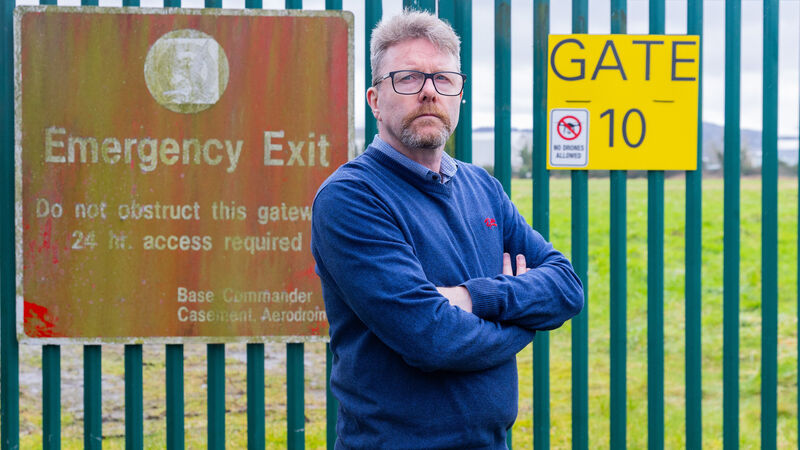
Gavin Tobin: 'A huge number of documents were utter junk.' Photo: Gareth Chaney
If Gavin Tobin wondered if the Air Corps would ever co-operate with his legal requests for data on the chemicals he and other personnel were exposed to, he didn’t wonder for long.
It took him more than 10 years, two High Court cases, and a Supreme Court judgment in his favour before he got any documents. The documents are not just relevant to his own case but for anybody also fighting the Air Corps and who shares his lawyer, Denis Bolland of PV Bolland Solicitors.
When the papers finally started arriving, the first tranche was “utter junk”. “I launched my case in November 2013,” recalls the former Air Corps air technician, who served from 1989 to 1999.
“But as part of my court case, I asked what I had been exposed to, but an Air Corps officer said it would take too long to get the full list. So I took and won a High Court case that was heard in 2016.
Read More
"As a result, the Air Corps was supposed to give me all safety data sheets for all chemicals used by the Air Corps from 1990 to 1999. But they appealed, and won and then I took my case to the Supreme Court and it ruled in my favour with a unanimous 5-0 verdict delivered in July 2019.”
While in the Air Corps, Mr Tobin maintains that he was — like so many other men — exposed to a wide variety of chemicals.
He worked in a specialised technical unit known as engine repair flight (ERF), which was responsible for aircraft engine overhaul. He was exposed to industrial solvents trichloroethylene TCE, dichloromethane DCM, and cresylic acid.
He worked in the basic flight training school from September to November 1991, where he helped maintain the Marchetti light aircraft. He says he was exposed to leaded gasoline fumes as well as piston engine oil and grease.
While serving there, he would be working while other men spray-painted aircraft nearby.
When he served in the light strike squadron, working on the 1950s French two‑seat jet trainer aircraft the Fouga Magister, between December 1991 and February 1992, he was also exposed to Jet A‑1 fuel, hydraulic fluid, turbine‑engine oil, and industrial greases.
While working on the government jets in the transport and training squadron from March to May 1992, he believes he was exposed to more fumes from fuel, hydraulic fluids, and greases.
“In all locations I would also have been exposed to corrosion inhibitors and a lot of exhaust gasses too,” recalls Mr Tobin.
“I do remember one pair of communal goggles, one communal apron, and one pair of communal gloves in ERF. But the goggles and apron were so dirty you would get contaminated just putting them on.
“I do recall one instance using the gloves and as I reached into the bottom of the Ardrox 666 tank, I felt my arms go cold as the gloves filled up. I immediately dashed 20m-30m to the wash area to wash the chemical off my arms.
“Basically, if two people were on the same job, there was only one pair of gloves and one set of the manky apron and goggles that were like something out of a movie,” he says, referring to the 1986 British sci-fi film.
Mr Tobin's jubilation after the Supreme Court ruling was short-lived as the Air Corps turned round and said they couldn’t release the documents due to covid-19 restrictions. In the end, he had to take another High Court case to compel the Air Corps to abide by the Supreme Court ruling.
The night before the case was due to be heard, the Air Corps delivered 2,500 pages. The hearing got put back, and Mr Tobin was able to spend months sorting out the documents, only to discover the documents were in effect junk.
Although it gave him what appeared to be hundreds of chemical transaction listings from the Air Corps computer section, there were so many duplicated pages that he only received details of 17 chemicals.
All of the chemicals listed began with the letter 'A', which meant that according to the records he was given, the Air Corps had apparently only used chemicals beginning with 'A' from 1990 to 1994 — and had never used any whose names started with B, C, D, E, or any other letter.
Mr Tobin said: “I was also given a copy of an 800‑page document called the Defence Forces Safety Standards (DFSS) from 1994, but the chapter on 'Aircraft Maintenance Workshops' was blank.”
Despite this, Mr Tobin managed to obtain an intact version of the DFSS, which included two pages of chemical listings.
He used optical character recognition (OCR) software to compare the intact copy of DFSS he had with the one the Air Corps had given him, and discovered the Air Corps had hidden the pages in different unrelated chapters.
“So, they gave it to me but didn’t give it to me,” he said.
“So I took them to the High Court in February 2023 and the Air Corps were found to be in breach of my 2019 Supreme Court order.”
Some nine months later, Mr Tobin received 13,500 pages of documents. About 4,500 were blank. It took him two months to read the remaining 8,000 pages.
“A huge number of documents were utter junk about fixing urinals in Avionics, fixing a wall in main tech stores, and fixing the roof of the NCOs' (non-commissioned officers) mess,” he says.
“But while a lot of it was utter, unrelated shite, there was some gold that will haunt the Air Corps in the courts in time.”
The State Claims Agency has been asked a number of times about the way it has treated Air Corps litigants, including Gary Coll — whose case the SCA settled for €2m last year — and Gavin Tobin.
While it says it does not comment on individual cases, it stated: “In performing its functions, the SCA seeks to act fairly, ethically, and sensitively in dealing with people who have suffered injuries.”


CONNECT WITH US TODAY



Be the first to know the latest news and updates