Paul Hosford: For much of the public, the EU presidency will bring nothing but disruption
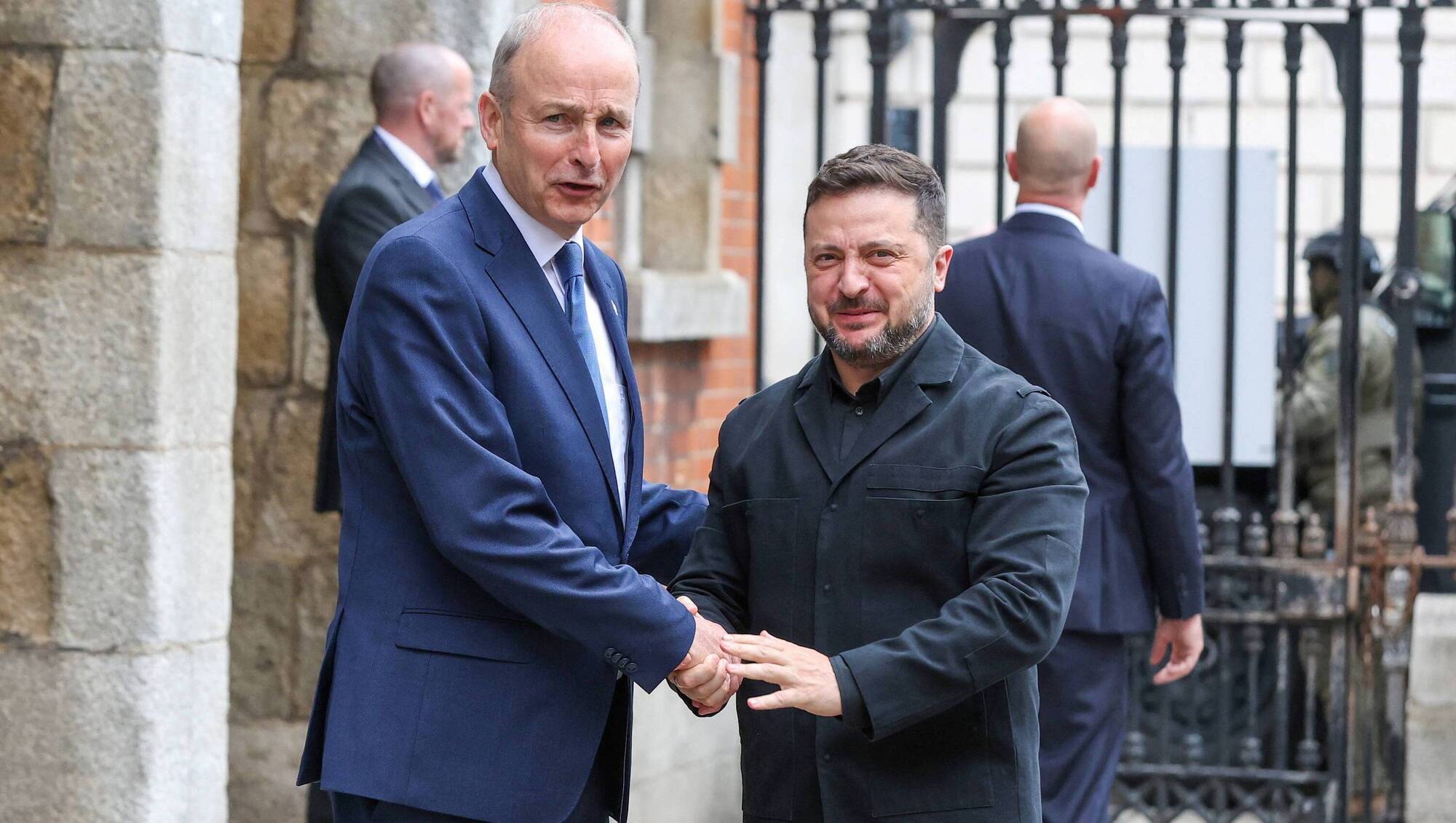
Taoiseach Micheal Martin welcomes Ukraine's President Volodymyr Zelensky as he arrives ahead of a formal ceremony to mark the launch of Ireland's eighth EU presidency, at Dublin Castle. Photo by Paul Faith / POOL / AFP via Getty Images
If you felt the crackle of anticipation as you awoke on Wednesday, you are not alone.
Like Christmas in July, better than any World Cup qualification, a moment of true national unity.
From Beara to Achill, from Dublin to Galway, people celebrated. On the Walkinstown roundabout, they waved flags.
Not just any Wednesday, this was the day that Ireland took over the EU presidency.
Ok, so it wasn't like that, really.
But across the next six months, more than 270 events will take place across the country, as Ireland chairs most meetings of the EU Council, sets its work programme, and acts as its representative.
Ireland's presidency will focus on: "Competitiveness — fostering prosperity and wellbeing; values — upholding the indispensable foundation of our Union; security — protecting our citizens".
While the symbolic handover from Cyprus had taken place a few weeks ago, Ireland's official tenure did not begin until Wednesday, and president of the European Council Antonio Costa was on hand to represent the EU, though the sharp-dressed former prime minister of Portugal and his travelling contingent, which included 60 journalists, saw proceedings pushed back as his Ryanair flight from Brussels was delayed by 40 minutes.
Mr Costa's arrival at Government Buildings saw a quick meeting with Taoiseach Micheál Martin before a press conference gave Irish journalists a taste of what's to come this summer — pooling.
In most Irish settings, questions to the Taoiseach or his Cabinet colleagues are loose arrangements, with questions peppered from across the horseshoe of media representatives.
Under the watchful eye of the EU presidency and its Irish staff, however, things become more formal and restricted, questions pooled and shared out — two for Irish media, two for those who had travelled from the Belgian capital — with journalists deciding amongst themselves who asks and what.
That level of formality speaks to one of the more tangible facts of the presidency for the Irish media — this isn't business as usual.
Last week, when EU foreign policy chief Kaja Kallas came to the capital, she was hosted in the Dublin Castle.
On the walk to the media centre, tourists could be heard asking gardaí for access to the attraction, only to be told that their plans would have to wait until next year as the castle will remain closed to the public until December 31.
For much of the public, that will be their primary experience of the EU presidency — disruption.
Read More
In Cork on Thursday, the EU's College of Commissioners will arrive and bring with it rolling road closures and motorcycle escorts.
In Dublin, streets around Dublin Castle are to be shut for months.
Drone restrictions are in place.
Concern over drones had been raised after a report of an unidentified, unmanned craft in Irish skies when Ukrainian president Volodymyr Zelenskyy visited Ireland in December, and Mr Zelenskyy was a guest of honour in Dublin on Wednesday.
Despite being some way off EU accession, much is made of Ukraine's joining of the EU bloc, a stated goal of both sides.
The Taoiseach suggested on radio on Wednesday that joining could happen even while war with Russia rages on, and Mr Zelenskyy did not use his guest status to be silent.
At the official opening ceremony, he said that Ireland's probe into the Limerick-based plant Aughinish Alumina’s exports to Russia for use in its war effort must not take months and that “every tonne” of raw material that ends up in Russia is used against Ukraine.
The presidency will dominate much of the political and media bubble for the next six months — RTÉ's hosting of a special programme at lunchtime on a Wednesday is just an example — but Mr Zelenskyy's presence, and that of protesters on Dame St as the official ceremony took place, is a reminder that the EU's functions take place against the backdrop of a world in flux.
This will be the eighth time Ireland has led the EU Council since 1973, last holding the presidency in 2013, and that means that many experienced civil servants won't have worked during one.
While the holding of the presidency is unlikely to capture the public imagination, it has increased the workload for them and pulling off a successful six-month presidency is no mean feat, and their efforts are to be applauded.
But just how much the work of the EU — whether Ireland has the chair or not — is noticed as it plays out by the public at large is probably encapsulated by Wednesday's pomp and ceremony, all carried out while Dubliners got on with their day.


CONNECT WITH US TODAY



Be the first to know the latest news and updates