Establishment of 24-hour adoration is 'a real sign of hope' for the church, says Cork bishop
Members of the perpetual Eucharistic Adoration group at St Peter and Paul's Church. Cork. Picture: David Creedon
The Bishop of Cork and Ross has described the establishment of 24-hour Eucharistic adoration for the first time in Cork city as “a real sign of hope” for the church.
Fintan Gavin said the fact that dozens of lay people have volunteered their time to ensure that people can now pray before the consecrated and exposed Eucharist at any time of the day or night, seven days a week, in the heart of the city, is “wonderful blessing for the city”.

“Adoration is very much a personal encounter with Jesus, rather than a cultural thing as has tended to have been the case in Ireland in the past,” he said.
“It’s where people make a personal commitment, it’s a conscious decision on their part, and part of the challenge for me, for bishops, as spiritual leaders of faith communities, is to find ways to support that choice. And I have had great support in that here in Cork.
Eucharistic adoration is a Catholic devotion where the consecrated Eucharist, or Blessed Sacrament, is exposed for worship and prayer in the belief that Jesus is “truly present” in the Eucharist.
It can involve the Eucharist being placed in a closed tabernacle but more commonly, it is exposed to the faithful in a monstrance. It is popular in big US parishes, and there are adoration chapels around the country open for set hours, some days of the week. It is also live-streamed in some cases.
However, it is believed that this is the first time that 24-hour, or perpetual adoration, has been made available in an Irish city.
A large team of volunteers signed up to help make it happen, and they are being coordinated by a 28-strong committee.
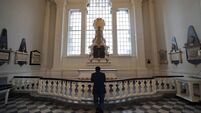
It means that perpetual adoration is now available from 8am to 8pm in St Peter and Paul's Church, just off St Patrick’s Street, and in the Dominican Church at St Mary's on Pope's Quay from 8pm, running right through the night.
Volunteers are on hand at all times. Access to the night-time chapel is controlled via a fob, with security systems and procedures in place.
Bishop Gavin has attended several times for personal prayer and said he has been struck by the variety of people there.
“There are people from all walks of life, and sometimes it’s been hard to get a seat," he said.
He said he himself has prayed for guidance on the concrete challenges facing the diocese day to day, but also in relation to the bigger challenges facing society and the world.
“I have to be in touch with God, with Jesus. If I'm not, I have nothing to add to people," he said.
“There is a solidarity in people praying together.
“In a world of noise, this reminds us that there is another way and the answer is often in silence.
“In a world of frantic busy-ness, it is a reminder and a witness to slowing down."
He paid tribute to the volunteers but especially to the late Willie Walsh, from Carrigaline, who encouraged the diocese to establish perpetual prayer.
Ann Keating chairs the Cork and Ross Adoration Committee, which arranges the volunteers' roster.
“Last year we gave presentations at different masses including all the Polish and Brazilian Masses. After the presentations, we had 600 people who signed cards committing to an hour of adoration a week,” she said.

Aine Lee, aged26, is among the volunteers.
“I find it incredible that we have 24-hour Eucharistic adoration in Cork city,” she said.
“It is so amazing that I can pop into the chapel at any point of the day or night to spend some time with Jesus who is truly present in the Blessed Sacrament. What a blessing.”
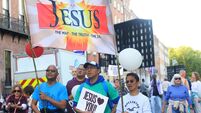
Meanwhile, the 99th staging of the city's historic Eucharistic procession takes place on Sunday, leaving from the Cathedral of Saint Mary and Saint Anne at 3pm.
The procession will be led by the Butter Exchange Band who have led it since 1926.
Thanks to increasing attendance since its post covid rejuvenation, its final prayers are being held outdoors again.
The event will culminate with final prayers and benediction on the Grand Parade, where a specially constructed platform and altar will be built.
A new radio frequency will be used to transmit the event to participants on the route, and to those who are overseas, in hospital or housebound, allowing them to listen in.
The first Corpus Christi procession took place on June 6, 1926, as part of wider efforts to heal the divisions of the War of Independence and the Civil War.
Some 4,000 people participated last year.