Cormac O'Keeffe: Drugs 'decriminalisation' call grabs headlines
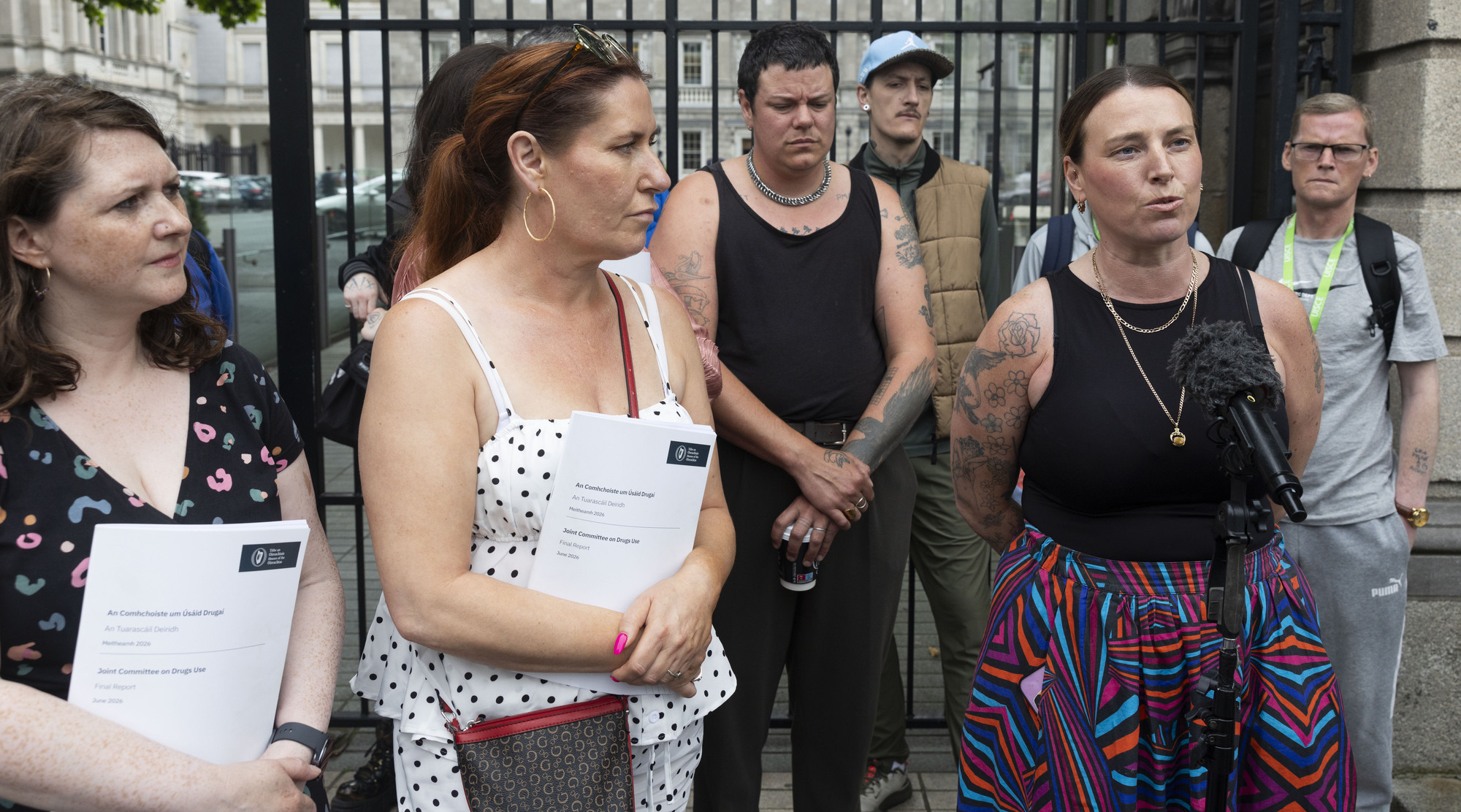
Senator Lynn Ruane (second from right) outside Leinster House after an Oireachtas committee recommended the decriminalisation of possession of all drugs for personal use. Photo: SAM BOAL/Collins Photos
It is annoying for politicians when they see their detailed work over nine months boiled down to one word: “decriminalisation”.
But it was clear attending the launch of the report of the Oireachtas Drugs Committee that there was a sense of occasion — and, in some quarters, celebration — with their most dramatic of recommendations.
Calling for the decriminalisation of the possession of drugs for personal use — by repealing Section 3 of the Misuse of Drugs Act — is bound to get the headlines. Such is the nature of things.
This is particularly so with the media, not least because the bulk of them did not cover the wide range of topics covered by the committee.
The did cover them, as it did during all the sessions of the Citizens’ Assembly on Drugs (CAD), which sat in 2023 and reported in January 2024.
It has been clear since the CAD recommendations and the interim report of the first Oireachtas drugs committee, and the hearings of the current committee, the direction things were heading.
Even still, the fact that the decriminalisation recommendation was an agreed one within the committee — reflecting full cross-party support — cannot be ignored by the Government.
This was demonstrated publicly on Wednesday with former Fianna Fáil TD, Senator Mary Fitzpatrick, and Fine Gael TD, and former drugs minister, Colm Burke, speaking very strongly about the need for change at the report launch.
The Government now has to give its response to recommendations of the Oireachtas committee and the CAD and hold a debate.
First, let's have a quick look at some of other 161 recommendations in the 134-page report.
Throughout the many pages of recommendations, the committee tells the Government, and powerful departments and state agencies, that they must restore and strengthen the role of community drug groups and the local drug and alcohol task forces.
Recommendations urge “significant investment” in community organisations and supports for families of users — families that endure unbearable trauma over their loved ones’ addiction and the drug debt violence and intimidation that typically comes with that.
Moreover, the report says these community groups must have a formal role in advisory and decision-making bodies — unravelling the power that has been increasingly centralised in the Department of Health and HSE.
These groups, along with family resource centres, must have “ring-fenced, multi-annual budgets” to plan and do their work, the committee urges.
Task forces, which have also suffered in recent years, must be “co-decision makers” in deciding budgets and should be “at the centre” of designing responses and overseeing implementation.
Similar recommendations apply to youth services — with one recommendation stating that strengthening youth work should be a “cornerstone” of prevention and early intervention. More supports for schools, and a much greater emphasis on prevention, are urged.
Recommendations stress the need to tackle root causes in disadvantaged communities — from poverty and inter-generational trauma, to the housing crisis and social exclusion.
Ensuring political priority, the report calls for a permanent Oireachtas Committee on Drugs and a “super junior” drugs minister.
But decriminalisation dominates the headlines.
In its January 2004 report, the CAD had left it to the Oireachtas and Government to decide if decriminalisation should happen on a de-jure (in law) or de-facto (effectively or in practice).
Under the comprehensive health-led approach it recommended, the possession of drugs “would remain illegal” in law, but, in practice, the possibility of criminal sanction would be “minimised” or “completely removed”.
The Oireachtas committee decided to go for decriminalisation in law, not in practice. This would be done by repealing the criminal offence entirely (Section 3).
The report said that while state agencies generally favoured retaining criminal sanctions alongside expanded diversion, that the "overwhelming majority" of civil society organisation, academics, legal experts and international witnesses it consulted argued that criminalisation itself contributes to harm, stigma and exclusion" — and that a genuinely health-led approach required decriminalisation.
The committee said the “vast body of evidence” it consulted said decriminalisation is “not likely” to result in an increase in consumption. It did say that some jurisdictions reported “an increase in drug consumption in public areas”.
It called on local authorities to “discourage and reduce consumption in public areas”, by using bye-laws they currently have to stop public drinking.
Asked by the for detail as to how this would work, committee member Senator Lynn Ruane said that, in addition to the use of these bye-laws, public drug use could also be reduced by providing people with “safe spaces to consume”, which, she said, could be done by providing legal drug consumption rooms.
The main reasons cited in the report for decriminalisation include the negative impact criminalisation has on users and their families and research indicating limited, if any, impact on use.
Asked by the if sufficient assessment had been made of the impact on communities most affected by the drugs trade by decriminalisation, committee chair, Gary Gannon said there were deeper issues of poverty and marginalisation in disadvantaged communities that the committee wanted addressed.
Ms Ruane said their recommendations were "completely grounded" in the communities most affected.
Given existing Government drug diversion policy, adopted almost seven years ago, has still not been introduced, there may be a long road, with many twists and turns, ahead.
CONNECT WITH US TODAY



Be the first to know the latest news and updates