The couple who cycled around the world and returned full of gratitude
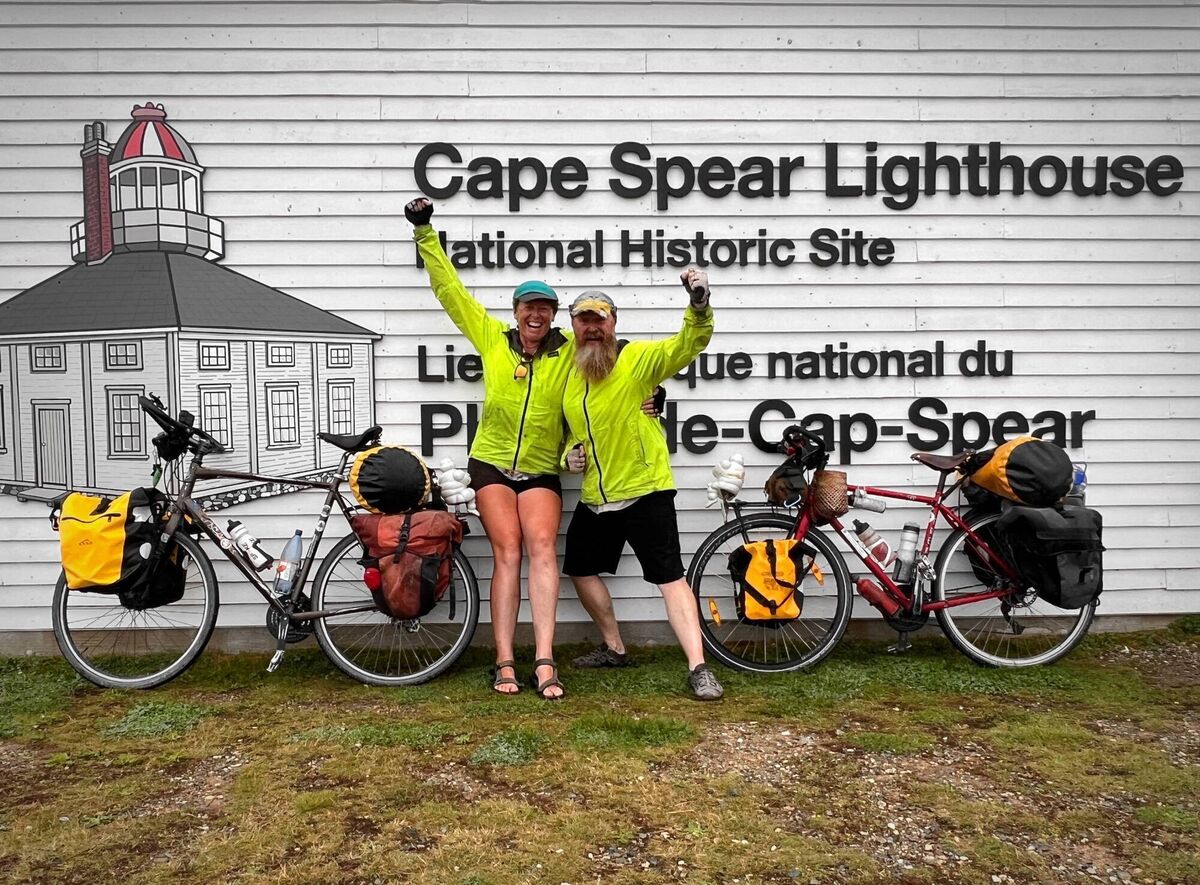
The easternmost point on the North American landmass should have been visible. But a blanket of mist and rain had descended over Cape Spear in Newfoundland, soaking us and obscuring our view of the Atlantic.
We were completely exhausted. As a steep hill kicked up ahead of us into what looked like a nearly impossible gradient, I felt, for a panicky moment, that I wasn’t going to make it.
That the third-last kilometre of the 31,509km we had cycled around the world was going to beat me and that I’d have to get off my bike and push.
I could sense Mark, with characteristic stoicism, digging deep alongside me to find the reserve of energy necessary to make the climb. I followed his lead. Hearts pounding, we crested the hill together, only to see more hills ahead of us.
My heart sank.
A blue pick-up truck pulled in and a man stuck his head out.
“I know it’s brutal, but you’ve got this,” he said in his musical Newfie accent. “And there’s a little group of people waiting for you at the top.”
He smiled, gave us the thumbs up, and drove off.
Fifteen minutes later, our bikes ground to a halt in the car park of Cape Spear lighthouse only for us to find a group of about 20 hardy people standing and cheering us in the rain.
Mark laughed in delight as a cardboard “Up the Déise” sign was shaken joyfully by the children of a fellow Tramore man who had lived in Newfoundland for years.
Laughter and greetings turned to tears in an emotional moment as I looked out towards where the Atlantic lay under its grey duvet.
Ireland was out there. Ireland, home, and our families.
Read More
Some 20 months after we set off from Tramore, Co Waterford, the only thing left to do was to fly over the Atlantic, get off the plane in Dublin Airport and cycle right back to our front door and we would have cycled around the world.
Circumnavigating the globe by bike had once been a crazy dream of ours, and it was hard to believe we had nearly accomplished it.
The UK’s Kyle and Amy Hudson set the official record for fastest married couple to cycle around the world in September of this year, when they returned home in a time of just 123 days.
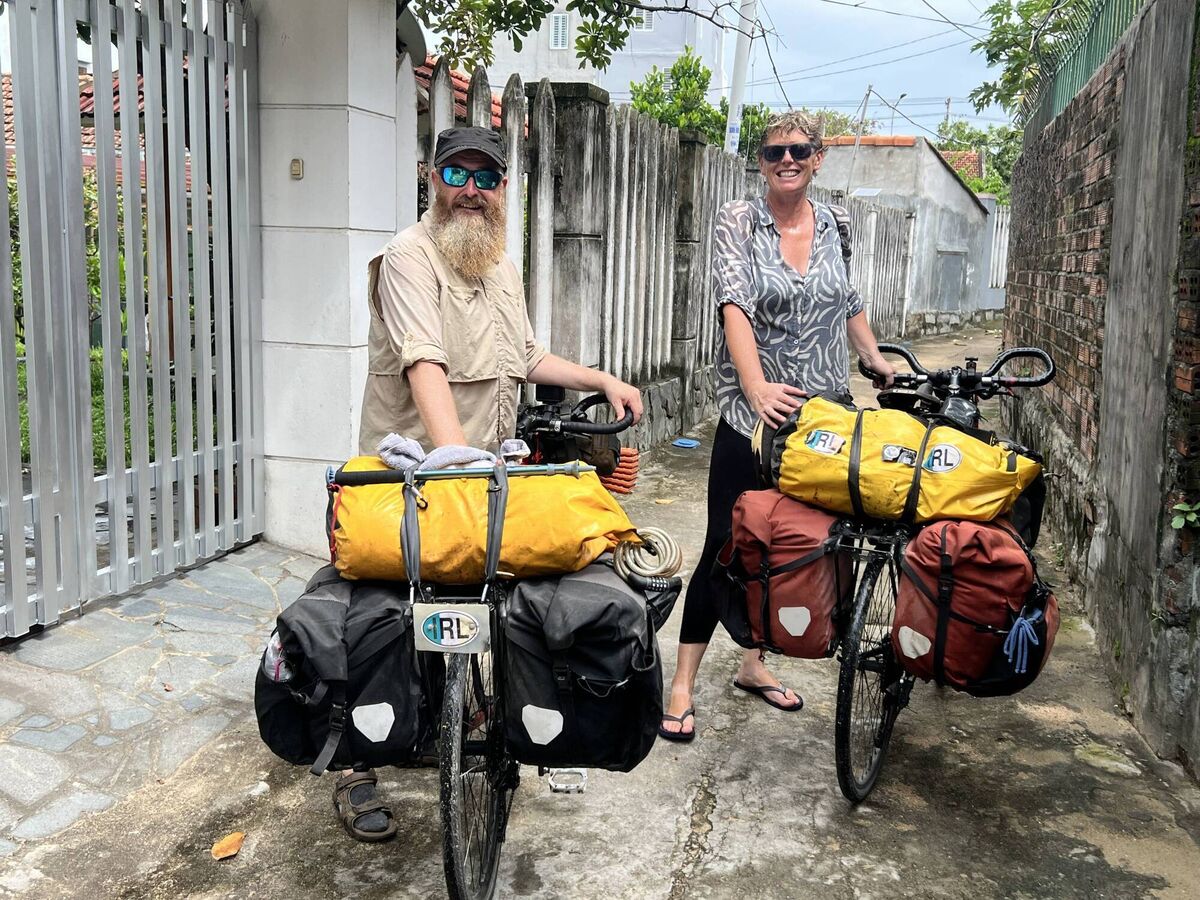
But Mark and I weren’t trying to set any sporting records. We were on a purely personal quest; we’re not athletes, or even particularly fit. We set out on our journey to see as much of this beautiful planet and its inhabitants as we could.
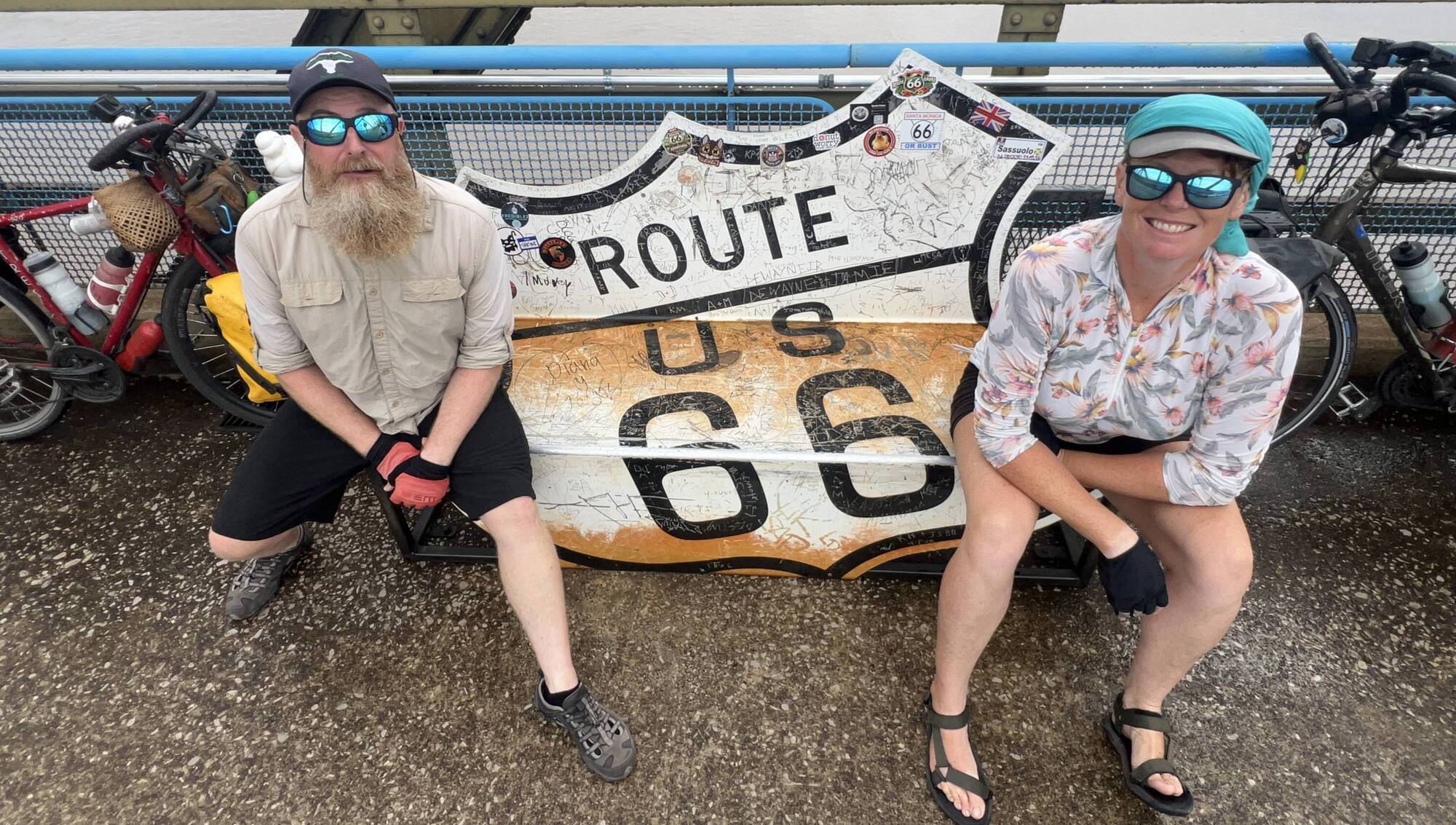
We had cycled through scorching deserts, snowy mountains, steaming jungles, and neon cityscapes. We had encountered bears, snakes, monkeys, and giant lizards. We had pedalled rutted muddy tracks, streets thronged with chaotic mopeds, abandoned Chinese superhighways, to half-built abandoned cities.
But I had one further challenge to face. The one I feared the most.
I had found a breast lump six weeks earlier, after we had cycled into New York. I had promised Mark, and myself, that as soon as we reached Cape Spear I would get it checked.
Europe was still engulfed in icy early spring when we set off on our adventure by taking the ferry from Rosslare to Cherbourg at the start of February 2025.
When I look back on those first few weeks of cycling now, what I remember is the giddy excitement: We had planned our world cycle for several years so there was an almost out-of-body feeling to be actually doing it.
“I can’t believe we’re really cycling around the world,” we called to each other as each new vista came into view and the low stone barns of French villages became the coloured wooden chapels of the Black Forest.
At a little German town called Donaueschingen, we came to what Mark dubbed “the Shannon Pot of the River Danube”, the place where the famous river bubbles out of the ground as a pristine spring.
Overlooking the spring, a statue of the goddess Baar, representing the spirit of the Black Forest, points the way to the young figure of the River Danube. “Flow east,” she instructs her daughter.
This was our route too, as we followed the river 1,300km to the Hungarian capital of Budapest before striking off across the Carpathian Mountains in Romania and down to the Black Sea coast in neighbouring Bulgaria.
It was a good thing we were so high on the thrill of cycling in those early months because it helped us overcome some of the challenges we faced.
The biggest of these were the cold and the aches and pains of our bodies trying to get used to cycling 80-100km per day. Unused to such heavy pannier bags on my bike, I had weeks of painful tendonitis in my wrists and arms to battle through, while Mark’s knee joints complained relentlessly.
We often camped in patches of woodland where temperatures dipped well below freezing at night. We learned to bring our water bottles into the tent with us to stop it from freezing.
We were extremely impressed one morning when Mark, making our morning cuppa, poured water into our metal cooking pot only for it to freeze on contact.
“Why are you setting off when it is so cold?” many sensible French and German people asked us.
But there was a method to what looked like our madness: We knew we’d rather hit the deserts of Central Asia as early in the summer as possible.
It was June by the time we had cycled the entire length of the Black Sea coast in Turkey, negotiated Georgia’s stunning scenery and aggressive drivers, and made our way to the city of Aktau, on the edge of Kazakhstan’s Ustyurt Desert.
We hoped we would be through this stunning but inhospitable landscape before the highest temperatures arrived in July.
Even so, the desert was reaching a searing high of 45C by midday.
Mark and I soon learned to set off on our bikes before sunrise, and that we couldn’t count on there being any form of shelter to get in out of the sun.
Occasionally, at anywhere between 40km to 80km intervals, a simple bus shelter and latrine toilet would come into view, but apart from that, our road across the desert passed very little in the way of settlements.
We carried 8l of water each, which made our bikes a good deal heavier. At times, the heat seemed frightening, the desert endless. At other times, we could appreciate its desolate beauty.
On our fifth day, we were set to arrive in the town of Beyneu and were eagerly anticipating showers, junk food, and a sleep in a hotel, when, like a mirage out of the desert, a small service station came into view about 20km outside the town. Cold drinks!
Covered in dust and sweat, we dashed in the door of the service station and stared with goggle-eyed glee at the fizzy drinks in their chilled cabinet.
“Where are you from?” the lone attendant asked his strange customers using Google Translate.
We had grown used to a disconcerting phenomenon: All across Romania, Turkey, Georgia, and into Kazakhstan, the only Irish person that was well-known was Conor McGregor.
MMA fighting is huge in all these countries, so when you said you were from Ireland, a lot of people would nod knowingly and say, “Ah, Ireland. Conor McGregor.”
Neither Mark nor I being of the opinion that we want the aforementioned notorious character to serve as our unofficial ambassador, this would cause us to wince slightly as we tried to nod politely and take it in the spirit in which it was intended: A friendly attempt to find common ground through the only mental association people could summon with the distant speck of our tiny island.
So when the petrol pump attendant said, “aaaah, Irlandia…”, we waited for the inevitable. He racked his brains and then he said, “Roy Keane?!”
The poor young man must have been a bit taken aback to have a pair of dishevelled, dust, sand, and sweat-covered lunatics jumping up and down and whooping in joy in his shop. Maybe he thought the sun had gone to our heads.
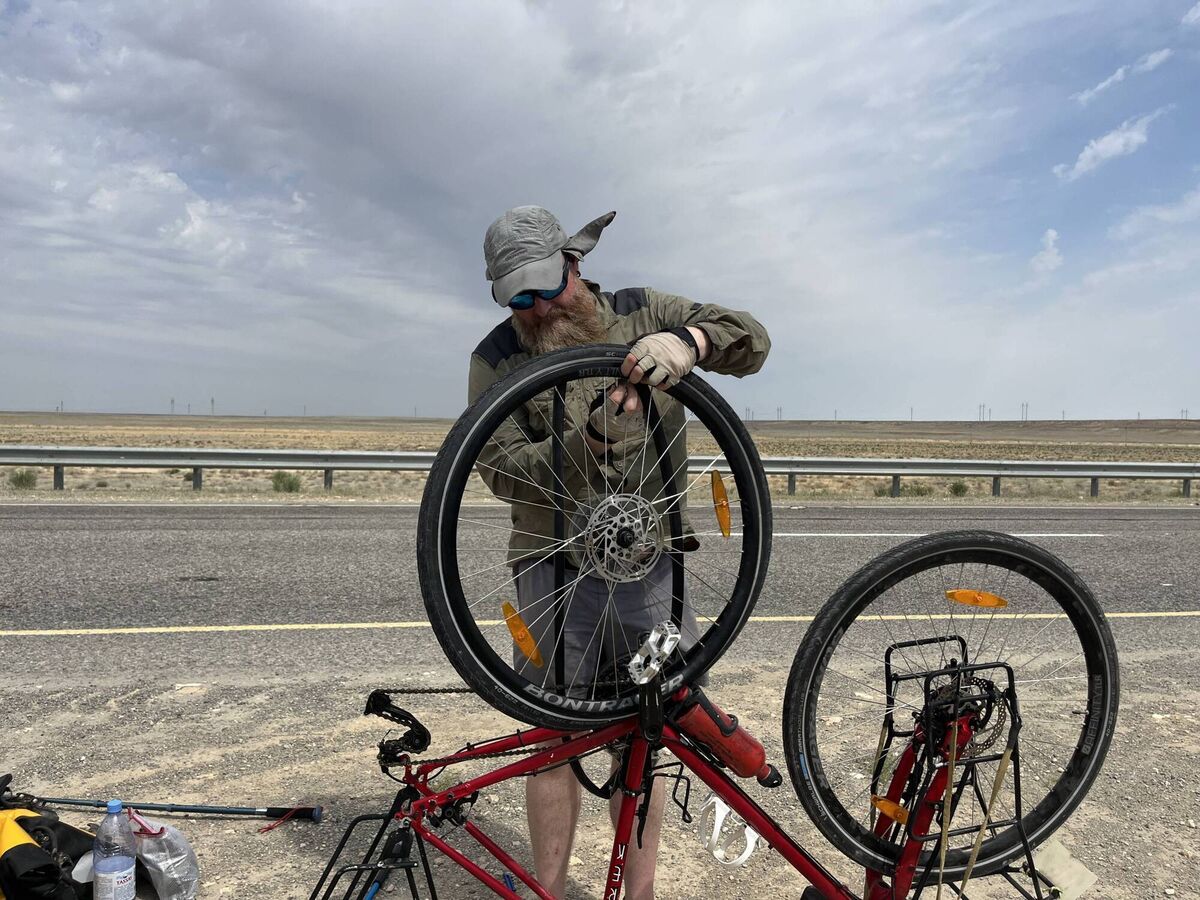
That desert, and the one that followed, the Kyzylkum desert in neighbouring Uzbekistan, made us tougher and more capable as people. We fixed punctures and broken spokes and Mark even replaced a frayed gear cable at the roadside without panicking, and by supporting each other through moments where one or other of us was overcome with exhaustion or doubt.
Kazakhstan was our second Muslim-majority country after Turkey, and we realised that the deeply ingrained respect for long-distance travellers, and the hospitality and kindness extended to them, was not just a phenomenon of Turkish culture, but is actually fundamental to Islam because of the very sacred position of pilgrimage in the religion.
Truckers would pull in when they saw us, hand us bottles of frozen water from their personal stash, and ask in concern if we needed a lift.
Long after we left the arid parts of Central Asia, if we had a day of rain, we’d try to see the positive in it by saying to each other, “we would have given anything for this rain in the desert”.
Almost nowhere challenged our preconceptions as much as the US, whose politics and international relations dominate our news feeds and movie screens.
Nothing prepared us for the inequality we found there.
We had cycled through countries that were by no means wealthy in Central and Southeast Asia, but in the states, extreme affluence seemed to live right alongside devastating socioeconomic struggle.
We started cycling across North America in the dripping spruce forests of Washington state in spring, crossing the Rocky Mountains, the vast prairies of the west, and the Mississippi River, before eventually cycling into Manhattan and then up the eastern seaboard to Maine and into Canada again.
It was while we were visiting family in New York that I found the lump in my right breast.
The so-called “rust belt” towns of Missouri, Illinois, Indiana, and Ohio were a shock. Former coal mining and steel towns where thousands once lived out a prosperous American dream are often gutted now.
Predictably, the remaining population claw desperately for any perceived political support for their plight, seize a hold of anyone cynical enough to make fresh promises that won’t be kept.
In Knox City, Missouri, a forlorn sign from Donald Trump’s 2020 election campaign bearing the poignant legend, 'Trump: Keep America Great', stood on the lawn of one of the only maintained houses on a block. The town hall appeared to have the back half of the building ripped off.
Once-handsome clapboard houses leaned sideways on the edge of ruin as though a giant hand was pressing down on them from above. A tattered stars and stripes flag slouched against the porch of a closed bar.
Even in towns like these, the people were kind, friendly, trusting and optimistic by nature.
The former mining town of Lucas, Ohio, used to have a population of around 7,000. Today, it’s home to 250. It still has a small town park, and when we cycled into town one afternoon it was the town park’s pavilion we had our eye on, because there was a tornado watch in place and huge black clouds were amassing on the horizon.
We had become used to the extremities of US weather and the speed with which it changed, so we hurried into the picnic shelter and began putting up our tent, lashing it securely to pavilion’s posts.
While half the buildings in Lucas were boarded up, the former bank, a beautiful old red brick Western 'false front' style building, was being converted into a home.
The homeowner hopped in his car and made his way down to us in the gathering gloom.
“Guys, I have to go into Des Moines for the night,” he told us. “Go right on up to the house. I changed the sheets, there’s a washer dryer, there’s soda in the fridge. Make yourselves at home.”
Scott Edwards had barely taken the time to learn our first names before offering us his house for the night because he didn’t want to see two total strangers left out in a storm.
This natural trust and hospitality was something we found again and again across the US, in all 18 states we cycled in and across both sides of the increasingly fractious political divide.
As with almost everywhere we had been on the planet, the vast majority of people were kind, friendly, and helpful. Our gratitude to the hundreds of people who helped us grew as our journey did.
But in Newfoundland, where we ended our North American leg, the friendly welcome reached new, unforgettable heights.
We had been granted a writer’s retreat at Pouch Cove, a gallery and arts residency outside the capital, St John’s. The plan was to work on the book about our global cycle before returning to Ireland.
It felt like a home away from home. Although 20% of Newfies can claim direct Irish ancestry, this reached localised peaks of 80% in some coastal fishing villages.
Mark’s Waterford accent was sometimes mistaken for an accent from “the Irish Loop,” a collection of settlements on the Avalon Peninsula below the capital of St John’s where people are genuinely more Irish than the Irish themselves.
We were welcomed with open arms and incredible kindness everywhere we went. When a retired nurse called Kelly sent us a Facebook message asking if we needed a lift anywhere, we gladly accepted.
On the morning of my hospital scan appointment, Kelly pulled up in her car and took us to St Clare’s hospital, vowing to return when we were finished.
I was actually eager for this: Weeks of uncertainty and worrying about the lump had impacted my sleep and had taken their toll on my enjoyment of the last few weeks of cycling through Maine, Quebec, New Brunswick, and Nova Scotia.
I was preoccupied, and Mark was too. He came with me and sat in the waiting room, as keen as I was to know what we were dealing with.
At the scan, the radiologist smiled as he delivered some decisive good news. The lump was definitely nothing to worry about.
“This must be the nicer part of your job,” I said to him as he took obvious satisfaction in my happiness and relief.
He agreed, and I thought of the very many women who don’t get to feel relieved and who find themselves navigating the breast cancer journey.
For now, for me and for Mark, our journey had become suddenly simple again.
All we had to do was pack our bikes up, fly from St John’s to Dublin, and pedal home to the exact point at which we started.
That benign lump became just one more thing to be grateful about on the adventure of a lifetime.
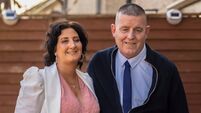
- Mark Graham and Ellie O’Byrne reached The Prom in Tramore, Co Waterford, on Friday, October 23, having cycled 32,339km on their global cycle

CONNECT WITH US TODAY



Be the first to know the latest news and updates