People living with Friedreich’s ataxia beg HSE to approve drug
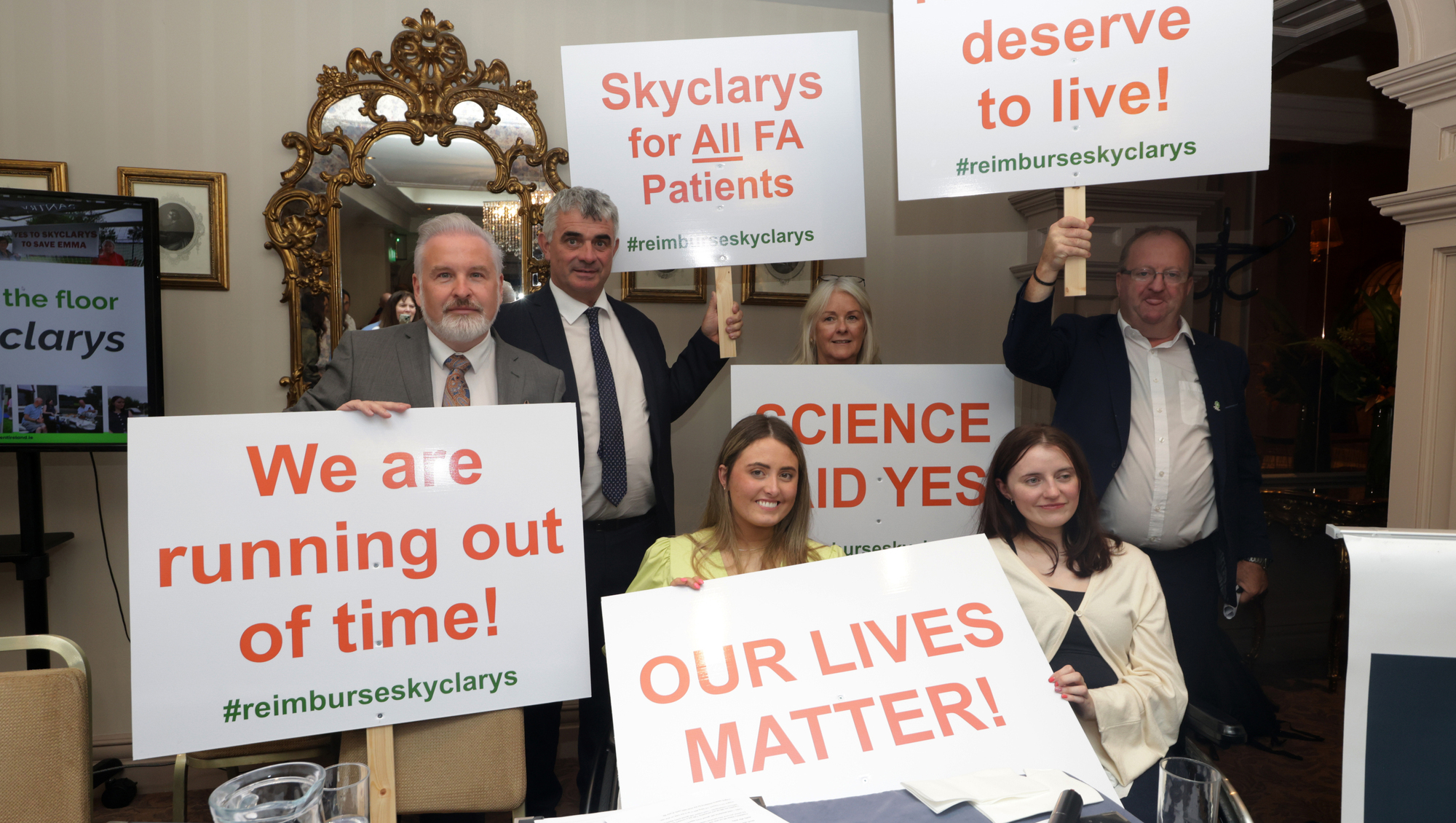
TDs Ken O'Flynn, Richard O'Donoghue, and Michael Collins and Emily Felix at the Friedreich's ataxia press conference at Buswells Hotel. Picture: Leah Farrell
People living with the rare genetic disorder, Friedreich’s ataxia, have pleaded with the HSE to urgently allow a potentially life-changing medicine to be made available.
Campaigners gathered in Dublin on Thursday to beg the HSE to approve the Skyclarys drug for State's reimbursement scheme.
Skyclarys is the only drug approved for the treatment of Friedreich’s ataxia, a rare progressive neuromuscular condition affecting around 200 people in Ireland.
The genetic disorder causes progressive damage to the nervous system, while also leading to heart complications.
On August 11, the HSE Drugs Group met and decided against recommending the drug for reimbursement.
This is despite a report from the Rare Diseases Technology Review Group examining Skyclarys and supporting its introduction.
A final decision on whether to make the drug available will come on Tuesday, when the HSE’s senior leadership team meets.
Read More
Emily Felix, 28, told a meeting of campaigners she had been diagnosed with Friedreich’s ataxia at age 12, saying, as she went through secondary school, she was required to use a walker and later a wheelchair.
“People often assume that when you start using a wheelchair, it can’t get any worse. But that’s not the case,” Ms Felix said.

“This disease keeps on taking, month after month, year after year, ability after ability. Friedrich’s ataxia won’t stop until every aspect of your life is ruined by this disease.”
Ms Felix said she requires support for all aspects of her life, while also highlighting that her voice and speech is beginning to deteriorate.
She told the meeting that she has begun using a voice bank and that without immediate intervention, Friedreich’s ataxia will “take my voice from me”.
Ms Felix said that when she first became aware of Skyclarys, she believed access to the drug would be “simply a matter of time”.
“Instead, we have spent the last two years waiting for Ireland to reimburse the drug, which has been reimbursed in 11 European countries,” Ms Felix said.
“It feels as though cost has become the deciding factor and there is something profoundly dehumanising about that. To be reduced to a number on a spreadsheet, to have your future reduced to cost, to feel that your life is being measured against a budget line.”
Mr Coady said he was “begging” both the Government and the HSE to give people access to the drug, so they “can get on with their life”.
He said Paudie is no longer going out to play with his friends, while he is also prevented from playing soccer.
“When he was told he could no longer play soccer, pieces of his heart left. It died, and he’s never been the same since,” he said.
Dr David Lynch, a neurologist for the Children’s Hospital of Philadelphia, told the meeting via videolink that while Skyclarys is not the cure for Friedreich’s ataxia, his patients have seen improvements in their quality of life.
“The benefit is not massive. It’s not that four-letter word cure, but it’s significant,” Dr Lynch said.


CONNECT WITH US TODAY



Be the first to know the latest news and updates