US sanctions ‘assault against the rule of law’, ICC president tells Four Courts
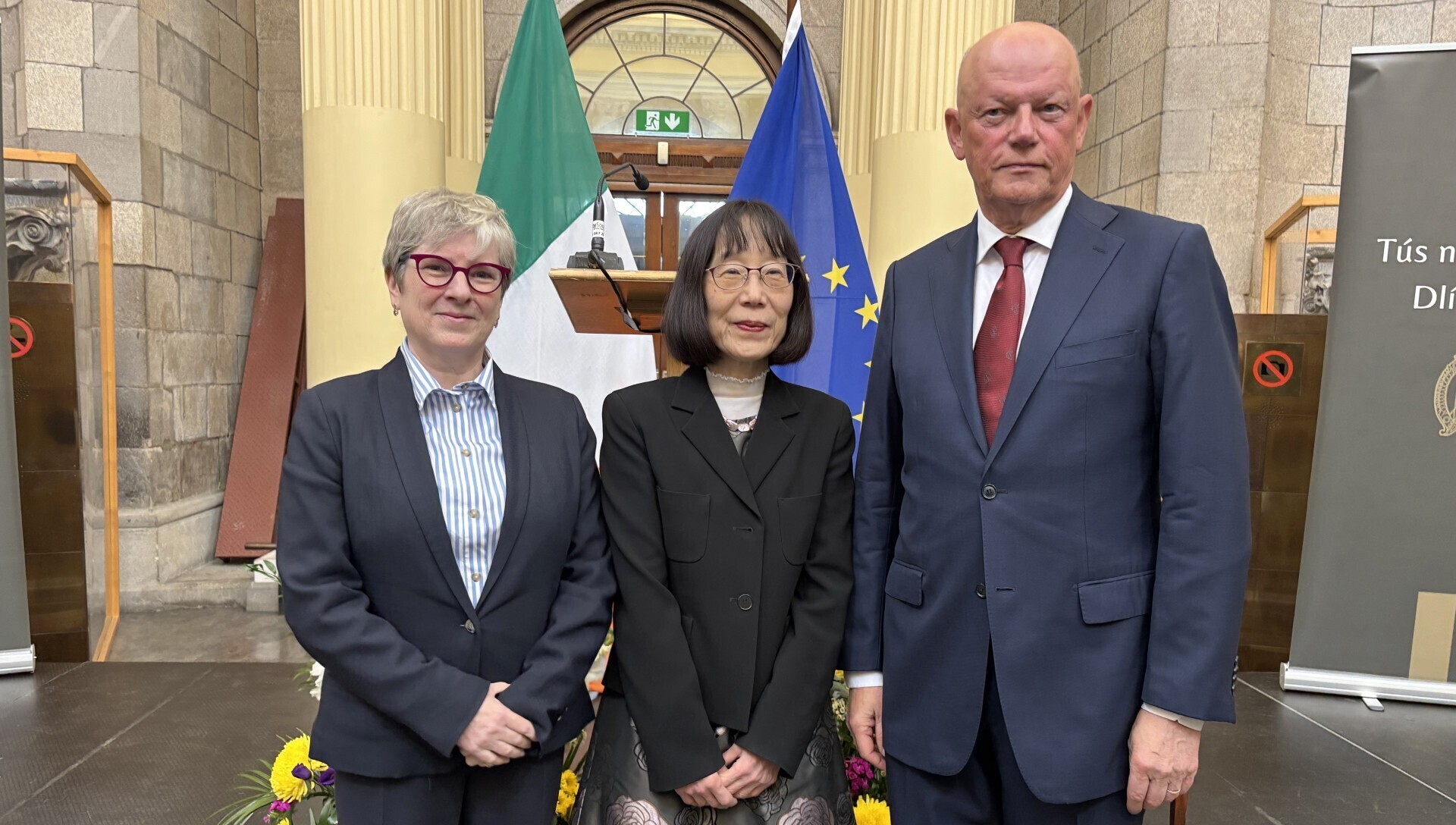
Supreme Court judge Aileen Donnelly, President of the International Criminal Court Judge Tomoko Akane, and Chief Justice Donal O'Donnell at the opening of the new legal year at the Four Courts. Picture: Cate McCurry/PA
US sanctions on International Criminal Court (ICC) officials are part of a “broader assault against the rule of law”, the ICC president has told the Four Courts.
Speaking in Dublin to open the legal year on Monday, Tomoko Akane said it is vital that the ICC can remain immune to political pressure.
“We have faced several obstacles since our establishment, but this has intensified significantly during the last few years,” the Japanese judge said.
“At this moment, 12 of the 18 ICC judges are the subject of at least one of these coercive measures.
Read More
“Such attacks against independent servants of the law are couched in narratives that are specific to the ICC and its activities, but they are also part of a broader assault against the rule of law.
“It is of vital importance that courts, whether that is the ICC or any other court, remain independent and free from political pressure or any kind of coercion.
But at times, it feels to me that this very foundational notion is corroding before our eyes.”
Chief Justice Donal O’Donnell said the sanctions are unjustified and “sobering”.
Opening the legal year, he said: “I am very grateful to president Akane for providing a first-hand view of the work of the International Criminal Court, and the difficult position the court and its judges find themselves in, particularly because of the unjustified imposition of sanctions by the US upon judges, including Madame Akane as president.
“That provides a sobering reflection for all of us here. What courts have, what judges have, is judgment.
“President Akane’s account of the ICC continuing to discharge its judicial duties despite coercive measures illustrates this.”
Meanwhile, Mr O’Donnell called for a structure to be set up to allow judges to discuss pay with the government.
In 2014 the Council of Europe’s body against corruption, Greco, made a series of detailed recommendations including the establishment of an appropriate structure but Mr O’Donnell said this was never established, leaving judges in limbo.
“The government accepted all of the recommendations including that one and, to my knowledge, has never sought to resile from it. However, it has never been implemented,” he said.
“There are some important issues related to pay and pensions which would clearly benefit from this approach.
“It is not open to judges to engage in industrial action or engage in collective bargaining with the other branches of government on whom they are expected to act as a constitutional check.
“It is frustrating that not only has the body recommended by Greco not been established, but that the failure to establish it has never been explained, let alone justified.
“This is another area of structural reform which could be addressed to reinforce the resilience of our constitutional structure.”


CONNECT WITH US TODAY



Be the first to know the latest news and updates