Adams arrest: ‘It should never have happened to us’
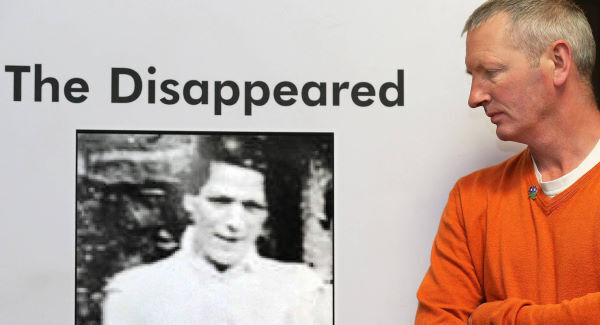
The mother of 10 was taken down the stairs of a high-rise block of flats, bundled into a van, and never seen again, wrongly suspected of informing to the security forces in republican west Belfast during the height of the conflict.
Michael McConville said her 80th birthday would have been approaching this year.
He added: “The IRA robbed a family of their mother growing old, they took everything away from us.”
The children looked out the window and saw the gang putting their mother into a van, which drove off with one car in front and one behind.
Mr McConville, aged only 11 at the time, added: “I would have liked to have seen her being 80.
“I would have liked to have seen her seeing her children and grandchildren growing up. She missed all that.”
The day before, the IRA had come to a bingo hall and took her outside, beating her until she did not know where she was, Mr McConville said.
She was found, disorientated and wandering the streets, by the British army. The family went to the army’s “police station” and brought their mother home.
Mr McConville said: “She had cuts and bruises all over her face and around her arms and legs, she said that the IRA had done it. We wanted her to go to her mother’s house, my grandmother lived in East Belfast, she said she was not going as she had nothing to hide.”
Her son described what happened that evening, between 5.30pm and 6pm, after a rap on the door.
“People barged their way in, some had masks and some had not.”
He recognised some of the faces as neighbours, people living in the same Divis flats as them.
“We knew these people by name and they knew us by name.
“We held on to our mother and [were] crying and screaming and our mother was crying, she was squealing as well because she probably knew that if she went outside what she was going to go through from the night before.”
Her abductors told her family they were only taking her for a short period of time and allowed another son to leave the room with her. Once in the stairwell they put a gun to his head and told him to “fuck off”.
Mr McConville added: “As a child I was thinking why do people do this, the brutality of what they did the night before, why do this to my mother?”
He was put in a children’s home.
“I knew then that my mother was dead.”
His siblings were put in separate properties, meeting rarely.
Mr McConville added: “When I see my younger brothers and sisters, the way they have turned out, it really wrecks me, it should never have happened to us.”

The orphaned children of Jean McConville had to wait more than 30 years to make the first step towards some form of closure.
A storm in August 2003 shifted a sand embankment on the edge of Shelling beach, Co Louth, exposing her remains not far from where the Provisional IRA said they dumped her body.
A series of prolonged and extended but ultimately failed searches were carried out along that area of coastline near the Irish border in previous years.
But the chance discovery on the coastal beauty spot was not made until a man out walking his dog saw the animal agitated by the mother-of-10’s exposed grave.
In 1999, after the Independent Commission for the Location of Victims’ Remains had been set up as a go-between to find the so-called Disappeared, the IRA had passed on information on Mrs McConville’s murder. Provos identified a stretch of the Co Louth coastline, some of which had been developed in the 30 years since the secret burial with a car park being built on one spot.
The commission’s primary role was to find the bodies of the Disappeared with the promise that any detail given over could not be used by any other authority or used for a prosecution.
But following the chance discovery of Mrs McConville’s remains, a coroner ruled at the inquest into her death that her murder would not be covered by the deal. Any forensic evidence found at the site and during the examination of her remains can be used in any criminal proceedings against her killers.
Among that material was a flattened .22 calibre lead bullet found embedded in the skull.
The IRA had been given assurances by authorities that the only forensic tests on bodies of the Disappeared would be for identification purposes.
The chance discovery of Mrs McConville’s body put paid to that notion in this case.
Incorrect information from the IRA saw massive excavations by gardaí andthe car park dug up in 1999. Later searches removed tonnes of sand on anextended area of Shelling beach and 80km from Belfast. All to no avail.
Members of the McConville family kept heart-wrenching vigils overlooking the supposed burial spot as repeated unsuccessful attempts were made to find their mother.
Poignantly, one of Mrs McConville’s daughters, Agnes, would reveal that while searches along the coastline failed, she had a vivid dream that her mother had been buried on a beach.
It would be four years before the remains were uncovered with nature’s help. After the discovery in late August 2003, near a car park and coastal path, the missing woman’s sons and daughters suffered another anxious two-month wait for DNA results to confirm their fears, and hopes. Gardaí confirmed forensic tests had revealed she had been shot in theback of the head.
Mrs McConville’s body was returned to her family in October 2003 and she was finally given a funeral in Belfast and buried next to her husband Arthur in the Holy Trinity cemetery in Lisburn.
The IRA issued a statement apologising for the grief caused to the families of the Disappeared.
The McConville family said the Provos’ words meant nothing to them.

The Irish and British governments have both rejected Sinn Féin’s claims that the arrest of party leader Gerry Adams for questioning about the murder of Jean McConville was politically motivated.
The 65 year-old TD for Louth was still being questioned last night at the serious crime suite of Antrim police station about the 1972 abduction and murder of Mrs McConville. He was arrested on Wednesday evening after agreeing to meet with officers of the PSNI to discuss the case.
Sinn Féin reacted to Mr Adams’s arrest by saying he and the party were being victimised by unionist elements within and outside the PSNI, seeking to discredit them during election campaigns on both sides of the border.
Taoiseach Enda Kenny insisted, however, that there was no question of political influence being brought to bear on the PSNI’s decision to bring Mr Adams in for questioning.
“I want to make it perfectly clear that parties in the south, and I can speak for our own, have absolutely no connection with this at all,” he said.
“The most important fact is that Jean McConville was murdered, a widowed mother of 10 children, and her body wasn’t found for very many years. The people who are the real victims are the family of Jean McConville. She was murdered and her murder has not been solved.”
British prime minister David Cameron also rejected the claims. “This is entirely, and rightly so, an independent police matter,” his spokesman said. “There has been an ongoing investigation into this for a period of time now.”
Mr Kenny added to calls for Mr Adams to co-operate with the investigation by answering questions from the PSNI “in the best way he can, to the full extent he can”.
Labour’s deputy leader Joan Burton, meanwhile, described the murder of Mrs McConville as a war crime, and questioned Mr Adams’s refusal to disassociate himself from her killers.
“If what happened to Jean McConville and her family had happened in any other country it would be treated properly as a war crime,” she said. “She was basically executed, her body treated like that of a dog, and her family was left in a dreadful situation. Gerry Adams just will not disassociate himself from the organisation that did that.”
Fianna Fáil called on Sinn Féin deputy leader Mary Lou McDonald to withdraw the claims of political motivation and warned that her comments could endanger police officers in the North.
Niall Collins, Fianna Fáil’s justice spokesman, said her comments were “inappropriate and ill-judged” and were insensitive to Mrs McConville’s still grieving family.
“There is an ongoing police inquiry and I do not believe that politicians from any quarter should interfere with or undermine the work of the investigation team,” said Mr Collins.
“By moving so quickly to criticise a police investigation and question the motives of the officers involved, it is Deputy McDonald who has introduced politics into this inquiry.
“Talking of sinister ‘unionist influenced’ elements within the Police Service of Northern Ireland, as Deputy McDonald has done, harks back to some of the worst and most divisive rhetoric of the past and could be seized on by dissident groups.”
Jean McConville’s abduction and murder by the IRA has been the most high-profile of cases known as the Disappeared.
The killings span more than 31 years and include 16 victims. Of those connected to republican activity, nine were named by the IRA in spring 1999 as having been murdered by members of their organisation and their bodies hidden across a number of areas in the Republic. Seven bodies have been found but others remain missing.
The Irish National Liberation Army splinter group claimed one death.
Forensics-led searches have been carried out by the Independent Commission for the Location of Victims’ Remains, established in 1999 by treaty between the British and Irish governments to obtain information.
Those found include:
* Peter Wilson: The vulnerable man with learning difficulties went missing at the age of 21 from his west Belfast home in 1973. Reports suggest that he might have been abducted and murdered by the IRA. His remains were found at Waterfoot beach in Co Antrim in November 2010.
* Eamon Molloy: He was abducted from his home in the Ardoyne area of north Belfast in July 1975, after being accused by the IRA of being an informer. His body was discovered in a coffin left at Faughart graveyard near Dundalk, Co Louth, in 1999.
* Brian McKinney: He was abducted with his friend John McClory in 1978. He allegedly admitted stealing IRA weapons for use in robberies.
His body was uncovered with his friend’s in Co Monaghan in 1999.
* Danny McIlhone: He disappeared from his west Belfast home in 1981. The IRA said Mr McIlhone was being questioned about stealing weapons. Remains discovered in the Wicklow mountains in November 2008 were confirmed as his.
* Charles Armstrong: The 57-year-old from Crossmaglen disappeared on his way to Mass in 1981. Human remains were found in Co Monaghan in July 2010. Two months later, they were confirmed as being those of Mr Armstrong.
* Gerard Evans: The 24-year-old was last seen hitch-hiking in Co Monaghan in March 1979 and no-one has admitted responsibility for his death. In March 2008, his aunt was given a map claiming to identify the location of his body. His remains were found in Co Louth in October 2010.
* Eugene Simons: The 26-year-old went missing from his home near Castlewellan, Co Down, on January 1, 1981. His body was found accidentally in May 1984 in a bog near Dundalk.
Others are still missing include:
* Captain Robert Nairac: The SAS-trained British army officer, 29, was abducted by the IRA in Jonesborough, Co Armagh, in May 1977.
* Columba McVeigh: The 19-year-old from Donaghmore, Co Tyrone, was abducted and murdered by the IRA in 1975 after allegedly confessing to being a British Army agent with instructions to infiltrate the IRA.
* Seamus Ruddy: The 32-year-old from Newry, Co Down, was working as a teacher in Paris when he went missing in 1985, believed to have been killed by members of the INLA.
* Kevin McKee: The Belfast IRA man was alleged to have been a British Army agent. He was murdered by the IRA in 1972.
* Brendan McGraw: The IRA claimed that the 24-year-old from Belfast confessed to being a British undercover agent in 1978.
* Seamus Wright: The Belfast IRA man was murdered in 1972 by his former colleagues who accused him of being a British Army agent.
* Joe Lynskey: The former Cistercian monk from west Belfast later joined the IRA. He disappeared in 1972 and republicans claimed he was “executed and buried” by the IRA.

Gerry Adams has been forced to deny involvement in Jean McConville’s murder for years.
But a court decision in the US has now compelled the Sinn Féin president to make those same denials to detectives investigating the mother-of-10’s abduction, killing and secret burial by the IRA.
In 2001, Boston College commenced a five-year oral history project aimed at documenting perspectives on the Troubles from those involved in the conflict.
Academics, historians and journalists interviewed former paramilitaries, both republican and loyalist, about their roles in the 40 years of violence that blighted the North.
The participants took part on the undertaking that their accounts would only be made public upon their death.
When one such interviewee, former IRA commander in Belfast Brendan Hughes, died in 2008, it emerged that on the tapes he alleged Mr Adams was a senior IRA leader during the Troubles and had ordered Mrs McConville’s killing — claims that Mr Adams vehemently contested.
Prior to her death last year, Old Bailey bomber Dolours Price made it public that she had also given an interview to Boston College about Mrs McConville’s death in which she made similar allegations about Mr Adams. Again the Louth TDrejected the claims.
The revelations prompted lawyers representing the PSNI to launch a legal bid in the US to obtain the Boston College tapes that touched on Mrs McConville’s death.
A long court battle ensued but last year the PSNI won and the college was ordered to pass over the tapes.
Having taken time to examine their contents, detectives ramped up theirinvestigation in the last two months, making a series of arrests.
In March, veteran republican Ivor Bell, 77, from Ramoan Gardens in the Andersonstown district of west Belfast, was charged with aiding and abetting in the murder — a counts he denies.
Five others have been detained and questioned by detectives.
But the latest arrest is undeniably the most high profile to date.