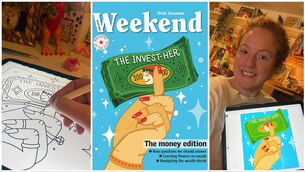
Caitríona Redmond: When you have less money, you have to spend more — here’s why

If you feel like you are juggling your finances on a knife-edge, you are not alone, says Caitríona Redmond
The quickest way to get around the disposable income versus quality clothing or items issue is to stop shopping for new items.

The quickest way to get around the disposable income versus quality clothing or items issue is to stop shopping for new items.

MANY of us feel like we are constantly running on a hamster wheel to earn money, while our bank accounts are like a dripping tap. 

No sooner is something paid for than something else breaks, the kids grow out of their shoes, or there’s a new bill we didn’t expect. If you feel like this, know that you are not on your own.

There’s a character in Terry Pratchett’s Discworld series called Vimes who discusses earning less, and it’s a very good analogy. Vimes reckons that the reason why people are more affluent is that they can afford to spend more money, not less. Let me explain.

If someone on a budget needs new work shoes with only €50 to spend, they’ll probably have to choose a cheaper, lower-quality pair. These are made to last for a short while, but since that’s the budget and they need shoes for work, they’ll opt for the poorly manufactured ones to get by. If they’re lucky, those shoes will last for a year, if even that.

Let’s imagine, for a moment, that their neighbour is flush with cash and also needs a new pair of shoes. They can then choose a higher-quality pair of shoes, designed to last for ages. For this example, let’s say the shoes cost €100 and last five years.

As the person on a tight budget rarely has much disposable income, by the time a year rolls around, their shoes are falling apart. They scrabble around to find another €50 for another pair of shoes to do the job, for now. And so on for five years.

Over the course of five years, the first person will have spent €250 on new shoes that really don’t last very long. Their wealthier neighbour will never have to buy another pair of shoes, and they spent €100. 

One savvy shoe buyer made do with their disposable income, but over time, it cost them €150 more than it did the person who could afford a higher-quality pair of shoes.

The quickest way to get around the disposable income versus quality clothing or items issue is to stop shopping for new items.

There are several second-hand online options, such as eBay, Vinted, and Vestiaire. Just remember to check what country you’re purchasing from.

It all depends on the budget you’re working with. Vestiaire is new to me. After a bit of research, I found it sells high-end designer items. If I’m honest, it’s out of my price range, but I guess it’s nice to dream!

The same principle applies to buying a new or second-hand car.

Somebody with less disposable income is more likely to enter into a PCP or car finance arrangement. Both of these options incur more interest over time and, in the case of a PCP, require a lump sum at the end of the arrangement to own the car outright.

Living on less, it’s unlikely that a borrower will have enough money to pay the lump sum, and they get caught in a PCP cycle to hold on to a decent car.

Likewise, a cheaper second-hand car is more likely to have mechanical or electrical faults. While cheaper to buy at the start, the cost of repairs and maintenance will, over time, erode any other disposable income, making it less affordable.

A consumer with more money can make a larger down-payment on a newer, lower-maintenance vehicle and also pay less interest on any financing they arrange. They may even buy the car outright and save a fortune on potential interest. 

Most brand new cars come with a service agreement for three to five years, too, which eliminates the need to free up income for repairs.

Thirteen years ago, Jamie Oliver famously criticised lower-income families for having large TVs. 

What he failed to understand was that those living on less will rarely, if ever, have enough money to buy a TV outright. They will instead arrange finance on a TV, and yes, it is easier to have a large TV when you are paying by the month.

Finally, a personal bugbear is people who criticise families for buying poor-quality food or not cooking from scratch. 

At the same time, food waste is a massive issue in Ireland, with the Environmental Protection Agency (EPA) reporting that approximately 26% of the food we buy for our homes is wasted.

Anyone with a tighter budget knows that throwing out food is the same as throwing away money. The way to avoid wasting food is to make sure you buy food your family will definitely eat, that’s easy to cook and store, and that won’t add to the overwhelming mental load of trying to get things right.

So no, you’re not imagining it. If you feel like you are juggling your finances on a knife-edge, that’s because with less disposable income, you end up spending more money, not less.

Many of us are caught in this cycle, and as the cost of living continues to make life difficult, the cycle gets worse, not better.

Redmond Recommends

With the summer holidays officially underway for all primary school students, now is a great time to remind you to make the most of your local library.

We are so lucky in Ireland to have 330 free library branches, with over 13 million items in stock across the country.

Library services don’t end at a bricks-and-mortar location either, because librariesireland.ie is the place to join online and access free magazines, newspapers, ebooks, and audiobooks on Borrowbox.

There’s an option for young people to join the Summer Stars programme on Borrowbox or in person, and it’s a lovely way to encourage and log reading activities over the summer. 

I’m delighted to see audiobooks available, because we all know that listening to a book is still reading, and should definitely be encouraged.

x

More in this section

Lifestyle

Newsletter

Eat better, live well and stay inspired with the Irish Examiner’s food, health, entertainment, travel and lifestyle coverage. Delivered to your inbox every Friday morning.

Cookie Policy Privacy Policy Brand Safety FAQ Help Contact Us Terms and Conditions

© Examiner Echo Group Limited