Heatwaves, drought and then a tornado: France fraught over extreme weather stress
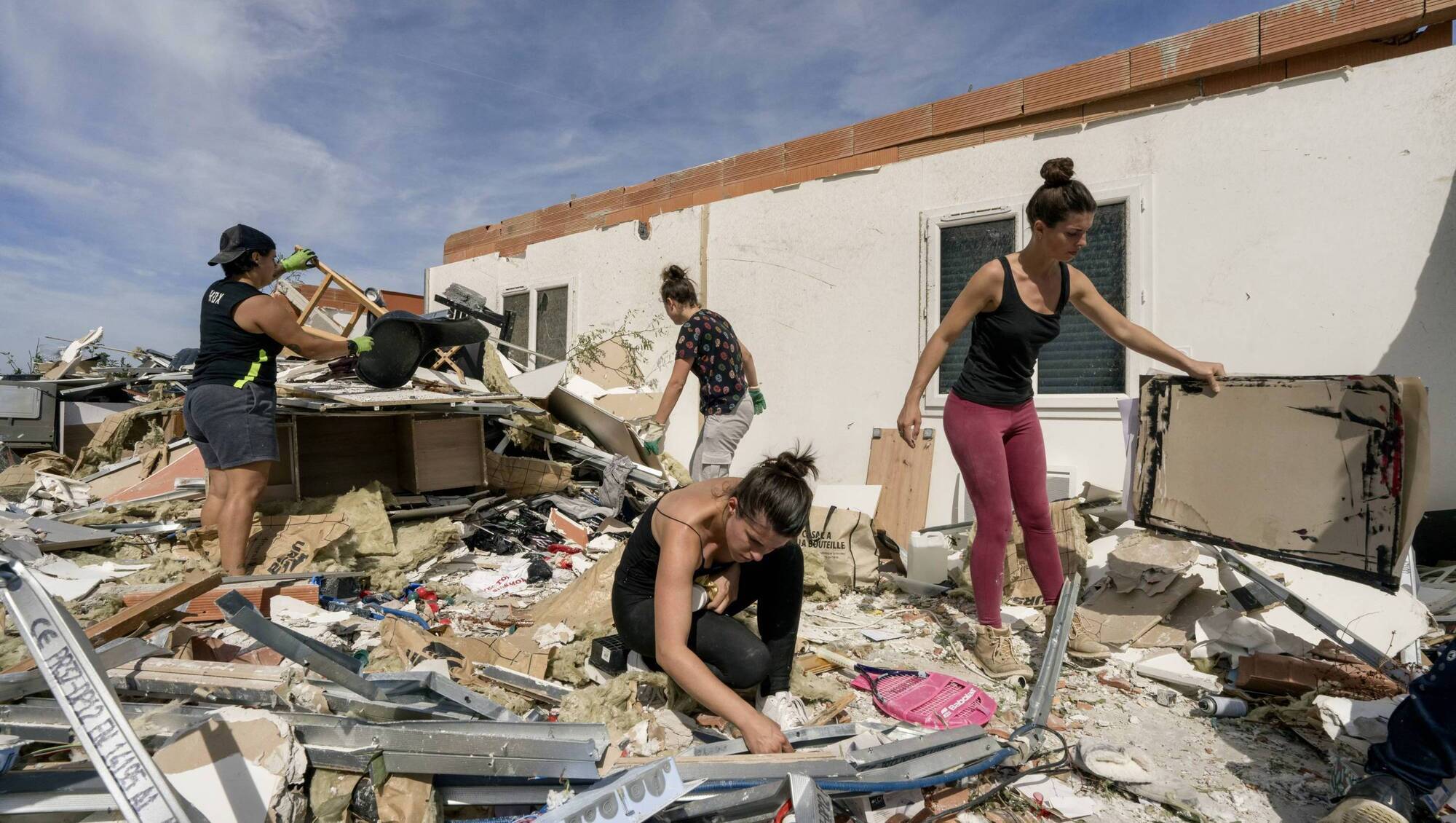
People clean debris of a damaged house following a tornado in Pomas, southwestern France on August 25 that injured 39 people and damaged more than 300 homes.
Visitors to the Languedoc in France these days know there is an increased likelihood of encountering a ferocious storm, but turbulence that erupted south of Carcassonne in late August was of a different dimension.
A raging tornado was thrown into the mix. Inevitably, people linked it to a summer of repeated heatwaves frequently touching 40 degrees.
Although the link between tornadoes and climate change is tenuous, it illustrated the possible shape of future extreme weather events that will undoubtedly be fuelled by elevated global temperatures. It was a tough lesson too on what is needed at local level by way of emergency response.
Arriving for a late summer holiday days later, I was staying about 35km away from where the tornado struck. It was “a mature, damaging supercell twister” with a typical vortex connecting the ground to the base of a storm cloud. It came in advance of a complex of thunderstorms. The “aftershock” was palpable among those who witnessed it.
It tore through the village of Pomas, injuring 39 people and damaging more than 300 homes. “Half the village has been destroyed,” said one resident, who described the tornado as a swirling, “huge red and yellow chimney”.
It was of EF3 strength (level three of a five-level scale) with winds of up to 240km/h. Classified as “severe”, EF3s are not uncommon in the US, where they can destroy well-built houses, overturn trains and uproot heavy trees, but they are rare for France.
But in Pomas, monuments from medieval times were reduced to heaps of stones, steel roofs crumpled, signage and seats were blown huge distances. Many roads were closed for days.
Remarkably, it all passed in about 15 minutes. It seemed arbitrary in exacting its toll: the village where I was located escaped with a heavy burst of rain, yet in Capestang, a village a few kilometres away, numerous trees were down and damage to property was extensive. Three large plane trees on an approach road were ripped out, causing large cracks in the thoroughfare. Known as platanes in French, these hardwood trees provide shade across the country’s squares, waterways and roadways. Napoleon ordered them to be planted along roads and canals in the 19th century to shade travelling troops.
Scientists do not have definitive proof climate change makes tornadoes stronger or more frequent, but it is changing where, when and how they happen and cluster. One climatologist specialising in tornadoes, Flavio Pons, described current circumstances in France as similar to the Gulf of Mexico, where warm seas fuel destructive hurricanes.
The nearby Mediterranean is very warm. Some of its waters reached 30 degrees this summer, which will feed a lot of energy and humidity into the atmosphere, creating the possibility of storms with potential for tornadoes this autumn. Proximity to the Pyrenees, Pons added, creates a wind dynamic and atmospheric circulation that could heighten that risk.
Because tornadoes are small and short-lived, it is difficult for climate models to simulate them and predict their occurrence. Scientists are more inclined to study how warming affects basic ingredients needed for severe thunderstorms.
Higher global temperatures can weaken the jet stream, which may decrease the wind shear needed to spin up tornadoes, yet a warmer, more humid atmosphere increases instability and provides more energy for storms. As these two essential ingredients work against each other, scientists do not have a simple answer on whether tornadoes will become more frequent overall.
What occurred in the south of France was not Nepal in terms of climate rage with associated loss of human lives and destruction. But it is a warning on how preparedness and ability to respond to extreme weather events must change in Europe.
Rural France is having a tough time; all to do with climate. Optimism associated with harvesting of grapes – the vendange – was absent as vineyards hit by severe drought and heatwaves are expected to report a 30-year low in wine production after the country’s hottest ever recorded summer.
It coincided with British people being urged to have enough food and water on hand to survive a few days without power or water, as the UN warned the El Niño climate phenomenon is “supersizing before our eyes”, exacerbating extreme weather events worldwide. This is separate to – and on top of – the human-induced rapid rise in global temperatures.
Forecasters are braced for the biggest El Niño in 1,000 years, predicted to bring wildfires and floods to parts of the world and a wet, stormy winter for Ireland.
This is yet another manifestation of nasty climate concoctions – immediate, unpredictable and destructive of our way of life – that are becoming normal. Their victims will be all of us, in some way or other.
- Kevin O’Sullivan is an environmental commentator and consultant


CLIMATE & SUSTAINABILITY HUB
CONNECT WITH US TODAY



Be the first to know the latest news and updates