Islands of Ireland: Oak, yew and strawberry trees — and serenity — at Monk’s Island, County Sligo
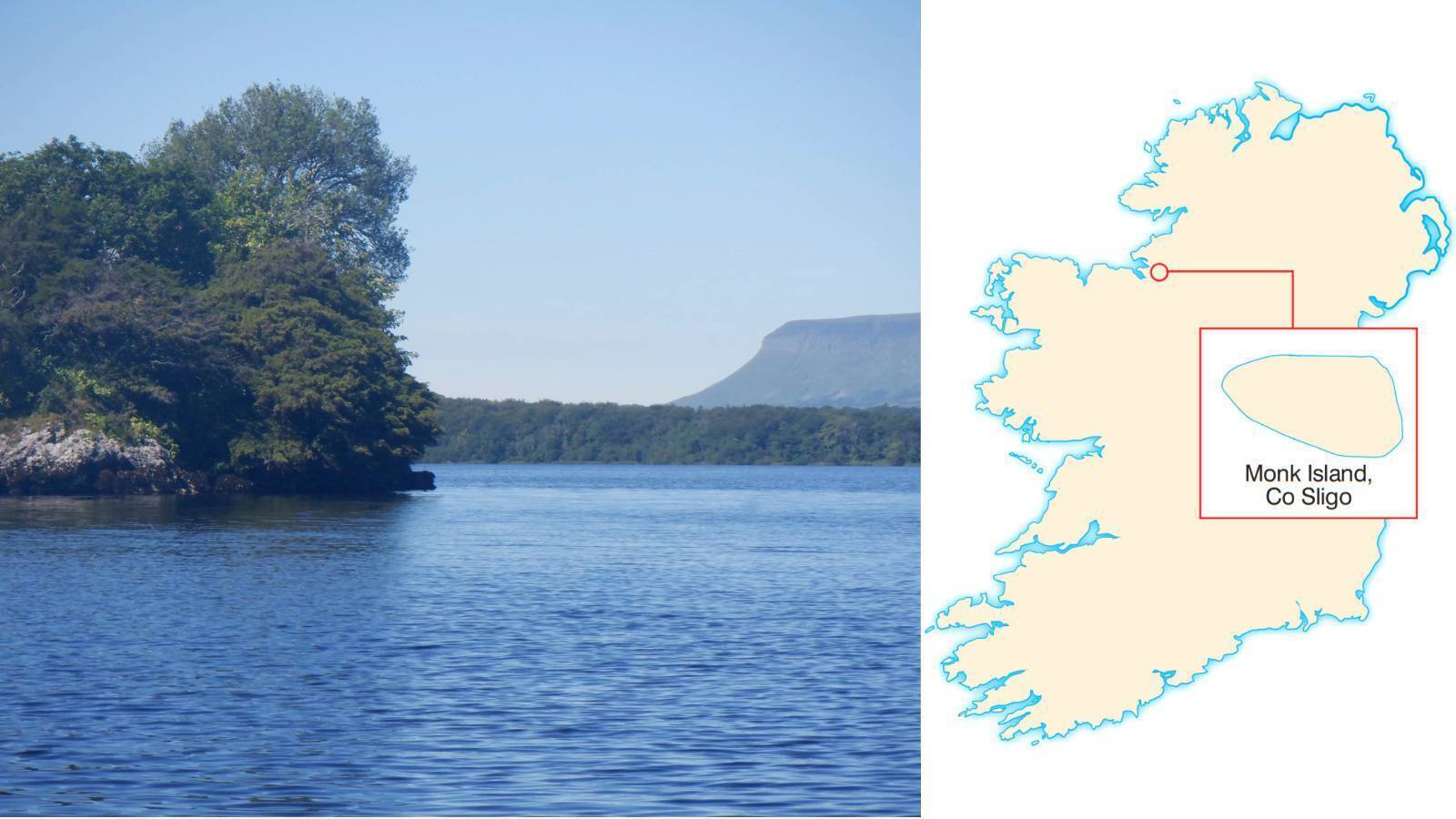
Monk's Island, Lough Gill, County Sligo with Ben Bulben in the background. Picture: Dan MacCarthy
If serenity is the sole objective in reaching an island (as it often is), then this County Sligo island has it in spades. Where other islands have golden beaches, historic ruins, or rare bird species to offer up by way of attraction Monk’s Island has a more ethereal quality to entice.
WB Yeats of course wrote famously about another island in this lake, Lough Gill, and the words of ‘Lake Isle of Innisfree’ could just as easily be applied to Monk’s Island on the other side of the lough: “I will arise and go now, for always night and day/ I hear lake water lapping with low sounds by the shore”.
And the medieval monks chose their locations very well in pursuit of their lives of contemplation. This two-acre island in the centre of the lough and about 5km from Sligo Town, is an idyll, though however charming that word is, it does not truly evoke the place. ‘Paradise’ is too grandiose. ‘Sylvan’ is too romantic. ‘Woody’, too prosaic. Reader, choose your own word for this magnificent grove of oak, birch, yew, and the arbutus, or strawberry tree which only grows at Lough Gill and the Killarney Lakes. The tree cover is so dense that just a lonely few beams of sunlight can penetrate the canopy.
Any monks here (not currently resident as we shall see), would have been connected to the 15th-century Cistercian community on Church Island — about 150metres away. Friar’s Island in Lough Leane, Killarney, would have fulfilled a similar purpose. Monk’s Island has a number of neighbours as well as the huge Church Island: Fairy Island, Swan Island, and the curiously-named Black Tom’s Island.
For all of our rich history of monasticism there are only a few islands directly named after the ecclesiastical way of life. Just to the south of Lough Gill is Lough Key, County Roscommon which has Church Island, Trinity Island, and Hermit Island, all of which are associated with the ecclesiastical way of life. And there is a Nun’s Island on Lough Ree; St Patrick’s Island in County Dublin, and Illan [correct] Columbcille on Lough Mask, County Mayo. St Enna’s Island in County Kerry is named after the eponymous saint; St John’s Island on the County Waterford coast is a tiny sea stack linked to that saint. There are dozens of other islands with a tradition of monasticism, Skellig Michael being the prime example, but not directly named after such activity apart from the numerous Church Islands. There is a second Monk’s Island in County Westmeath.
Inis Mór / Church Island, Lough Gill, Co #Sligo. Photo appeared in the 1st issue of ‘Irish Travel’ in Sep 1925, an illustrated monthly magazine produced by the Irish Tourist Association (forerunner of Bord Fáilte now Fáilte Ireland).
— Irish Heritage News (@heritage_irish) May 7, 2021
Source: TU Dublin. #ChurchIsland #LoughGill pic.twitter.com/SesxKMFOQl
Monk’s Island first appears on maps, and has been recorded with the same name as today’s, since the early 19th century, 1819 to be specific. In Irish it is Oileán an Mhanigh. However, why it was not previously named accordingly is somewhat of a mystery. Perhaps it was and folk memory sustained it until cartographers got around to including it.
An exhaustive study of Irish islands linked to monasteries does not include Monk’s Island, or Hermit’s Island for that matter. It may be that they were of very minor importance with no significant religious buildings. The archaeological record bears out this theory with no monastic or other discoveries there.
The likelihood is that monks based on Church Island took their currachs over to Monk’s Island to embrace solitude and contemplation for a period. Though the western bay on Church Island is heavily screened by a bank of reeds, there is a landing spot adjacent to it which could well have been used by the monks for this purpose. Currach tied up, it is only a stroll through the trees to reach the monastery.
Annette Kehnel writes that “a total of 103 monastic islands have been identified [on Irish islands]. Of the 51 island monasteries in inland waters, more than half are situated in the North”. Part of the reason for this is that most of our lakes are in the northern half of the country and Lough Gill suitably fills that category.
: For tours on Lough Gill:
: Annette Kehnel, List of Medieval Religious Houses on Islands: Ireland