Book review: Rome wasn’t built on fair play

Emma Southon's 'Servus' acts as a great corrective to an immense historical lacuna; you will see Rome in a new and sulphurous light
Emma Southon’s opinion of the Romans brooks no shades of grey. They invade, rape, brutalise, enslave. They cross the seas 'like a virus'. Picture: Jamie Drew

Emma Southon’s opinion of the Romans brooks no shades of grey. They invade, rape, brutalise, enslave. They cross the seas 'like a virus'. Picture: Jamie Drew

  • Servus: How Slavery Made the Roman Empire
  • By Emma Southon
  • Hodder & Stoughton, €22.95

Demographers estimate that around 30% of the population of the Roman Empire was enslaved. 

Rome’s dominance in battle and conquest unbalanced its own economy, which “simply could not survive without slavery”.

Yet the enslaved peoples of the empire have been subject to centuries of historical amnesia, in part because, reflecting the Romans’ contempt for those who toiled under them, the primary sources are so meagre.

Against this backdrop, Emma Southon has written Servus, a rescue mission to restore to our sight this enormous, hidden swathe of people. 

Southon knows her material and uses it to produce fine acts of both historical imagination — concerning, for instance, the hideous conditions endured by men and beasts in flour mills — and literary imagination: 
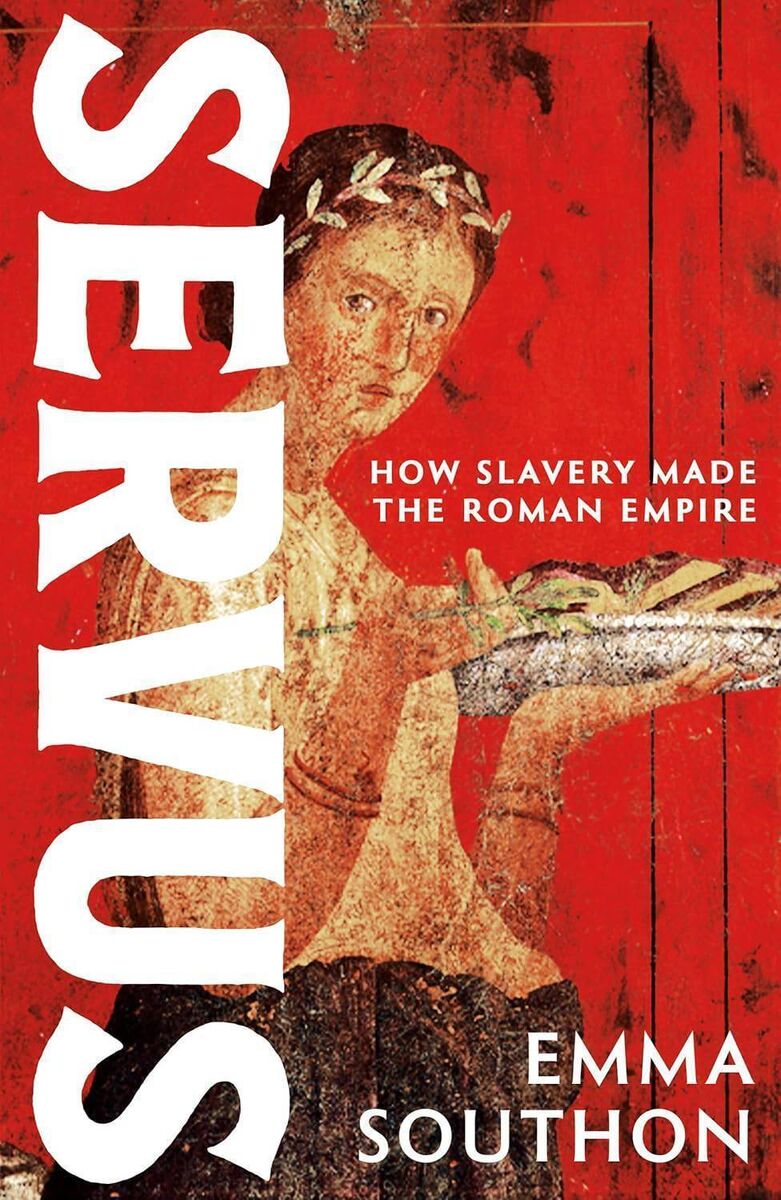
There is a bravura passage in which she invites us to picture a tunic-ed and toga-ed figure alone in a spotlight with the hands of unseen others stretching out from the surrounding darkness to serve his every need and make him look splendid.

Southon shows us how unfree people could try to build some kind of approximation of a free life within the constraints of slavery. 

She confronts us with the sadistic violence inflicted by enslavers on people they owned, explains the powers and resources made available by the state for retrieving those who “self-emancipated”, and, with true and touching empathy, skilfully explicates “the cage for the soul” made by slavery.

Acknowledging that the voices of the enslaved of the Roman empire are largely lost, she uses testimonies of people who suffered under the Atlantic slave trade as a means of compensating, a device deployed judiciously and well. 

Servus thus acts as a great corrective to an immense historical lacuna; you will see Rome in a new and sulphurous light.

But Servus has its defects too. Emma Southon’s opinion of the Romans brooks no shades of grey. 

They invade, rape, brutalise, enslave. They cross the seas “like a virus”. If they had a talent, “it was making things appalling”. They were “sneaky little f***s who cheated”, “a profoundly unfunny people”.

The charge sheet is unremitting and no doubt holds good for a lot of the time. (Tacitus himself records his surprise at the better treatment of slaves by Germans.) 

But when you come down this hard on an entire ancient people, some context would help. 

Southon mentions, only in passing, that the Roman slave state was bordered by other empires “each full of their own slaves”.

Elsewhere, the Aztecs, infamously, used captives, including children, as human sacrifices. Where the Romans really stood out was in the scale and longevity of their enslaving enterprise.

And just as the Romans in this book are all vile, so the enslaved largely glow with humanity and decency. 

Yet Servus is dotted with examples of men who, on achieving manumission or acquiring some money, scoop up slaves of their own. 

And there are also curious blind spots where Southon’s sympathies evaporate: The bullying for his faith of an enslaved Christian child is something wonderful, apparently. (“Kids are so funny and so silly.”)

The other factor that unbalances Servus (previewed in some of the quotations above) is stylistic. 

Like the narrator of a YouTube watchalong, Emma Southon continuously inserts her reactions and feelings into events. 

But knowing, for instance, that the author is “allergic to numbers”, or that she finds something “super weird and super wild”, or that something else is “really cool”, adds nothing (and ends up an irritant). 

No opportunity to inject a glib quip is turned down. No swearword is off limits. No phrase of the moment, however flippant and anachronistic, goes missing: there are, for instance, “besties” throughout. 

The narrative groans under the accretions resulting from the author’s seemingly uncheckable desire to insert, for uncertain purposes, herself and her own preoccupations; which is a great shame as Southon, when not indulging in banter, is a powerful writer and Servus is a mighty endeavour.

x

BOOKS & MORE

Check out our Books Hub where you will find the latest news, reviews, features, opinions and analysis on all things books from the Irish Examiner's team of specialist writers, columnists and contributors.
More in this section

Scene & Heard

Newsletter

From music and film to books and visual art, explore the best of culture in Munster and beyond. Selected by our Arts Editor and delivered weekly.

Cookie Policy Privacy Policy Brand Safety FAQ Help Contact Us Terms and Conditions

© Examiner Echo Group Limited