Book review: Grim story of Magdelene laundries just short of steaming with rage

Officially, more than 10,000 females were incarcerated in these institutions between 1922 and 1996, although many historians say this is a gross underestimation
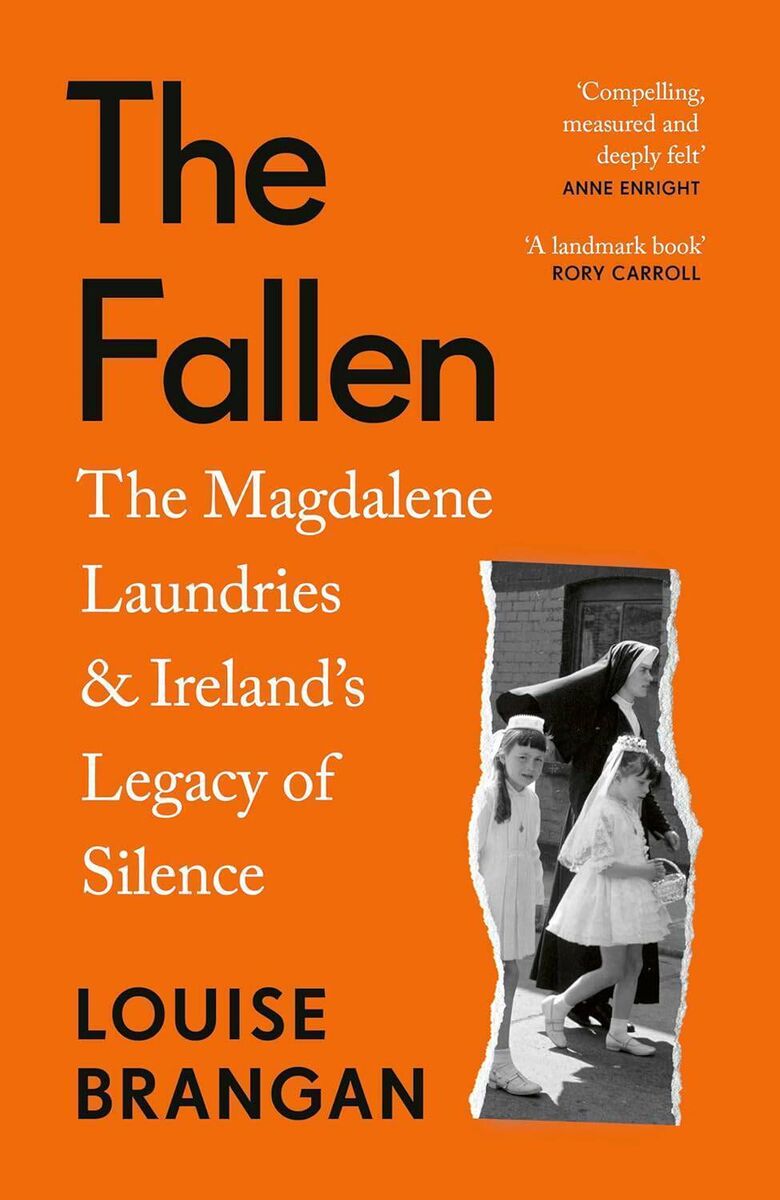
We have over the course of nearly three decades of rolling back stones on the past seen depictions of the Magdalene laundries in reports and particularly on screen; Louise Brangan’s ‘The Fallen’, however, presents the full picture.

We have over the course of nearly three decades of rolling back stones on the past seen depictions of the Magdalene laundries in reports and particularly on screen; Louise Brangan’s ‘The Fallen’, however, presents the full picture.

  • The Fallen: The Magdalene Laundries & Ireland’s Legacy of Silence.
  • Louise Brangan 
  • Penguin Random House UK, €18.99

Try to imagine the following. The scene is a totalitarian state in the 20th century, governed by diktat, its will imposed by violence. 

All citizens must pledge allegiance to the state. The smallest infraction, anything can could be interpreted at hinting of disloyalty or give rise to a remote fear of a refusal to conform, is dealt with swiftly.

Those who are deemed not to conform fully to the state’s wishes often simply disappear. 

Everybody else just puts the head down and gets on with things because they know that this is as things must be and, well, there but for the grace of God go they.

In the gulags where the disloyal, the unclean, those considered unworthy of full citizenship, are kept, they are often treated in a subhuman manner.

For instance, one person who was deemed fit for punishment was subjected to humiliation in front of 80 other inmates at mealtime.

“She was told to take to her knees. Bowed in obeisance upon the floor, she was made to eat from her bowl like a dog.”

Such a setting would, until recent decades, have prompted many to speculate that the cruel regime must have been somewhere behind the Soviet Union’s Iron Curtain, or maybe in Asia or Africa, where godless, ruthless, and often crazed dictators treated all citizens as either a threat or a plaything.

But no, what is set out above is lifted from the pages of a groundbreaking book on life in a western European, democratic state. 

For the gulags of the Soviet Union, read the Magdalene laundries. That is no exaggeration as Louise Brangan sets out in cold detail in The Fallen

Women who were committed to the laundries had much the same alleged protection from the law as citizens living in totalitarian states.

We have over the course of nearly three decades of rolling back stones on the past seen depictions of the laundries in reports and particularly on screen. The Fallen, however, presents the full picture.

Book compiled from research that includes myriad rreports

The book is compiled from research that includes myriad reports — some of which included the crucial element of first hand testimonies of the women who were incarcerated. 

What emerges is a digestible narrative, presented in controlled prose, albeit just short of steaming with rage.

The genesis of the laundries came about on establishment of the Free State following independence. 

Once the smoke had cleared, the powers that be “became gripped by a fanatical right wing zeal about how society should be organised and how citizens should behave.” 

Classifying it as “right wing” is debatable. Put simply, power in relation to anything that came into the ambit of the Catholic Church’s obsession with sexual mores was directly handed over.

The worst strictures of what was effectively a theocracy were imposed on women. 

In the Ireland of the times, there were more Magdalene laundries for women than prisons for men. 

Incarcerating a girl or woman in this respect did not require even the most cursory nod to a law that was supposed to govern a democracy.

Incarceration that could extend to decades

A man who, for instance, was found guilty of having committed murder could expect to serve about seven years in prison. 

By contrast, a girl or woman who offended, in even the most negligible way, the mores of the time, were subjected to life-transformative incarceration that could extend to decades.

“By the 1940s the mildest transgression of girls or young women caused more outrage than the taking of a life,” Brangan writes. 

Apart from that, the living conditions in a prison were, on the whole, much better. Inmates in the laundries were in effect used as slave labour in a commercial venture.

Officially, more than 10,000 females were incarcerated in these institutions between 1922 and 1996, although many historians say this is a gross underestimation.

The author deals with a widely held misapprehension that committal to a laundry was usually as a result of expecting or giving birth to a child outside of marriage.

That would be cruel and inhumane enough, but the reasons for committal were actually trivial even by the warped standards of the time.

Locking-up of 15-year-old Eileen for predelinquency

The book begins with this: “Fifteen-year-old Eileen disappeared on a quiet Sunday evening in February 1954.” 

She had been born in a mother and baby home, raised by relatives in a cold house and fled to Dublin to find work once she could.

She was in the early straits of a new life on this day when two women from the Legion of Mary visited her place of work. 

She was alone there and the women asked her to accompany them. They were on the lookout for girls showing signs of “predelinquency”.

Eileen went with them and ended up in laundry and given simply the number 60. 

Her life was taken from her under the wholly fraudulent premise that her jailors were acting on behalf of a higher, loving power. 

She was, in effect, locked up and enslaved by one of the religious bodies which ran the laundries.

Then there was Brigid, who had been born outside marriage and raised by her grandmother. 

In 1948, during her childhood, Brigid “skipped classes and sometimes left school early”, Brangan writes. “What matter anyway? She was at that age where most of her friends were leaving school”.

Brigid was dispatched to the Irish version of the gulag.

Carmel was taken to the Good Shepherd laundry in Sunday’s Well in Cork. On arriving, she stood silently as some of the nuns decided what her new name should be. 

The girl watched as her identity was swiped away but the nuns had some difficulty in coming up with her new identity.

“They could not agree a house name, as if having conducted this ritual so often they had reached the limits of their imagination.”

From the outside, the laundries were hailed as some form of a re-education camp, doing God’s work. 

The book recounts how one Catholic magazine praised the work of the nuns in the laundries.

“It was a place where women’s vice and virtue confronted each other,” the piece read, adding how gratifying it was to see “the spotless lily side by side with the sour smelling weed. The consecrated nun speaking to the polluted outcast”.

Beyond the centres of power, the silence was deafening. It had been decreed that these women would be among those selected to act as deterrents to society, examples of how a life could be condemned if the strictures demanded were not observed.

The Fallen is a powerful and disturbing read. To those who have tirelessly advocated for the females who were victimised by the State and society at large, the details will be well known. 

For the survivors themselves there is within these pages the grim satisfaction that the silence no longer prevails.

For the rest of us, and those who will come after, this book should be retained and displayed in every public shelf and beyond as testament to how a group of people can so easily be cast as “the other”, their lives dehumanised, their plight ignored under some cruel and corrupted premise.

x

BOOKS & MORE

Check out our Books Hub where you will find the latest news, reviews, features, opinions and analysis on all things books from the Irish Examiner's team of specialist writers, columnists and contributors.

More in this section

Scene & Heard

Newsletter

From music and film to books and visual art, explore the best of culture in Munster and beyond. Selected by our Arts Editor and delivered weekly.

Cookie Policy Privacy Policy Brand Safety FAQ Help Contact Us Terms and Conditions

© Examiner Echo Group Limited