Why singletons are fall-ing in love in the autumn (and snubbing dating apps)
It's called 'cuffing season' — when the evenings draw in, and singletons start to pair up. And, says Jenny McEntegart, many are now abandoning dating apps and turning to singles group events to find love
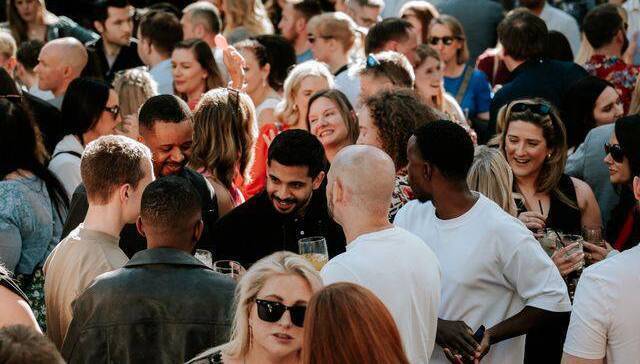
A Singles Party run by singles events company Your Friend, My Friend. The founder of the company says dating app fatigue is now the most common complaint she hears from attendees.

A Singles Party run by singles events company Your Friend, My Friend. The founder of the company says dating app fatigue is now the most common complaint she hears from attendees.

As the evenings begin to close in and the long, hot summer is consigned to memory, some of us may find ourselves contemplating another seasonal change.

The prospect of having somebody to share a bottle of wine and the remote control with as autumn arrives can seem considerably more cosy and appealing than it did during a sunny July.

Welcome to ‘cuffing season’: That time of year when single people are supposedly more inclined to pair up as temperatures fall, only to potentially rediscover their independence somewhere soon after Valentine’s Day.

Popular culture has certainly done its bit to romanticise the colder months. Films such as The Holiday and the Bridget Jones series have long presented winter as a backdrop for romantic possibility. The instinct to seek somebody out as the nights draw in, however, may pre-date the romcoms by several thousand years.

Martin Graff, a psychologist at the University of South Wales, has examined the possible evolutionary explanations behind ‘cuffing season’. In our evolutionary past, seeking the company of others during colder, darker months may have offered warmth, safety, and protection.

There may even be a biological component. Testosterone levels in men fluctuate seasonally and tend to be higher during winter, potentially influencing the motivation to seek a sexual partner.

Research has also found intriguing seasonal differences in attraction. In a 2008 Polish study of 114 heterosexual men, ratings of women’s bodies were highest during winter and lowest during summer. 

Researchers suggested that greater exposure to uncovered bodies during warmer months may make them seem less novel. In other words, your sudden October conviction that the man you have been ignoring since June has developed a certain something may not be entirely attributable to his new jumper.

Despite all this talk of coupling up, however, Graff points out that the clue is in the word ‘season’. Cuffing traditionally refers to a temporary liaison during the winter months rather than the pursuit of a long-term relationship. So perhaps hold off on clearing him a drawer.
It appears that both biology and evolutionary psychology offer possible explanations for why our appetite for connection might change with the seasons. Graff cautions against conflating ‘cuffing season’ with the apparent move away from dating apps. 

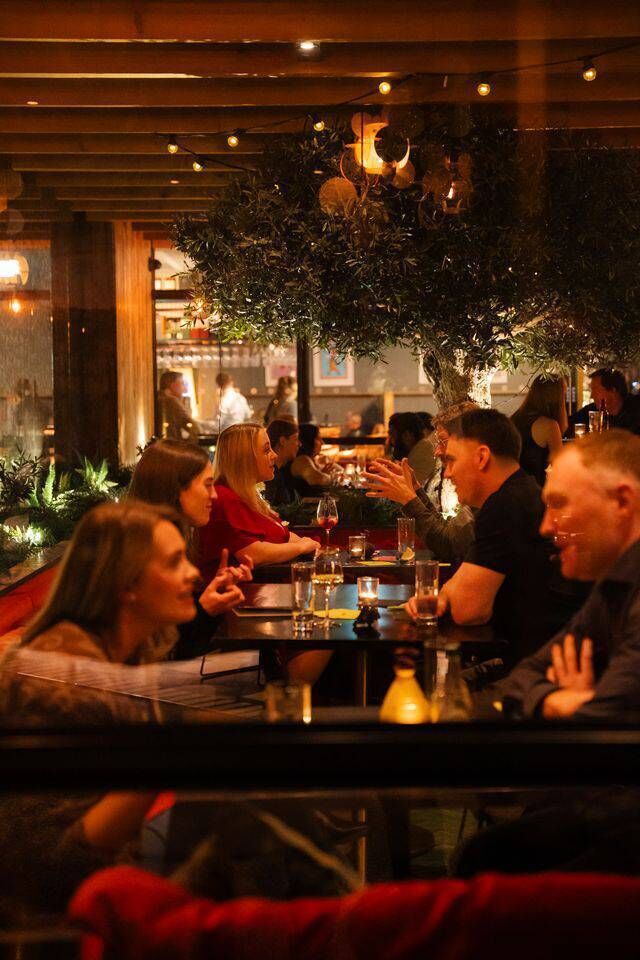
A speed dating event run by singles events company Your Friend, My Friend, which is reporting a huge increase in participants, particularly men

The possible explanations for cuffing, he says, suggest that the behaviour existed long before online dating and is therefore independent of it. There is also, he points out, a considerable difference between meeting somebody online for the first time and encountering them face to face.

What has changed beyond recognition is the number of ways available to find that temporary winter companion. Our ancestors may have sought another human being for warmth and protection; their modern descendants are more likely to be sitting in bed with a cup of tea, staring at two WhatsApp blue ticks and wondering why there’s still no reply.

Samantha Keating, founder of Irish singles events company Your Friend, My Friend, says dating app fatigue is now the most common complaint she hears from attendees. Earlier this year, the company surveyed 1,009 members of its singles community and found that 41% were not currently using dating apps, citing app fatigue as the reason. 

Perhaps, after years of swiping, matching, and trying to think of an opening line more inspired than ‘Hey’, the novelty is beginning to wear off.

Crucially, though, being tired of dating apps does not appear to mean being tired of dating. Your Friend, My Friend has been running singles events in Ireland since May 2023, and has doubled the number it holds year on year in response to demand.

Last summer was its busiest yet, with twice as many events as last year and expansion into new counties. Keating expects autumn to be busier again. While events have always sold out, this year they are typically filling three weeks or more in advance.

A speed dating event in Dublin’s Grafton Hotel tomorrow, October 15, sold out, and tickets for one in Seventy Seven in Cork on Friday, October 16, were almost gone too. Similar events in Dublin, Cork, and Belfast in the coming weeks are also selling rapidly.

Speed dating remains the core of Your Friend, My Friend and its most consistently popular offering, but finding romance offline no longer necessarily means sitting opposite a stranger attempting to establish mutual attraction against the clock. Singles are also meeting through running clubs, surf weekends, barbecues, and other activity-led events.

Last month, more than 450 singles registered to attend the company’s largest event to date. Keating says people increasingly want a low-pressure way to meet others that does not necessarily feel like a ‘dating event’. 

Having an activity or light icebreaker gives people something else to focus on and something natural to talk about. And if the chemistry is not there, at least you have gone hiking. It raises an interesting question about dating in 2026. 

Are single people less interested in finding somebody, or would they just prefer an alternative to swiping through a catalogue of strangers from their sofa? 

The figures from Your Friend, My Friend point towards the latter. Keating says 82% of attendees meet somebody they are attracted to at an event, while more than 70% have gone on a date afterwards. Increasingly, she says, people are treating singles events as a genuine alternative to apps rather than something to try once for the novelty.

The distinction is important. ‘Cuffing season’ may offer one explanation for why some singles seek connection as winter nears, while dating app fatigue may be influencing where they choose to look for it. As Graff points out, the two behaviours should not be regarded as the same phenomenon.

There is another change Keating has noticed, however, and it involves the very generation we might expect to be most comfortable conducting its romantic life through a screen.

Gen Z

Historically, singles events have struggled to get men through the door. Keating says that pattern is still evident among millennials, with women’s tickets sometimes selling out within minutes while places for men move more slowly.

Among Gen Z, however, she is seeing the opposite: Men are increasingly proactive and enthusiastic about attending, and men’s tickets are now selling faster than women’s. A speed dating event for ages 22-33 run by Your Friend, My Friend in Dublin this week tellingly had the sign ‘Men Sold Out’ up.


A lack of success online could be one factor encouraging some men to seek opportunities elsewhere, including offline. Perhaps there is something fitting about Gen Z leading this return to face-to-face dating. 

This is a generation that has grown up with almost everything available at the touch of a screen. Dinner can be delivered, a new outfit ordered, cinema tickets booked, and an evening’s entertainment streamed without leaving the sofa. Dating apps appeared to add romance to the list, placing an apparently endless catalogue of potential partners in our pockets.

Human connection, however, has proved rather less accommodating. You can order dinner in a few taps; unfortunately, there is still no reliable option for adding ‘mutual attraction’ to the basket.

Dating apps may offer access to thousands of potential partners but, as Graff points out, they do not work equally well for everybody. Research does indicate significant differences in how men and women experience online dating. Men are more likely to feel insecure about a lack of matches.

Perhaps, then, the novelty for a generation accustomed to having the world available on demand lies in doing something decidedly old-fashioned: putting down the phone, walking into a room full of strangers, and seeing what happens.

x

More in this section

Cookie Policy Privacy Policy Brand Safety FAQ Help Contact Us Terms and Conditions

© Examiner Echo Group Limited