Ireland slips behind EU rivals in milk production growth
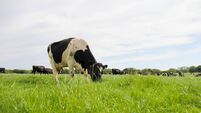
After many years of setting the pace in EU milk production growth, the momentum has faltered again, and Irish milk production for the first four months of this year was 0.7% below 2025.
Difficult spring conditions left Ireland among the laggards in EU milk production, in sharp contrast to the usual pace-making growth in Irish milk output.
From 2015 to 2022, milk solids output increased by more than 96% in Ireland. While there was a reduction in output between 2022 and 2023, milk solids output recovered and increased by 1% in 2024.
And Ireland hit a record milk output volume of 8.84 billion litres in 2025. This was an increase of 406.8 million litres (4.8%) compared to 2024.
However, after many years of setting the pace in EU milk production growth, the momentum has faltered again, and Irish milk production for the first four months of this year was 0.7% below 2025.
April was the month when milk yields slipped most, having exceeded 2024 and 2025 levels in January and February, and matched 2025 levels in March.
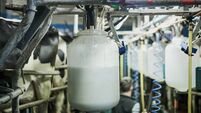
In May, the intake by milk processors and co-ops was estimated at 1.16 billion litres, a decrease of 19.1 million litres (1.6%) when compared with May 2025 (but up 5.1% when compared with the same month in 2024).
Fat content for May 2026 was 4.1%, up from 3.98% in May 2025. Protein content also rose from 3.47% to 3.51% in the 12 months to May 2026.
The January to May intake was still 6.9% better than in 2024, so dairy farmers will hope to repeat that year’s performance by increasing production over the 12 months, despite a slow start.
However, that recovery may become more difficult as drought conditions affecting parts of the country place additional pressure on grass growth and forage supplies, potentially compounding the impact of the difficult spring on milk production during the peak summer months.
They are still recovering from the difficult spring grazing conditions, which left grass quality on many farms requiring correction, such as tight grazing. Slippage of calving dates may also be a factor behind sluggish spring and early summer milk production nationally.
Read More
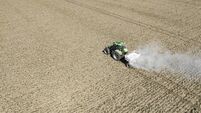
More favourable conditions as they moved into the main grass growing season will enable farmers to produce milk with maximum efficiency. This will be necessary to compensate for this year’s depressed milk markets and prices, and the geopolitical events which are expected to add at least 4c per litre to milk production costs in 2026 (such as the jump in fertiliser prices after the USA and Israel attacked Iran).
Just how slow the spring and early summer has been so far for Irish milk production can be seen by comparing it with other countries. Next door in the UK, milk deliveries in the first quarter were 3.4% higher year-on-year, on top of its record deliveries in the 2025-26 season.
And milk deliveries across the EU increased by 4.6% in the first quarter.
This helped to boost EU dairy exports by 6.9% in the first quarter, compared to 2025.
For the first four months of the year, the latest EU figures showed milk production gained 7% in Italy, 6.7% in Germany, 5.4% in the Netherlands, 4.5% in France, 3.2% in Poland, 2.1% in Denmark, and 1.7% in Spain, compared to 2025.
In contrast, milk yields for the first four months slumped 11.5% in Romania, 9.6% in Estonia, 4.8% in Latvia, and by lesser percentages in Bulgaria and Malta.
The total volume of the major global dairy exporters (including the EU) was 3.8% higher in the period through April 2026 than a year earlier.
Global milk production in the calendar year 2026 is expected to increase 1% year-on-year. But this includes a fourth quarter decline of about 1.6%, which could start to turn dairy markets around.
Depending on how the predicted El Niño weather pattern affects milk production in South America, Australia, and New Zealand, there could be a larger-than-expected decline.
Recovery in milk prices would be welcomed everywhere by farmers whose profit margins are squeezed by this year’s rising input costs.