Barn robots ready to steal the show at EuroTier 2026
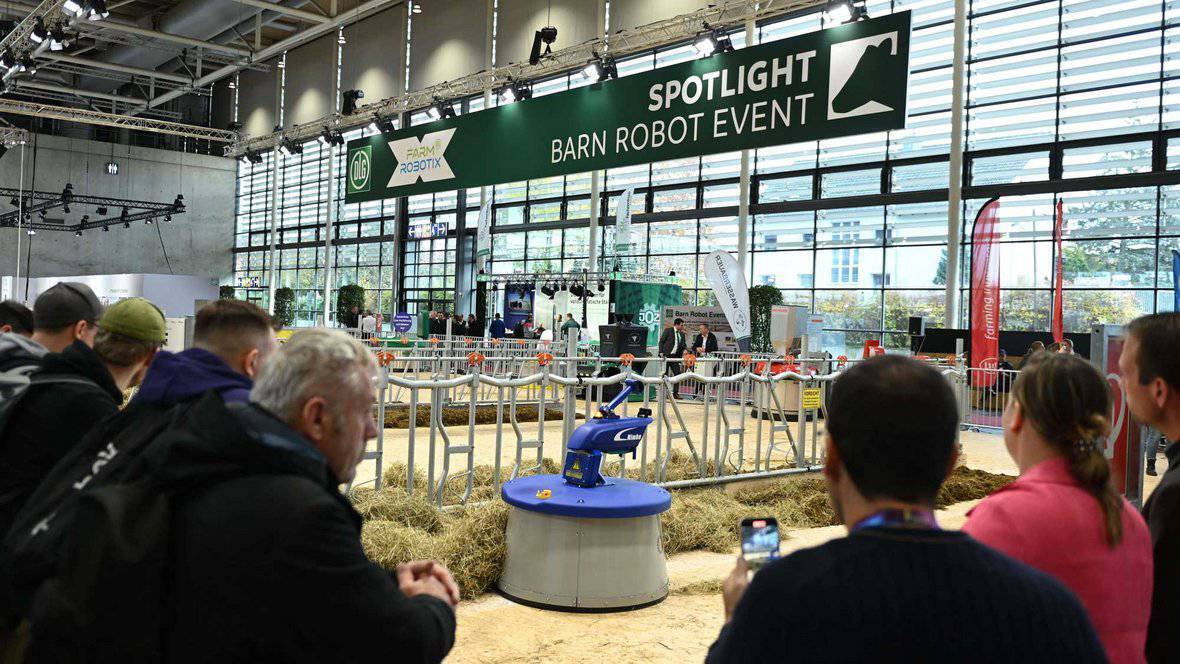
Farmers will love the Barn Robot Event at EuroTier 2026, the world's leading trade fair for professional animal husbandry and livestock management, next November in Hanover, Germany. Picture: EuroTier/DLG
Working displays are always a big hit at agricultural shows. Nothing draws farmers better on their day off than watching work being done, and relishing their own temporary release from hard labour.
“I love work, I could watch it all day”, might well be the motto of those crowded around dynamic “live action” displays. They will love the Barn Robot Event at EuroTier 2026, the world's leading trade fair for professional animal husbandry and livestock management, next November in Hanover, Germany.
They can watch a farm being run by robots. The German Agricultural Society, which organises the biennial EuroTier event, believes that there is no alternative to the continued automation and digitalisation of livestock farming, and that robotics will play an increasingly important role in the future.
The primary aim is to relieve farmers of physically demanding and time-intensive tasks, improve operational accuracy, and address the growing shortage of qualified labour in agriculture. Farmers in Hanover will watch a milking robot which can perform up to 200 milkings per day.
They will also see modern feeding robots mix individual feed components and deliver fresh rations to the animals several times a day. Automated feeding systems retrieve hay, silage, as well as mineral and protein supplements from storage units, and prepare precisely balanced rations.
During feeding, these systems also automatically push the feed so that animals can access it easily at all times. The Barn Robot Event will also have cleaning and manure removal robots scraping passages.
Pig farmers at EuroTier will be interested in the PigPooPicker. Although still only at the research stage, it is an autonomous cleaning and manure removal robot for open housing systems with bedding and outdoor access. It is designed to carry out cleaning tasks continuously.
Automated systems are also gaining importance in poultry farming. For example, a robot moves autonomously through poultry houses for chickens and turkeys and uses light signals, sounds and movement stimuli to keep the animals more active.
At the same time, modern robotic systems perform monitoring tasks and collect important data on poultry housing conditions such as climate parameters.
Robotics has made particularly strong progress in cattle farming over recent decades. The first milking robots were introduced on German dairy farms in the late 1990s. Today, automatic milking systems are standard technology in many operations.
Fixed milking times in the early morning or at weekends are no longer required. The quality of life of farming families improves considerably.
Manure scraper robots are now considered indispensable helpers on many farms and are often integrated directly into newly planned housing systems. Robots operate consistently and are not affected by physical or mental fatigue, which reduces the risk of errors in animal management.
Milking robots automatically recognise individual animals, monitor milk quality, and collect health data. Diseases or irregularities can therefore be detected at an early stage.
The animals encounter identical conditions in the robot every day, which reduces stress on them and improves animal welfare. Cows can decide themselves when to visit the milking robot. Lower-ranking animals benefit in particular, as competition is reduced.
Automated feeding systems also operate with a high degree of precision. They prepare feed mixtures exactly according to programmed recipes and adjust supply to the specific needs of different animal groups.
Cows, calves and dry cows receive precisely the ration they require. Providing freshly mixed feed several times a day also improves feed quality.
In pig production, continuous cleaning to reduce ammonia emissions is a key factor.
The benefits of robotics are multiplied for farmers encountering a shortage of skilled labour. Qualified workers are becoming harder to find across many areas of agriculture, even as requirements for animal welfare, hygiene and environmental standards continue to increase.
But many tasks that were previously carried out manually can now be automated, reducing dependence on human labour. This advantage is particularly evident in dairy farming, and in milking, one of the most labour-intensive tasks on a farm.
The time gained by using robots can be invested in more intensive animal observation and management.
However, for farmers convinced by the display at EuroTier, the high investment costs for robotics remain a challenge.
A milking robot can cost well over €100,000, and cleaning robots are in the five-figure range. For smaller farms in particular, this can represent a significant economic barrier.