How can grassland farmers adopt a climate smart approach to drive production?
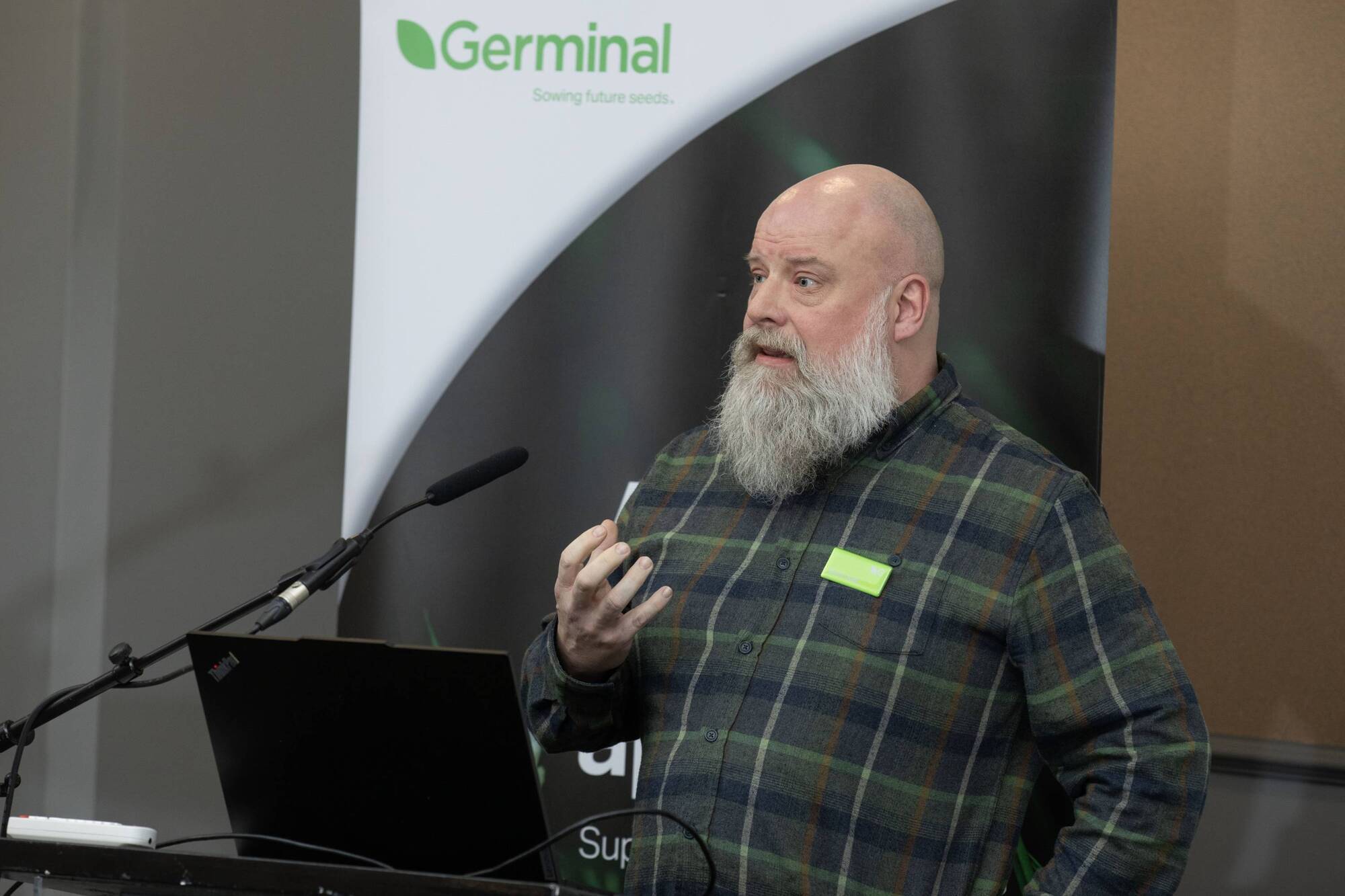
Dr David Lloyd
Utilising legumes and growing catch crops to protect soil health are climate-smart ways grassland farmers can lower inputs while continuing to drive production.
This was the message at Germinal’s recent Technical Day in Portlaoise (2 February).
“Pasture utilised continues to be a key driver of profit per hectare. It is important we don’t start to see system drift. Grass and clover management will become increasingly important,” Mary McEvoy, Germinal technical director, told delegates.
She added: “Healthy soils will underpin the profitability of our systems. We need to maintain productive agricultural systems to ensure we can feed the world.”
90% of land in Ireland is in grass which provides huge scope to sequester carbon at a national level, she said, adding: “Agriculture and the environment can have a very symbiotic relationship in the future.”
She highlighted the importance of using the Pasture Profit Index published by the Dept. of Agriculture and Teagasc for grass seed to select top-performing varieties.
There is a €157/ha/year difference between the best and the worst perennial ryegrass on the list, she revealed.
The role of Red Clover Clover establishment in grassland swards was becoming ‘an absolute necessity’ to reduce reliance on artificial nitrogen, she said.
Dr Nicky Byrne from Teagasc Grange agreed that Red Clover could play a key role in helping to meet lower nitrogen derogation limits.
Since 2019, Teagasc Grange has reduced chemical nitrogen from 250kg/ha/year to 120kg by incorporating white and red clover into grassland.
Dr Byrne explained that red clover could biologically fix up to 300kg of N/ha but needed careful management to achieve good persistency.
He encouraged farmers to select varieties for good persistency after year three and sow red clover alongside good quality perennial ryegrasses and white clover to bridge the gap when red clover diminishes in the sward.
New developments in plant breeding Dr David Lloyd, Head of Plant Breeding at Germinal Horizon, which is part of Aberystwyth University, explained how Germinal is developing improved varieties of red clover to improve persistency.
One of these is RedRunner, which has a stoloniferous growth habit like white clover, which he said could be "revolutionary in grassland agriculture".
Not only does it have improved grazing tolerance, but it also reduces ammonia losses.
“When leaves are damaged during grazing or when clover is ensiled, it produces compounds that bind to proteins, making them less vulnerable to degradation by fermentative processes. Therefore, it reduces the loss of nitrogen as ammonia and increases protein available for use by the animal.” Dr Lloyd explained.
RedRunner is one of the varieties being developed as part of the Nitrogen Utilisation Efficiency-Legume (NUE-Leg) project which has recently secured €4m in grant supports from the UK Dept. of Environment and Rural Affairs for its next on-farm trial phase.
Project NUE-Leg seeks to combine newly developed legume varieties with selected soil microbes and bespoke plant nutrition programmes to achieve a three-fold increase in fixing atmospheric nitrogen, to thereby eliminate dependence on fertiliser nitrogen.
Cover crops soil scientist Neil Fuller from Atlas Sustainable Soils Program, talked about how cover crops could retain nutrients like nitrogen whilst building a ‘brand new proposition’ for agriculture in helping to mitigate climate change.
“The only piece of the puzzle that can get involved with carbon removals is farmers because they have land and that’s a unique proposition. The whole thing pivots around soil [sequestration],” he said.
Growing multi-species cover crops for 90 days after barley harvest retained 120kg of N and 32kg of phosphorus, three years of data showed.
“If it’s green, it’s growing, it’s multispecies, it’s really climate-friendly, and you’re taking the first steps towards climate-smart farming,” Dr Fuller told the audience.
Germinal Area Sales Manager Diarmuid Murphy said: “Germinal is driving change through innovative forage breeding. We believe there’s a positive future for those in farming, particularly those with a low-cost base.”