Dairy farmers facing ‘most complex transition in living memory’

Tirlán CEO Jim Bergin: Nitrates decision is 'the culmination of a fear we have had for a long time'.
The decision to slash Ireland’s nitrates derogation following years of rapid dairy expansion will force farmers to endure the most complex transition in a lifetime, Tirlán chief executive Jim Bergin has warned.
Farmers have just over three months to meet the new stocking rate requirements by reducing their herd size or buying or renting more land — no easy task with thousands of other Irish farmers all in the same position.

It following news the European Commission will not review the decision to reduce Ireland’s nitrates derogation to 220kg/ha by January 1.
Dairy cooperative Tirlán’s 2,400 dairy farmers produce more than three billion litres of milk a year, accounting for about a third of Ireland’s milk production.
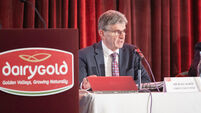
Speaking at this year’s Agricultural Science Association conference, Mr Bergin said it was “the culmination of a fear we have had for a long time”.
“We do have to remember, this is the most complex transition farmers possibly ever have been faced with… and I’ve been through three before this one — from being a young chap and seeing the focus on automation and quality back in the 70s, then for 34 years we focused on efficiency and consolidation on farm level, and then we have seen the massive expansion over the last number of years, from 2015 to 2021,” Mr Bergin said.
“But I am convinced that what this — and they only have done half the story — is the most complex transition they have ever faced. And we have to tackle it in a different way.”
Mr Bergin said the issue was creating an “incredible level of stress at farm level”.
“It is causing farmers to do things that in some cases are uneconomic — like for example, renting land on long-term leases for €500/ac not knowing what the market is going to give. It is the culmination of a fear we have had for a period of time,” he said.

Indeed, you didn’t have to go far at ‘the Ploughing’ to hear of stories of farmers paying upwards of €600/ac in the panic to secure land. Others feared long established conacre could be lost as landowners begin to look over the fence to greener pastures.
Irish Creamery and Milk Suppliers Association president Pat McCormack told the that despite public perception, the issue is not just limited to affecting the biggest herds.
He said many small herds from Kerry and Cork will be among the worst affected because the reduction of herd size on a smaller farmer will have a greater proportional affect on the farm’s bottom line.
“The first guy that rang us the other day about this, was a guy in Kerry with just 48 cows, and he had found himself back 40-42 cows. It’s hard to continue to be viable at that size,” Mr McCormack said.
“We have those cases right across the country, including farmers in Bantry with 76, 62 cows. They will be facing a significant reduction in volume.
"In the worst-case scenarios, they are facing a 14-15% reduction in 2023, and they are going to follow that on with a similar reduction in 2024.”
Mr Bergin confirmed a “high percentage” of Tirlán suppliers would be directly affected.
“The consequence now is that farmers will continue to acquire land or rent land and demand for land is already at a very high level, so we are worried about that,” he said.
“My worry is that the science of what is possible on the rivers hasn’t been done. So everyone talks about reduction and farmers are affected by that of course, because it affects their income. But no one actually has set a baseline to show what levels farmers implementing these policies and management and water quality management practices can achieve.
“We have to establish scientifically how much we can produce in this country on the basis of having best-in-class nutrient management and water quality management.”