Stephen Cadogan: Government must make it easier for farmers to borrow
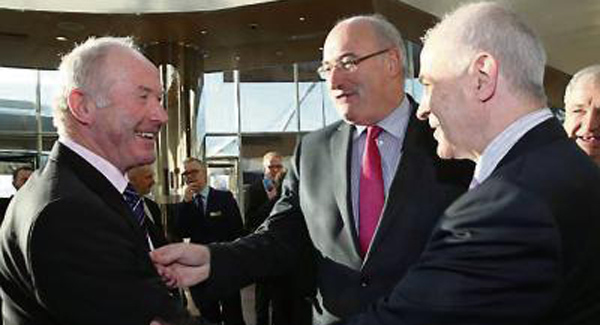
EU Agriculture and Rural Development Commissioner Phil Hogan has to be careful not to show any favouritism in his dealings with member states.
Stephen Cadogan: Government must make it easier for farmers to borrow

But he was nearly twisting the arms of his former Irish government colleagues when he was in Ireland recently to promote European Investment Bank loans for farmers, offering money at 3% over ten to 20 years.

The response from Agriculture Minister Simon Coveney has been no more than a “commitment” to examine the potential for the use of these financial instruments in Ireland’s rural development programme, despite the Commissioner’s enthusiasm for an initiative which he believes has enormous potential for farmers and rural communities throughout Europe.


Maybe the government will be more forthcoming after this week’s figures from the IFA showed that an Irish farmer has to pay back at least €2,000 per year more than farmers in other Eurozone countries, on borrowings of €100,000.

The cost of new borrowing for Irish farmers and small enterprises of 5.7% is significantly higher than for equivalent businesses in the Eurozone, where it averages at 3.3%. Farming is export dependent, and it is hard enough to compete overseas without having to overcome higher borrowing costs.

So Ireland should be first in the queue for what Mr Hogan says could be money at about 3% over a 15 or 20-year period for younger farmers taking over and investing in farms.

Ireland would have to include it as part of its rural development package, in order to get over the EU state aid restriction, and enter into negotiations with the EIB directly, and then find the distribution channel or financial institution to make the loans available in Ireland.

Mr Coveney has asked his officials to engage with the European Commission, EIB and other stakeholders to identify where financial instruments could be best implemented, and to explore the practical steps required.

This process needs to be prioritised, to match the government’s huge expectations of farmers.

At Ireland’s Pavilion in Expo 2015 in Milan, visitors are being told the entire Irish farming sector has voluntarily submitted itself to a programme of continuous verification of sustainability parameters, in order to become a world leader in sustainable production of food and beverages.

With such big aims, farming cannot be left handicapped by higher costs and lower availability of finance, compared to other EU farmers.

Therefore full advantage should be taken of the EIB rural loans offer, if agriculture and the agri-food sector are to continue as players in export-led recovery.

Agriculture should be an ideal candidate for the EIB rural loans, as it has one of the highest percentages of performing loans in the small-to-medium-enterprise in Ireland.

Throughout the Irish economy, the weak credit supply is a major drawback, blamed on low economic growth and the adjustments in Irish banking.

This hurts farming more than some other sectors, because it is the source of Irish food for export which must compete against produce from more competitive operators in other countries.

So far, the farming and food industries may have been luckier than other sectors in successfully overcoming handicaps like uncompetitive borrowing.

Farming and food have benefited more than most from the weak euro and favourable exchange rates — advantages which can be quickly reversed, leaving the sector depending on its inherent competitiveness, in which access to finance for enterprise is a big factor.

IFA says more needs to be done to promote a fully functioning commercial banking service and to drive down interest rates.

Putting the cheaper European Investment Bank loans for Irish farmers in place would go a long way towards a level finance playing pitch for Irish farmers, compared to Eurozone colleagues.

x

More in this section

Farming

Newsletter

Stay ahead of the season. Sign up for insights, expert advice and stories shaping Irish agriculture.

Cookie Policy Privacy Policy Brand Safety FAQ Help Contact Us Terms and Conditions

© Examiner Echo Group Limited