Behind the scenes at Cork Airport: Meet the workers who get your holiday off to a flying start
From lost property and passenger assistance to security screening and customs dogs, Deirdre McArdle meets the people behind Cork Airport’s success
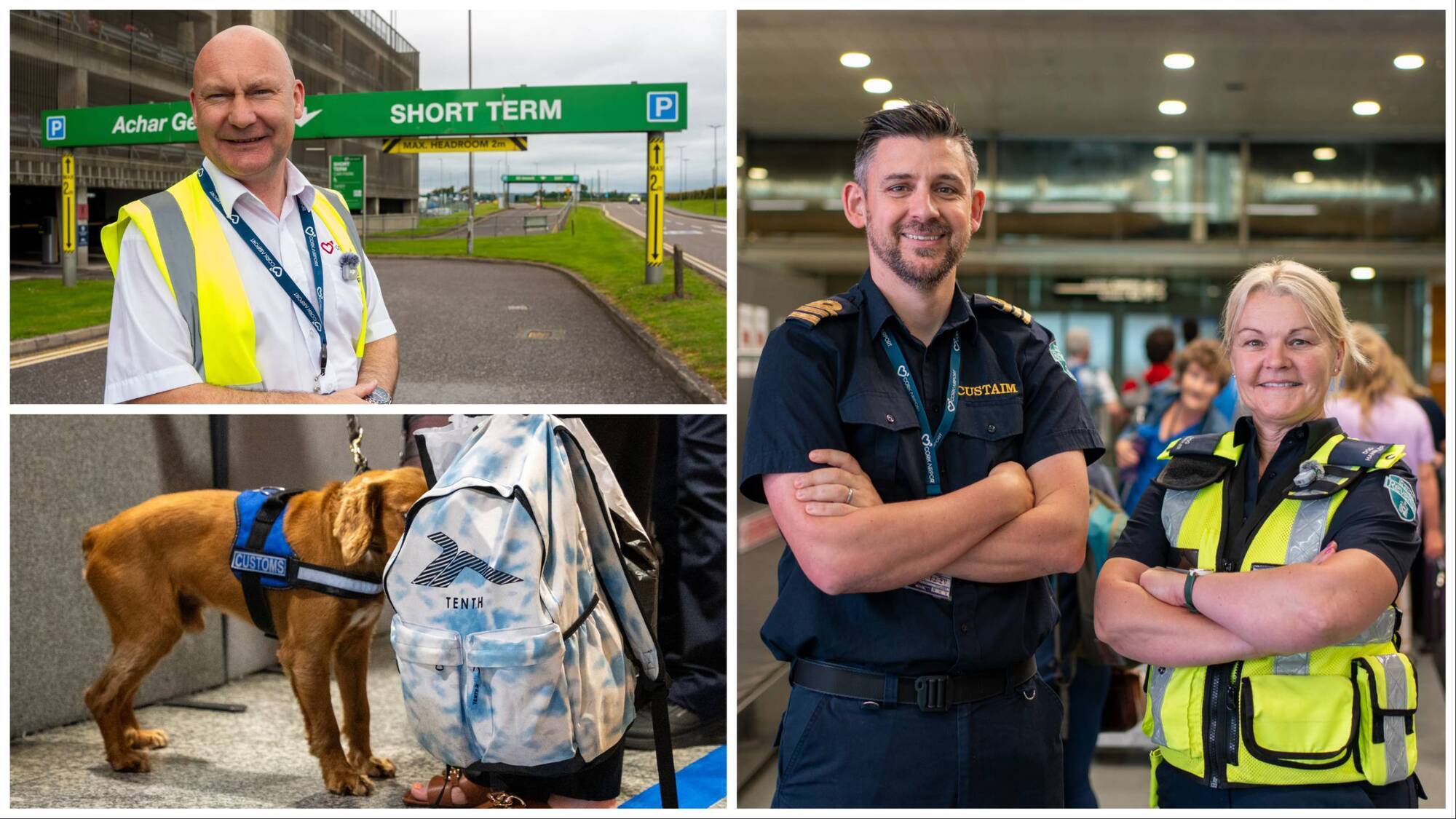
Some of the staff behind the scenes at Cork Airport. Pictures: Noel Sweeney
Some of the staff behind the scenes at Cork Airport. Pictures: Noel Sweeney

Cork Airport is a small airport with a big personality. In 2025, Airport Council International named it the best airport in Europe in the under 5m passengers category — the third time it has won this award.

The award focuses on operational efficiency, route development, sustainability and innovation, and the passenger experience.

It’s easy to see why the airport has won this award multiple times. ‘We care about our passengers’ may as well be hanging from a giant banner in the foyer. The ethos is everywhere you look.

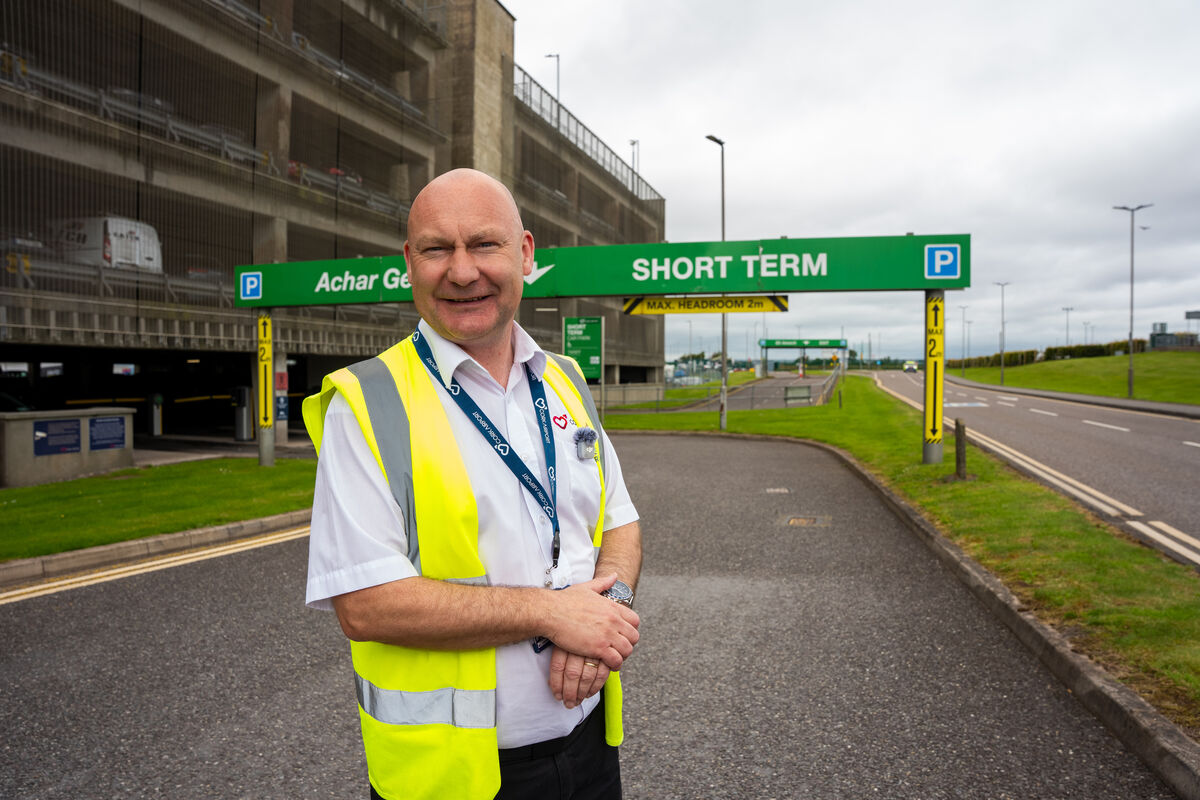
It begins in the car park where car park manager Bernard Dooling says: “We’d never leave anyone without a space. Even if someone hasn’t booked a space online and just turns up on the day, we’ll find a space for them.”

A typical day will also see the team patrolling the car parks, keeping an eye out for any issues, like a window left open in a car (which they promptly tape up to make sure it isn’t exposed to the elements), or an item left forgotten on a kerb (which they rescue and catalogue in the lost property office).

“You wouldn’t believe the stuff people leave behind,” says Dooling. “We’ve found a bird cage and a box of mackerel outside in the drop-off area. Best we can imagine is that someone took them out of the car boot to fit luggage in and simply forgot them!”

The lost property office is like a theatre props department. Cupboards and drawers are full of phones, tablets, chargers, earphones, scarves, hats, jumpers, jackets, jewellery, walking sticks — dozens of them — and, incredibly, three guitars.

Cork Airport Parking attendant Bernard Dooling. Picture: Noel Sweeney

“We catalogue all the items and keep a note of where and when they were found. People can submit a claim online or come in person to pick up items. We keep everything for three months; you can see the number of items here, we simply don’t have the space to store them long-term. Then we donate what we can.” Items like phones and tablets are destroyed after three months because of GDPR rules, he explains.

For Dooling’s team, it’s a busy job. There are three car parks at Cork Airport, providing 4,600 parking spaces. An extension to the Blue car park, due to be finished this month, will provide an additional 650 spaces. “There are the constant comings and goings, and the phone is always ringing with people asking about parking, looking for lost property, looking for assistance. It’s all go.”

A new initiative to build a solar farm over the Blue car park will be finished by summer 2027. It’s set to be Ireland’s largest solar-powered car port system and will generate 20% of the airport’s electricity.

A helping hand

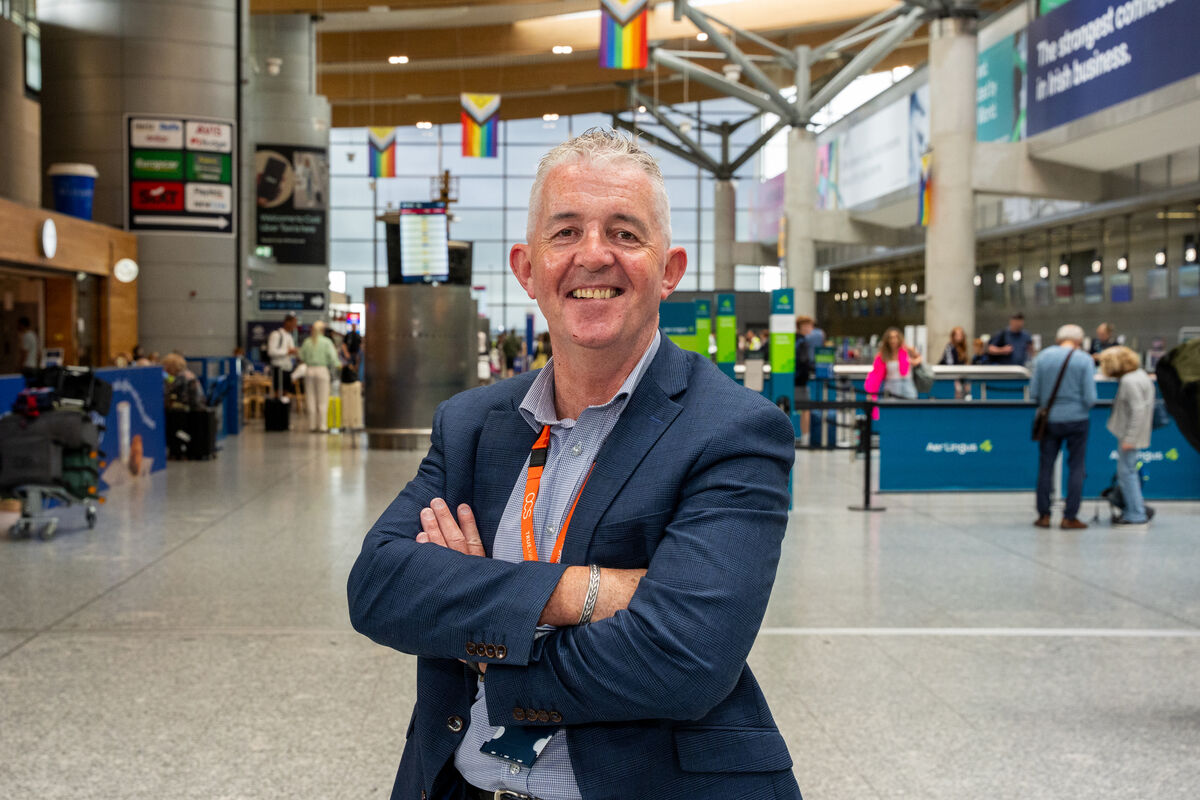
OCS provides assistance to passengers with reduced mobility as they make their way through the airport. Derek Murphy, OCS operations manager based in Cork Airport, says that, each day, around 140 people require assistance. Last year, the team assisted 36,000 people and they expect to help 40,000 in 2026.

Derek Murphy, Operations Manager for Cork Airport on behalf of OCS (One Complete Solution). Picture: Noel Sweeney

“These are pre-advised, in that they’ll have booked assistance through our app. You can potentially add another 10% that haven’t been pre-advised to that.”

The app, developed in conjunction with Cork Airport, is called PRM Assist. Murphy says it’s the most important innovation he’s seen in his 24 years working in this area. “People can use it to book assistance, but also, it means their family can track their journey through the airport and know that they got to the plane safely.” Murphy calls what they do “seat-to-seat”. His team of 22 full-time and 10 part-time staff bring passengers from departures all the way to their airplane seat. “If they arrive into Cork, we bring them from their aircraft seat all the way through to their taxi, bus, or car seat.” It is a very rewarding job, says Murphy, who regularly provides assistance himself.

“I don’t believe that the operation can ever be run from behind a desk,” he says.

Citing new EU legislation that mandates free-of-charge assistance at airports and on board aircraft, Murphy says: “It really has opened up the door to travel for people — the elderly, the disabled, those with hidden disabilities.” You don’t need to provide any documentation to get assistance at Cork Airport, explains Murphy. “You might feel unwell on the day of your flight and might need help making your way to the plane, that’s fine, we can help with that too.”

In 2019, Cork Airport was the first in Ireland to introduce the sunflower lanyard, which helps passengers discretely show that they may need assistance. “[The lanyard] is bringing that hidden disability to the forefront. All staff are trained and know that if a passenger is wearing the lanyard they may

have a hidden disability or intellectual difficulties, and to manage or deal with the passenger in a sympathetic way.”

‘During peak season, 10,000 people pass through security each day’

One of the busier areas of the airport is security screening. Airport search unit supervisor Brendan Boylan says over 6,500 people pass through every day. “In August, on our busiest days that number goes up to about 10,000 per day.” The early morning shift tends to be busiest, says Boylan. “That time between 5.45am and 7am we could have 1,200 people going through screening.”

During those busy times, four security lanes will be open, with 17 security staff on the floor. One of those is Hazel Forde, who has been working as an airport search unit officer for about a year. Her intense training, a mix between classroom and practical training with repeated exams in search, X-ray image interpretation, bag search, access control, and general airport security, prepared her for the job, she says.

The team is also tested a couple of times each month with a ‘mystery’ passenger posing as a security threat with a bag containing various prohibited items. This is to ensure that the team are always on their toes, explains Boylan.

A strict 20-minute rotation at each station is also designed to make sure security staff retain concentration. “The X-ray role is intense, high-focus work,” says Forde. “It’s mentally demanding, especially trying to understand the images you’re seeing. I think people would be surprised what’s involved.”

Boylan explains that the difficulty is that the X-ray only shows shapes and densities; when objects overlap or are packed awkwardly, even ordinary things can look unclear, forcing staff to stop the belt, rescan, and physically search the bag.

For Forde, who used to be a nervous traveller, working in security screening has given her insights that have changed how she travels. “The longer I’ve worked here, the more organised I’ve become. I know now a lot more what to expect and what not to do, what not to bring.I’m a lot more comfortable.

“I think a lot of people find the airport quite stressful. Sometimes they can lose their head a little bit. But we try our best to be friendly, be relaxed, and let them know what to do,” says Forde.

“If you have a good team on, you can have a giggle with the passengers. It does relax them and we can get them through as quickly as possible. It’s a team effort,” adds Boylan.

Just shy of 3.5m passengers passed through the airport last year, up 12.8% on 2024. It’s a constant stream of people departing or arriving into Cork. If they’re arriving, they will pass through customs after they collect their suitcases in the baggage hall.

Rua, the dog star of Cork Airport

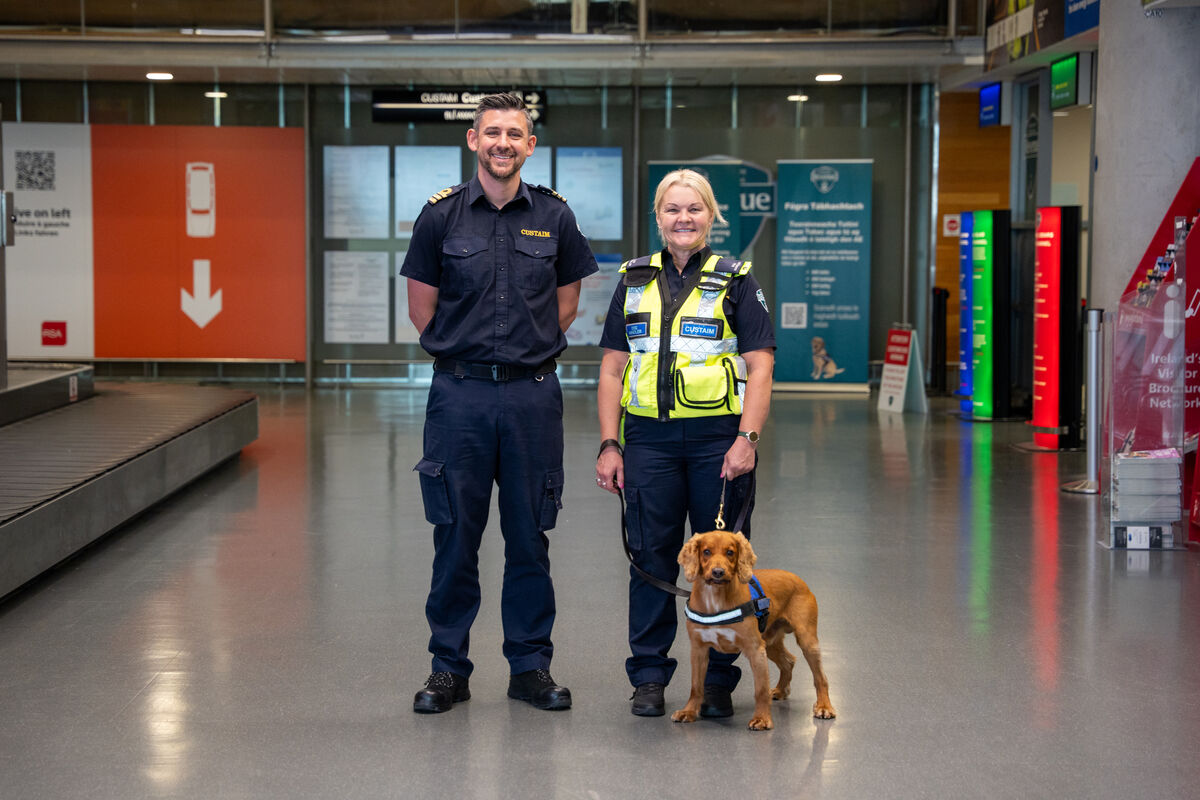
Here they may encounter Olivia O’Connor, a customs dog handler, and her dog Rua.

Rua is a four-and-a-half-year-old Sprocker, a cross between a Springer Spaniel and a Cocker Spaniel. He’s striking to look at, and excellent at his job.

His main task is to detect passengers trying to bring cannabis or large quantities of tobacco or cash into the country. John Adams, the airport’s customs manager, explains that, since December 2023, Irish rules on bringing back cigarettes from the EU have tightened. “From an EU country like mainland Spain, you can only bring 800 cigarettes and 1kg of tobacco.”

John Adams, Customs Manager at Cork Airport and Olivia O’Connor, Customs dog handler; and Rua, Customs detector dog. Picture: Noel Sweeney

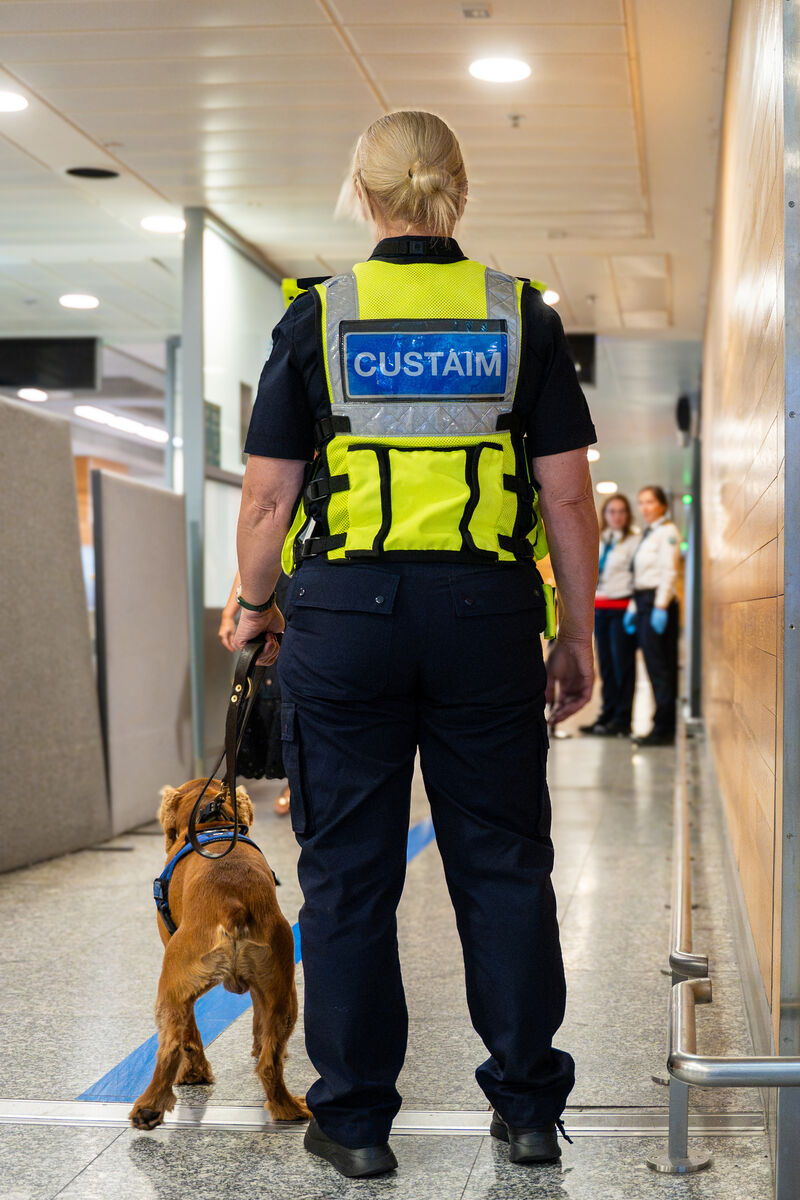
Any more than that and Rua will be on your case, literally. To detect contraband, Rua walks along lines of bags and passengers, sniffing as they pass.

If he sits, points and refuses to move, O’Connor knows there is likely to be cannabis — or a significant quantity of tobacco or cash — nearby.

“When you are training the dog on either cash or tobacco, you train them on the scent first, but you don’t reward them on small amounts,” she explains. “That means that Rua won’t stop at somebody who has a pouch of tobacco — but if there’s 10 or 20 pouches, that’s a different story.”

The same logic applies to money: “It’s the amount. The volume of it. Sometimes you’ll see him stop at a wallet, then he’ll just go, ‘No, not enough’.”

Adams recalls a funny incident where Rua stopped in front of a man’s suitcase and his young daughter piped up saying, “oh look daddy, Rua has found your cigarettes!”

Olivia O’Connor, Customs dog handler; and Rua, Customs detector dog. Picture: Noel Sweeney

In all seriousness, Adams says having Rua and Merlin, another customs dog who sniffs out Class A drugs, dramatically cuts down on the time people would have to queue if they were going through an X-ray machine.

“If we were checking those bags, if we had to X-ray every one of those bags, it would be so slow,” he explains. “Whereas Rua will just walk past and go, ‘no, no, no, keep going.’ It cuts down an awful lot of time.”

While we’re there, Rua makes several ‘finds’. Those passengers are passed over to the customs team who do a deeper investigation.

O’Connor, who has been a customs dog handler for over 20 years, proudly tells me that Rua is excellent at his job and works between Cork Airport and Cork Port. “He’s had unbelievable detections,” says O’Connor. “Trailers full of cigarettes and recently a concealment under the floor of a trailer that held over 100kg of cannabis.”

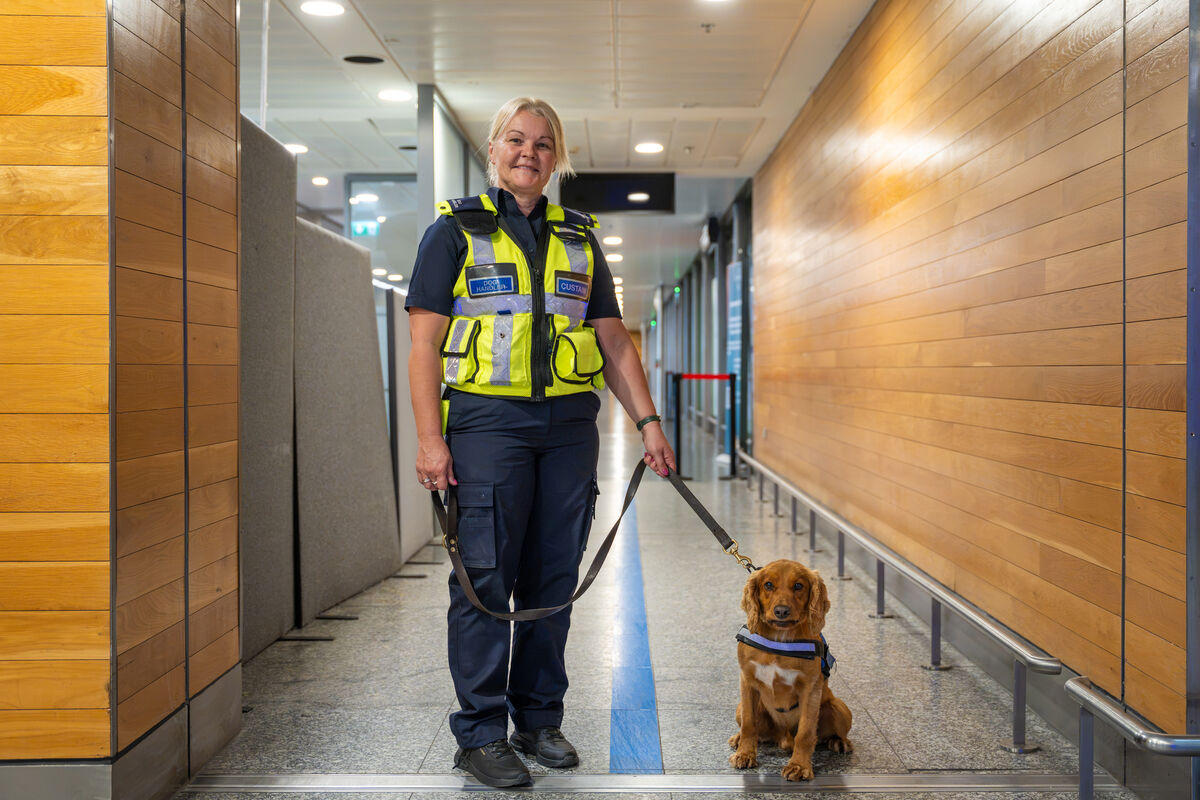
Olivia O’Connor, Customs dog handler; and Rua, Customs detector dog. Picture: Noel Sweeney

Rua is her sixth dog. “He lives with me, and when the dog retires, they stay with you as well. So I have two retired dogs at the moment at home, and Rua.”

There’s a clear bond between the two. While O’Connor was having her photograph taken, I looked after Rua, who did not take his eyes off her for a second.

Far from being intimidated, passengers’ faces light up when they see Rua. “We’re not there to frighten the people at all, so if someone is afraid of dogs, for example, they can tell us and I’ll walk Rua around their bag rather than up close. But by and large, most people are happy to see him, he changes the atmosphere in the room.”

There’s no denying airports can be stressful places. But with a bit of levity at the right time, a focus on passengers, and a friendly customs sniffer dog, Cork Airport is doing its best to make the experience that little bit easier to manage.

x

More in this section

Lifestyle

Newsletter

Eat better, live well and stay inspired with the Irish Examiner’s food, health, entertainment, travel and lifestyle coverage. Delivered to your inbox every Friday morning.

Cookie Policy Privacy Policy Brand Safety FAQ Help Contact Us Terms and Conditions

© Examiner Echo Group Limited