Zelenskyy says Putin has not ‘broken Ukrainians’ on anniversary of invasion
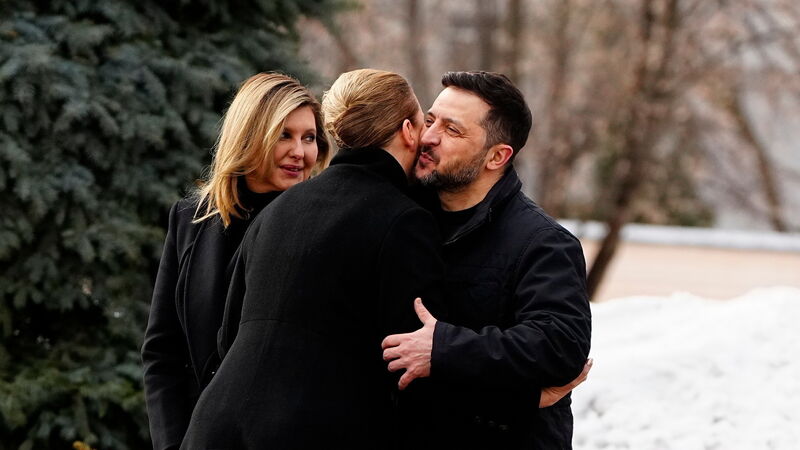
Denmark’s Prime Minister Mette Frederiksen, centre, is welcomed by Ukraine’s President Volodymyr Zelenskyy and his wife Olena Zelenska Picture: Mads Claus Rasmussen/Ritzau Scanpix via AP
Senior European politicians have travelled to the Ukrainiancapital in a show of support on the fourth anniversary of Russia’s invasion.
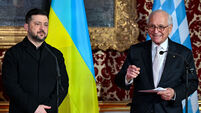
Ukrainian President Volodymyr Zelenskyy was defiant despite the devastating death toll, insisting that Russia has not “broken Ukrainians” nor triumphed in the war.
He said his country has withstood the onslaught by Russia’s bigger and better-equipped army, which over the past year of fighting captured just 0.79% of Ukraine’s territory, according to the Institute for the Study of War, a Washington-based think tank.
“Looking back at the beginning of the invasion and reflecting on today, we have every right to say: we have defended our independence, we have not lost our statehood,” Mr Zelenskyy said on social media, adding that Russian President Vladimir Putin has “not achieved his goals”.

“He has not broken Ukrainians, he has not won this war,” Mr Zelenskyy said.
However, as the war of attrition enters its fifth year, a US-led diplomatic push to end Europe’s biggest armed conflict since the Second World War appears no closer to finding compromises that might make a peace deal possible.
Negotiations are stuck on what happens to the Donbas, eastern Ukraine’s industrial heartland which Russian forces mostly occupy but have failed to seize completely, and the terms of a post-war security arrangement that Kyiv is demanding to deter any future Russian invasion.
The number of soldiers killed, injured or missing on both sides could reach two million by spring, with Russia sustaining the largest number of troop deaths for any major power in any conflict since the Second World War, a report last month from the Centre for Strategic and International Studies estimated.
European leaders see their countries’ own security at stake in Ukraine amid concerns about Mr Putin’s wider goals and has demanded its leaders be consulted in the ongoing US-brokered talks.
German Chancellor Friedrich Merz wrote on X that “for four years, every day and every night has been a nightmare for the Ukrainians — and not just for them, but for us all. Because war is back in Europe”.
“We will only end it by being strong together, because the fate of Ukraine is our fate,” he added.
Mr Putin believes that time is on the side of his bigger army, Western officials and analysts say — and that Western support will trail off and that Ukraine’s military resistance will eventually crumble.
But French President Emmanuel Macron described the war was “a triple failure for Russia: military, economic, and strategic”.
The war “has strengthened Nato — the very expansion Russia sought to prevent — galvanised Europeans it hoped to weaken, and laid bare the fragility of an imperialism from another age”, Mr Macron said on X.
The war has brought widespread hardship for Ukrainian civilians. Russia’s aerial attacks have devastated families and denied civilians power and running water.
It has drawn in countries far beyond Ukraine, giving the conflict a global dimension, and threatening to worsen shortages, hunger and political instability in developing countries.
While Nato countries have come to Ukraine’s aid, Russia has been helped by North Korea, which has sent thousands of troops and artillery shells, Iran, which has provided drone technology, and China, which the United States and analysts say has provided machine tools and chips.
Among the European officials visiting Kyiv on Tuesday were the President of the European Council, Antonio Costa, the President of the European Commission, Ursula von der Leyen, and Finnish President Alexander Stubb, as well as seven prime ministers and four foreign ministers.

CONNECT WITH US TODAY



Be the first to know the latest news and updates