Experts comb scene of Kenya mall carnage
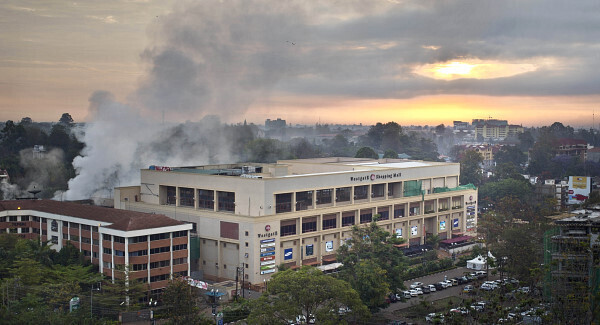
FBI experts have begun fingerprint, DNA and forensic analysis to help identify victims and the gunmen who attacked a Kenya shopping centre, killing more than 60 people.
A gaping hole in the Nairobi mall's roof was caused by Kenyan soldiers who fired rocket-propelled grenades inside, knocking out a support column, a government official said.
The official said the soldiers fired to distract a terrorist sniper so hostages could be evacuated.
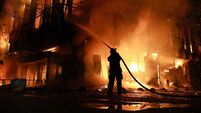
Video of the roof collapse showed massive carnage. The collapse came on Monday, shortly after four large explosions rang out followed by billows of black smoke.
Although a government minister said the terrorists had set mattresses on fire, causing the roof to collapse, the video showed such massive destruction that the explanation seemed unlikely to be the full story.
On its Twitter feed, al-Shabab, the Somali Islamic extremist group which carried out the attack, claimed the Kenyan government assault team carried out "a demolition" of the building.
The current death toll is 72 and is likely to climb with uncounted bodies remaining in the wreckage of the mall. Another 175 people were injured, including more than 60 who remain in hospital.
At least 18 foreigners were among those killed.
Al-Shabab said foreigners were a "legitimate target" and confirmed witness accounts that gunmen separated Muslims from other people and let the Muslims go free. The others were gunned down or taken hostage.
"The Mujahideen carried out a meticulous vetting process at the mall and have taken every possible precaution to separate the Muslims from the Kuffar (disbelievers) before carrying out their attack," the group said in an email exchange with The Associated Press.
Witnesses have said gunmen rounded up people, asked questions about Islam that a Muslim would know and told the Muslims to leave the mall. Still, some Muslims were among the victims.
Also among those killed when the militants entered the mall on Saturday, firing assault rifles and throwing grenades, were six Britons and people from France, Canada, the Netherlands, Australia, Peru, India, Ghana, South Africa and China.
Asked if al-Shabab had intended to kill foreigners, the group said "our target was to attack the Kenyan government on its soil and any part of the Kenyan territory is a legitimate target ... and Kenya should be held responsible for the loss of life, whether foreigners or local".
Al-Shabab had threatened retaliation against Kenya for sending its troops into Somalia.
The group's leader, Ahmed Godane, said in a new audio statement that the attack was carried out in retaliation for the West's support for Kenya's Somalia invasion and the "interest of their oil companies" - Somalia has untapped energy reserves.
More attacks would come, Godane said, if Kenya did not withdraw its troops.
Although Kenya's foreign minister said earlier that "two or three" American citizens may have been involved in the attack, a Western official said that after checking passport and refugee databases that there was not yet an indication any Americans were involved.
Several US cities, notably Minneapolis, host large Somali-American communities.
The violence continued elsewhere yesterday. In the Kenyan town of Wajir, which lies along the border with Somalia, one person was killed and four wounded after a gunman opened fire and threw grenades, the Interior Ministry said.
Interior minister Joseph Ole Lenku said forensic experts from the US, Israel, Britain, Germany and Canada were taking part in trying to reconstruct the scene at the mall. He said results would not be ready for a week.
Mortuaries in Nairobi have been prepared for the last two days for a large influx of bodies still in the mall. Officials have said the shopping centre, which the terrorists held for four days, could hold dozens more bodies.
The government has confirmed 72 total deaths: 61 civilians, six security forces and five attackers. The Red Cross says 71 people remain missing.
Al-Shabab said the Kenyan government assault team carried out "a demolition" of the building, burying 137 hostages in the debris.
A government spokesman denied the claim and said Kenyan forces were clearing all rooms, firing as they moved and encountering no one.
The al-Shabab claim appeared to refer to the rocket-propelled grenades fired inside the Nakumatt department store, in the incident described by a government official.
In a series of tweets from a Twitter account believed to be genuine, al-Shabab also said that "having failed to defeat the mujahideen inside the mall, the Kenyan govt disseminated chemical gases to end the siege".
Kenyan government spokesman Manoah Esipisu said no chemical weapons were used - including tear gas - and that the collapse of floors in the mall was caused by a fire set by the terrorists.
Mr Lenku said there were no indications that a woman took part in the attack, despite persistent press speculation, and he said officials had not yet confirmed reports that the attackers had rented a shop inside the mall.
In another development, a British man was arrested in Kenya following the terrorist attack, the Foreign Office said.
British officials were ready to provide assistance to the man, the FO said. The man is believed to be in his 30s and a newspaper report said he was arrested on Monday as he tried to board a flight from Nairobi to Turkey with a bruised face and while acting suspiciously.
Kenya says 11 suspects have been arrested in connection with the attack, including at least seven at the airport.
The International Criminal Court in the Hague has said it is prepared to work with Kenya to bring the attackers to justice.
ICC prosecutor Fatou Bensouda said while Kenya had primary jurisdiction in the murder of civilians in the mall, the atrocity could also fall under the court's remit.
The mall attack was the deadliest terrorist attack in Kenya since the 1998 al Qaida truck bombing of the US embassy in Nairobi, which killed more than 200 people.

CONNECT WITH US TODAY



Be the first to know the latest news and updates