Baghdad bomb makes UN review options

United Nations staff in Baghdad were told to stay at home today after a massive truck bomb levelled their headquarters and killed at least 20 people, including the top UN envoy in Iraq.

Baghdad bomb makes UN review options

United Nations staff in Baghdad were told to stay at home today after a massive truck bomb levelled their headquarters and killed at least 20 people, including the top UN envoy in Iraq.

The FBI was leading the hunt for clues in the rubble following the unprecedented attack on the world body, which also injured at least 100 people.

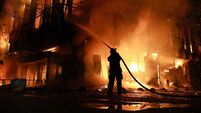
An all-night search for survivors appeared to have turned into a grim search for the bodies of the missing by dawn, as heavy machinery lifted away huge slabs of the shattered building.

“There are so many people who are still missing,” said Veronique Taveau, a spokesperson for the UN Humanitarian Coordinator.

Yesterday’s bomb blasted a six-foot crater in the ground, shredding the front of the Canal Hotel housing the UN offices and stunned an organisation that had been welcomed by many Iraqis in contrast to the US-led occupation forces.

Except for a new concrete wall built recently, UN officials at the headquarters had refused heavy security because the UN “did not want a large American presence outside,” said spokesman Salim Lone.

Taveau said the UN had temporarily suspended operations today and that travel arrangements were being made for employees who wanted to leave the country.

Iraqis who work for the UN were told to stay at home, and foreign staff were directed to stay in their lodgings, which are scattered in many small hotels around the capital.

“Moving outside is forbidden,” said Salam Quzaz of the United Nations Development Programme.

Spokesman Lone denied persistent reports today that the UN was pulling foreign workers out of Iraq.

“The news that we are evacuating to Jordan is not true. We are only evacuating those who cannot be treated in Iraq and those workers scheduled to leave,” he said.

He said all UN agencies working in the country would meet later today to discuss the world body’s next steps in Iraq.

The blast brought down the office of the top UN envoy in Iraq, Sergio Vieira de Mello, where he was meeting other UN officials.

Vieira de Mello – a 55-year-old Brazilian serving in what one UN spokesman called the world body’s toughest assignment – was wounded and trapped in the rubble, and workers gave him water as they tried to extricate him.

Hours later, the United Nations announced his death.

“Those who killed him have committed a crime, not only against the United Nations but against Iraq itself,” UN Secretary-General Kofi Annan said, calling the veteran diplomat “an outstanding servant of humanity”.

UN and US officials called the bombing a “terrorist attack”, but there was no immediate claim of responsibility.

Paul Bremer, the top US administrator in Iraq, walked through the scene of destruction as workers dug through the rubble with their hands. He had tears in his eyes and hugged Hassan al-Salame, an adviser to Vieira de Mello.

“We will leave no stone unturned to find the perpetrators of this attack,” Bremer said.

The bombing came nearly two weeks after a car exploded and killed 19 people at the Jordanian Embassy in Baghdad and after a string of dramatic attacks on oil and water pipelines in Iraq.

Like the remote-controlled explosion at the Jordan Embassy, the suicide bombing at the UN headquarters focused on a high profile target with many civilians inside and resembled attacks blamed on Islamic militants elsewhere in the world.

It was far more sophisticated than the guerrilla attacks that have plagued US forces, which have generally been hit-and-run shootings carried out by small bands, or remote-controlled roadside bombs.

US forces have been focusing on trying to put down Saddam Hussein loyalists thought to be behind the guerrilla campaign against American troops.

But the military has also warned of foreign Islamic militants slipping into the country and has said an al-Qaida linked group, Ansar al-Islam, was a possible suspect in the Jordanian Embassy bombing.

Dia’a Rashwan, an expert on radical Islam at Egypt’s Al-Ahram Centre for Political and Strategic Studies, said the attack fits “the ideology of al-Qaida. They consider the UN one of the international actors who helped the Americans to occupy Palestine and, later, Iraq.”

The UN distributes humanitarian aid and was developing programmes aimed at boosting Iraq’s emerging free press, justice system and monitoring of human rights. UN weapons inspectors worked out of the hotel before the war.

The Canal Hotel operates more as an office building than a hotel. The cafeteria was a popular place for aid workers and journalists to meet.

x

More in this section

Cookie Policy Privacy Policy Brand Safety FAQ Help Contact Us Terms and Conditions

© Examiner Echo Group Limited