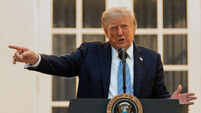
Donald Trump pulls Israel trip and will visit after ‘I’m elected’
Dozens of Israeli lawmakers had called Benjamin Netanyahu, to cancel the December 28 meeting with Trump.
The prime minister, wary of being seen as endorsing Trump’s positions despite his own Republican leanings, had given only guarded remarks, saying he would honour a previously scheduled meeting but at the same time rejecting Trump’s calls to ban Muslims from entering the US.
Trump announced his decision on his Twitter feed, saying he would reschedule “at a later date after I become President of the US.”
Trump told Fox News there were many reasons he decided to hold off on a trip, among them that he didn’t want to put Netanyahu in a bind.
“In fact, I did a campaign ad for him, and he’s a good man, but I didn’t want to put him under pressure,” Trump said.
10 actual facts about Muslims you'd never hear from Donald Trump https://t.co/wCXjDEif5R
— Mic (@mic) December 11, 2015
“I also did it because I’m in the midst of a powerful campaign that’s going very well.”
Trump has had the Republicans in turmoil over his call for a temporary ban on Muslims entering the US in the wake of last week’s mass shooting by an Islamic militant couple that killed 14 people in San Bernardino, California.
Critics say the proposal is racist and unconstitutional.
Trump, who has maintained a wide lead in most early polling, also sparked criticism among many American Jews last week after speaking to a gathering of Jewish donors.
He was booed after refusing to endorse Jerusalem as the undivided capital of Israel — a key Israeli position.
The US, like most of the international community, refuses to recognise Jerusalem as Israel’s capital and says the city’s status must be resolved in negotiations between Israel and the Palestinians.
Trump also made remarks that some said promoted Jewish stereotypes.
“I know why you’re not going to support me: You’re not going to support me because I don’t want your money,” Trump said.
“You want to control your own politician.”
He also said, “I’m a negotiator, like you folks.”
Marc Zell, the co-chairman of Republicans Overseas Israel, said that there had been no pressure from the organisation, which represents Republican expatriates living in Israel, for Trump not to come.
But Zell, stressing that he was expressing his personal opinion, said it was all for the best Trump had cancelled.
“He’s welcome to visit Israel, but I think it’s better that he didn’t come because his visit here would have been marred by a loud dissenting voice coming from all sectors of the population, including me,” Zell said.
Netanyahu’s office declined comment on the cancellation.
A visit to Israel is considered a rite of passage for US presidential candidates as they seek to burnish their foreign policy credentials and appeal to Jewish American voters, and Netanyahu has hosted scores of candidates and elected American officials over the years.
Like the other Republican candidates, Trump, whose daughter, Ivanka, converted to Judaism, has long worked to portray himself as a strong supporter of Israel.
In a 2013 video endorsing Netanyahu’s re-election, Trump called himself a “big fan of Israel” as Hebrew lettering scrolled below his face.
During the current campaign, Trump’s Republican rivals have questioned his foreign policy bona fides, suggesting he lacks the depth and diplomatic skill to tackle crises in the Mideast and elsewhere.
Trump has argued his vast experience brokering business deals qualifies him to negotiate with foreign leaders, and he has cited the Israeli-Palestinian conflict as a prime example.
Yet in contrast to other Republican candidates who have been reluctant to criticise Israel, Trump questioned in an AP interview this month whether Israel was committed to the peace process, a concern he said extended to the Palestinians as well.
Palestinian officials welcomed news of the cancellation. Ahmad Majdalani, an aide to President Mahmoud Abbas, said Trump’s visit meant “nothing to us”.
“We know he was coming to Israel to get Jewish lobby’s support.
"We were happy that we weren’t on his visit agenda because he would add nothing to us, particularly after his statements against Muslims,” he said.
Meanwhile, Trump has claimed the UK has a “massive Muslim problem” as a petition to bar him from visiting Britain topped 400,000 signatures.
The property tycoon and reality TV star has claimed that parts of London were so “radicalised” that police feared for their lives.
David Cameron said his comments were “divisive, unhelpful, and quite simply wrong”, while London Mayor Boris Johnson said they rendered him “unfit to hold the office of the president of the United States”.
A poll on the parliamentary website calling for his exclusion from the UK raced past the 100,000-signature threshold to be considered for debate in Parliament and looked set to top the current record of 446,482.
But polls taken in the US after the remarks were publicised showed a spike in support among Republican primary voters, with Trump on around 35% and as many as 20 points ahead of his main rivals.
Trump was unrepentant as he posted a message on Twitter: “The United Kingdom is trying hard to disguise their massive Muslim problem. Everybody is wise to what is happening, very sad! Be honest.”