Unions march against Brussels cuts
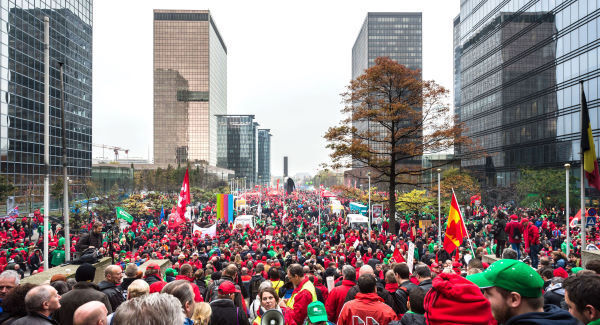
Cars were overturned or set on fire and projectiles thrown at police, who responded with pepper spray and water cannon. Police finally cleared the area with a charge in the afternoon.
A police spokesman declined to say how many people had been detained and how many police and protesters injured.
Around 100,000 Belgians had marched through central Brussels in protest against the new government’s savings measures. It was the first in a series of demonstrations and strikes planned for coming weeks.
Prime minister Charles Michel invited leaders of Belgium’s three main union branches to talks with the government, although did not offer any obvious concessions. Discussions began on Thursday afternoon.
Belgium’s centre-right government, installed only a month ago, has pledged to raise the retirement age and limit scope for early retirement, cancel an inflation-linked wage hike due next year, and cut the health and social security budgets.
Unions estimated that around 120,000 workers, from dockers to metalworkers, as well as students, had gathered to protest in the Belgian capital. Police put the number at 100,000.
The unions plan a series of regional strikes every Monday starting November 24, culminating in a national strike on December 15.
Rail operator SNCB said it sold 80,000 tickets in advanced group bookings for travel to Brussels for yesterday’s march, and had laid on 15 additional trains. Unions also booked 500 buses to get protesters from all over the country to the capital.
Otherwise, public transport in Brussels was severely restricted. Buses and tram services in other Belgian cities were also reduced.
“The signal is clear. People are angry, livid. This government’s policies are totally unbalanced,” said ACV union chief Marc Leemans.
The Socialists, excluded from government for the first time in 26 years, have complained that while workers were hit, the rich were unaffected.
“I share the concern of the people and the measures of the government are unjust,” said former prime minister Elio Di Rupo.
Central bank governor Luc Coene said Belgium needed reforms to cuts a public sector debt of around 100% of annual output. He said failure to act would simply increase the problem for the next generation.
“The people who go on strike against these savings measures are actually saying to their children: Get lost. I find that really bad,” said Coene.

CONNECT WITH US TODAY



Be the first to know the latest news and updates