Analysing Ireland: Ireland must look beyond Long ball game
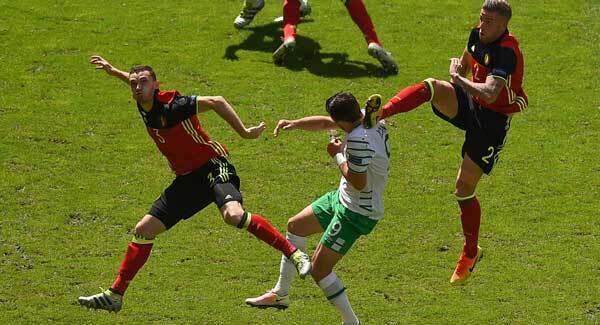
There was a moment, barely three minutes into the Belgium game last Saturday, when it became obvious it was going to be a dog of an afternoon for Shane Long.

Analysing Ireland: Ireland must look beyond Long ball game

James McCarthy won a loose ball deep on the left wing and with Wes Hoolahan dropping short as a tidy short-pass option to keep possession, McCarthy chose to bang the ball 40 yards up the line on top of Long and Toby Alderweireld.

An impossible pass for Long to collect under pressure — it bounced loose and Belgium regained possession, an outcome which basically replayed itself again and again.

By that stage, Romelu Lukaku had already been volleyed a pass to his chest by Eden Hazard, given a lovely run into space down the right channel by Kevin De Bruyne and been fed to his feet in the Irish box by Thomas Meunier. Belgium had a clear path to get their main attacking influences on the ball and nothing summed that up more than the comparison between how the teams played Lukaku and Long.

The only vaguely promising service Long got in the entire game was a hopeful probe in behind Belgium’s right side of defence by Stephen Ward — Long bolted into possession but nothing really came of it — and there’s a story somewhere in the fact that of the 18 passes Shane Long received in his time on the pitch, his most prolific provider was Darren Randolph.

This wasn’t just the pattern in the Belgium game: Of the 13 passes Long received against Sweden, more than half came from Randolph and the back four combined.

Ireland came into the tournament with an in-form striker but apart from an obsession with trying to hit him from everywhere on the pitch, haven’t figured out a clear way of creating situations that suit, either by crosses or 20-yard passes in behind defences.

Wes Hoolahan, despite the goal and some neat touches against Sweden, has been on the edge of games as well and it took an age to get him on the ball against Belgium.

Away from the broader matter of ball retention being Ireland’s oldest problem, Martin O’Neill has to find ways of getting the players who are likely to come up with a goal in the game more often than they’ve been doing.

The general idea of defending deep against essentially a front three of the top counterattacking players in the Premier League was hardly that flawed but was let down by (1) actually then getting caught on the break anyway for the game-changing opener, (2) James McCarthy’s defensive awareness malfunction for 20 minutes, and (3) lacking any kind of link to build an attacking threat.

Ireland aren’t likely to outpass any of the even moderately decent sides left — remember their possession stats of 36% and 37% against Bosnia — but they do need a workable concept on how to move the ball more coherently into positions from which they might actually create something.

McCarthy hasn’t been a player that possession flows through and the two games so far don’t suggest any major change.

He completed just 15 passes against Belgium but perhaps the most interesting figure is the comparison on passes received — Glenn Whelan took 40 passes from Irish players against Belgium while McCarthy took just eight, again continuing the trend from Sweden where Whelan received 26 passes, Hendrick 27 and McCarthy seven.

Delve a little deeper, and Ireland’s most frequent passing combination against Belgium was Hendrick to Whelan (11), which exactly reversed the most frequent passing combo from Sweden, Whelan to Hendrick (11).

Ireland’s midfielders haven’t been getting on enough ball and when they have, it’s not being moved often enough into the sort of areas that Hoolahan and Long might make something happen. Contrast with Belgium where Alex Witsel in midfield made 58 passes but the most common was to Eden Hazard, who he hit 15 times.

Ireland may need to alter the balance of that midfield to get more from Hoolahan and Long, or an alternative attacking arrangement if that proves fruitless.

A bold move might push Brady into the diamond and make a choice between Whelan/McCarthy as the holding player, just to give an extra ballplayer to link combinations centrally. If there’s an argument for sticking with the general idea of keeping things tight and hoping just some extra energy and forcefulness can nick a goal from somewhere, a set-piece even, against Italy, the need for a win may shift the emphasis. Ireland must find a way to score goals.

Previously in the ’Analysing Ireland’ series:

Analysing Ireland: Has Shane Long’s time arrived?

Analysing Ireland: The perennial predicament with Wes Hoolahan

Analysing Ireland: It ain’t what you’ve got, it’s all a matter of how you use it

Analysing Ireland: The unembroidered value of tigerish James McCarthy

Analysing Ireland: Where will the Euro 2016 goals come from?

More in this section

Sport

Newsletter

Sign up to our daily sports bulletin, delivered straight to your inbox at 5pm. Subscribers also receive an exclusive email from our sports desk editors every Friday evening looking forward to the weekend's sporting action.

Cookie Policy Privacy Policy Brand Safety FAQ Help Contact Us Terms and Conditions

© Examiner Echo Group Limited