Apathy and concern as future of Cork divisions in spotlight
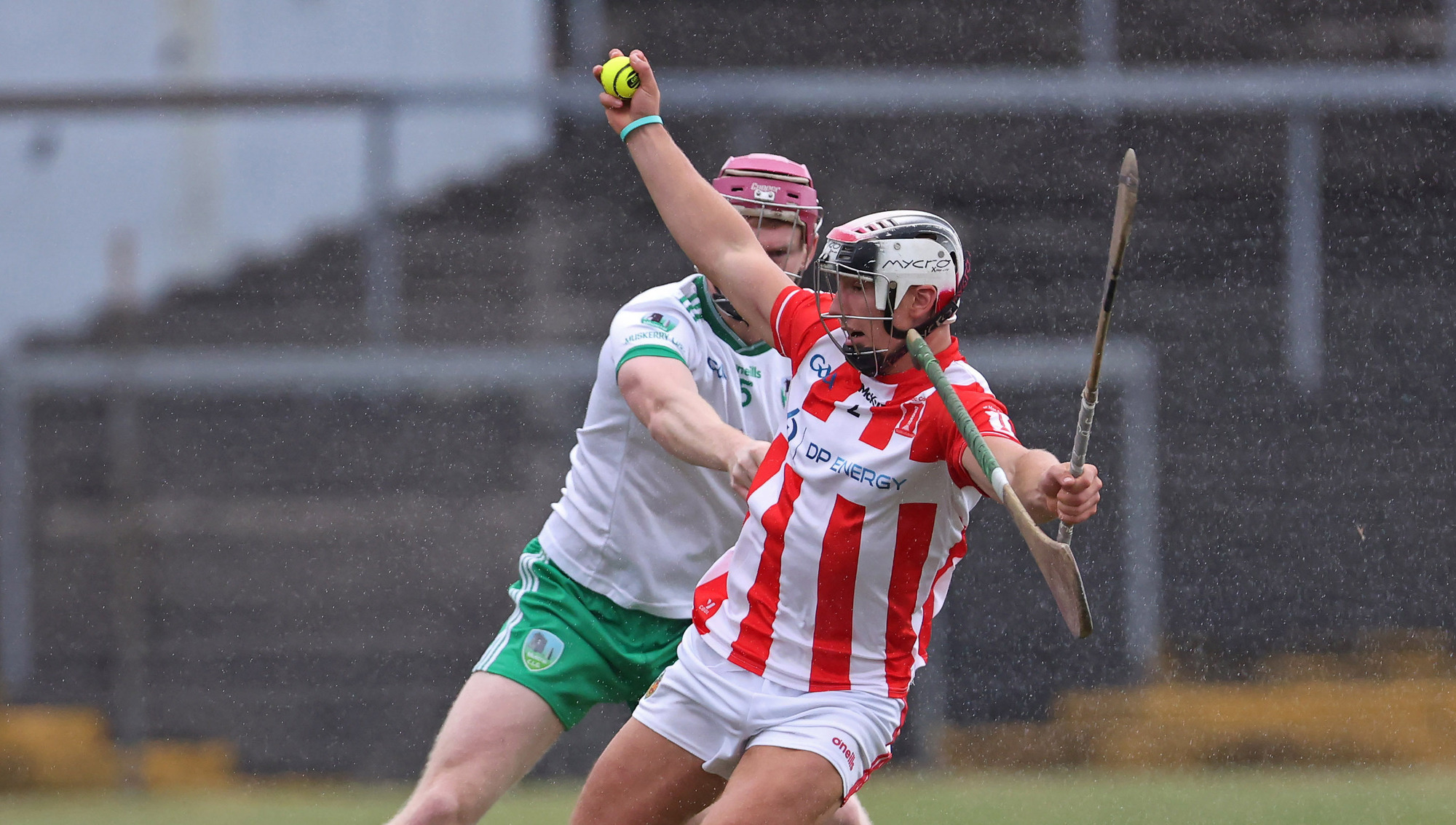
Imokilly's Timmy Wilk in action against Odhran O'Driscoll of Muskerry. Pic: Jim Coughlan.
It would be too easy and too convenient to state that Cork’s divisions are on borrowed time.
For while more and more baronies continue to cut themselves off from competitive existence, there’s no roadmap to suggest they will be permanently cut off from county championship involvement any time in the near future.
More accurate to state is that these are deeply uncertain times for Cork divisions and their long-standing participation in the county hurling and football championship.
At the end of a 2018 season where Imokilly successfully defended their Cork hurling crown and Duhallow reached the concluding Sunday of the football championship, Glen Rovers brought a motion to county convention proposing that each and every division be removed from the local hurling and football championship.
One North Cork chairman spoke for many at the time when he questioned if the motion was motivated by “jealousy” of Imokilly’s back-to-back.
“The club player has the option of playing in one championship. Those representing divisions have the luxury of playing in two championships. Is this fair? Surely this must be addressed,” said then Glen secretary Jude O’Callaghan when introducing the motion and the motivation behind it.
Leading the opposition bench was Imokilly president Willie Ring. He took aim at those attempting to thwart the East Cork division in the boardroom.
“If you want to get rid of divisional teams, this is not the way to do it. It should be done in manly combat, beating them on the field of play and no other way,” said Ring, to much applause, before delegates overwhelmingly rejected the motion.
Read More
If the same motion was tabled today, the vote would be far less conclusive. The number of divisions voicing opposition would be diluted.
Credibly tabling the well-worn argument that they offer a platform for junior and intermediate club players would be hard done when fewer and fewer divisions are taking up said platform.
Apathy has set in where the divisions in Cork are concerned - both from within and those on the outside.
The curtain falls on the latest edition of the colleges/divisions section with this Sunday’s hurling decider between Imokilly and Seandún (Páirc Uí Rinn, 7pm).
Once again, there was a farcical element to proceedings earlier in the summer where in the first round of the hurling section, Avondhu and Duhallow both handed 11th-hour walkovers to their respective opponents. In the case of Avondhu, that walkover came as late as the eve of their game against Seandún.
Carbery were successful in putting 15 players out on the field when fixture-makers asked them to do so, but defeat to Seandún in late June marked the beginning and end of their campaign. Their manager, William Hourihane, stated after this game that the present system will kill off divisional teams.
“It was a pity to see Duhallow and Avondhu pulling out this season and I’m not sure how long Carbery can keep going under this format. Will players commit themselves to six months’ preparation just for one game? I can’t see it happening,” Hourihane told the .
As much as the county board has tweaked the structure and dates over the years, the format Hourihane alludes to is in no way the main problem.
The outstanding challenge is rather how more and more clubs are becoming more and more reluctant to allow their players sign up for divisional involvement. And very few club players, most understandably, are going to jeopardise both their standing and their spot locally for an uncertain divisional cause.
“Not all clubs are committed to Carbery, some ignore us,” Hourihan explained after the Seandún defeat. “Tonight we had no player from the West Cork champions (Ballinascarthy) or from two of our intermediate teams. Managers don’t want to give their players. Whatever about the format, we have to get our own house in order first.
“We have to remember that every dual player is guaranteed six championship games, on top of about 20 league games. That's a busy schedule and it’s understandable that managers are protective of their players. Rightly so, and that is one reason to fear for the future of divisional teams.”
On the football side of the house, MTU Cork and Beara did return to competitive action for the first time since 2022, but you then had the situation of UCC being unable to field for their preliminary quarter-final against Carbery earlier this month.
It meant the West Cork division enjoyed a final-round free ride into the last seven of the county senior championship.
Progression by shambolic means, really. And when it wouldn’t be tolerated in the group stage proper, one has to ask why it is being entertained here?
Amid this wall of negativity and divisional - as well as college - non-starters, Seandún rejoining the dwindling divisional arena for the first time since 2021 has been a welcome change of direction.
Amid the growing irrelevance of the divisions/colleges section, their return and impact thus far recorded has been timely.
The city division fielded an U15 team in 2025 and the intention is to keep fielding in the higher age-grades in the years ahead so as to create a pathway to their flagship side.
The wider health-of-the-divisions picture was not a leading priority in resurrecting the Seandún flag.
As senior manager John O’Callaghan articulated to the this week, giving players from the smaller city clubs an opportunity to line out at the top grade both at underage and at adult level can act as a deterrent to the poaching activities of the city’s larger and more attractive establishments.
O’Callaghan cannot fault the buy-in of his players. But his and Seandún’s reality on this most important week of their year spells out the difficulties of preserving divisional involvement.
“We typically trained once before our previous matches. This week, we were supposed to train on Wednesday night, but numbers were too small, so we had to pull it because lads are back with their clubs and stuff,” said O’Callaghan.
“So, it's very hard to keep it going, but it'd be a shame to lose it as well, you know. It is up to the players themselves and the clubs to release them when we look for them.
“For me, I feel it is very important that we always have the divisions because for any junior club player you have the opportunity to go out and express yourself at senior level.
“In the next couple of years, and with so many club fixtures, I don’t know how it is going to go. The problem is trying to get time to fit in the divisions. Everything is very compact, there just seems to be no time for the divisions at the moment.”
For some, that is a source of deep concern. For others, they have long stopped caring.

A collection of the latest sports news, reports and analysis from Cork.
CONNECT WITH US TODAY



Be the first to know the latest news and updates