Colin Sheridan: What Pico Lopes and Cape Verde can teach Ireland about international football
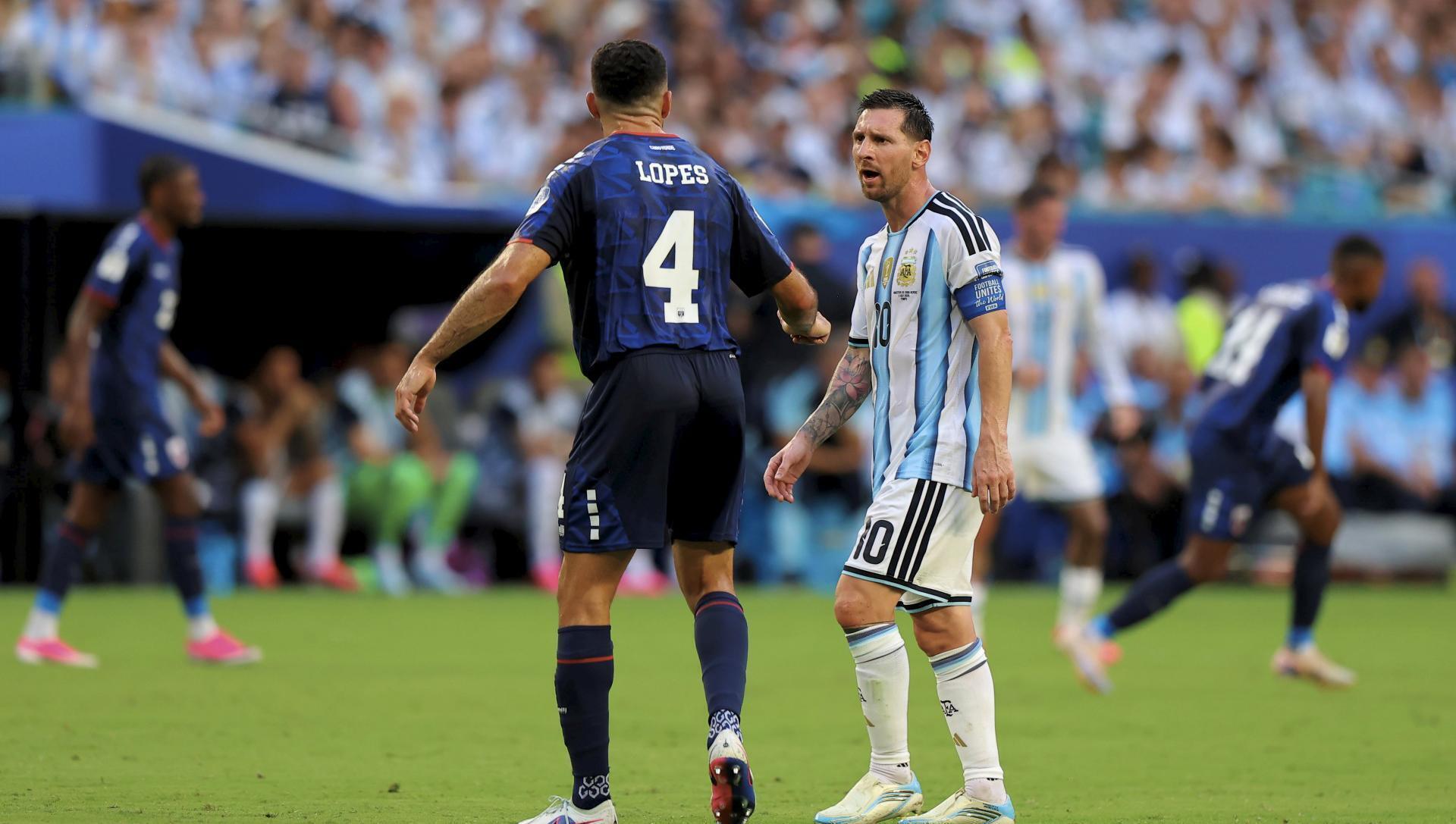
STANDING TALL: Roberto Lopes of Cabo Verde and Lionel Messi of Argentina at Miami Stadium. Pic: Eston Parker/Sportsfile
There is a metric in domestic football: if you want to know your current potential, count how many players you have in the Premier League. It is a comforting theory. It is also, increasingly, an incomplete one.
For years, Irish football has become almost consumed by the arithmetic of decline.

We count Premier League starters. We compare academy graduates. We lament the absence of world-class talent. Every disappointing campaign is followed by another audit of player production, another reminder that we simply do not have enough footballers competing at the highest level.
Some of that is undoubtedly true. Elite players matter. Better players usually make better teams. But only usually. The remarkable World Cup journey of Cape Verde should force every football nation, Ireland included, to reconsider what international football really rewards.
Here was a country of barely half a million people making history on the biggest stage of all. A nation that had never before qualified for a World Cup not only reached the knockout stages but pushed Argentina into extra time before eventually losing to an own goal.
They left the tournament with admiration from around the world, not because they possessed a squad of superstars but because they possessed something every bit as valuable: identity.
Watching Cape Verde over the past fortnight, it was impossible not to notice how completely they understood themselves. Every player knew his role. Every challenge was made on behalf of the man beside him. Against defending champions Argentina, they didn't hang on for dear life, they pressed and attacked like they'd never heard of Julián Alvarez. Most importantly, they believed together.
Read More
That belief cannot be measured by transfer fees, nor can it be found in league tables.
Irish football has become so accustomed to explaining failure through economics that we sometimes forget international football has never obeyed club football's rules. Countries do not have transfer windows. They cannot buy solutions. They inherit whatever generation happens to arrive and must somehow mould it into something greater than the sum of its parts. Irish managers treat it as a genetic disorder passed down generations.
History, however, is full of teams that embrace rather than lament that poverty.
Greece did not possess Europe's finest footballers when they won Euro 2004. Denmark did not become European champions in 1992 because they suddenly produced a golden generation. Morocco reached a World Cup semi-final in 2022 because they forged an extraordinary collective spirit that repeatedly overwhelmed supposedly superior opponents.
Cape Verde now belong in that conversation.
Perhaps the most beautiful symbol of their achievement was Pico Lopes.
For years, Irish supporters have known him simply as a dependable League of Ireland defender with Shamrock Rovers. During this World Cup they watched him marking Lionel Messi in the knockout stages.
Think about that for a moment. A veteran defender from the League of Ireland lining up against arguably the greatest footballer who has ever lived. If our theories about international football were entirely correct, that should never happen.
Yet there he was. Not because he had suddenly become one of Europe's elite defenders. Not because Cape Verde had stumbled into success. But because he belonged to a team that had created an environment where every player consistently performed beyond what outsiders believed possible.
After the tournament, fighting back tears, Lopes spoke not about himself but about his country.
"We've made history," he said. "Hopefully we've inspired a generation back home. We showed the world what Cape Verde is about."
International football has always been about far more than identifying the best 11 players. It is about convincing 11 players they belong together.
That may sound sentimental, but psychology has always been football's hidden currency. Nations spend millions building academies, analysing data and developing talent pathways. All worthwhile pursuits. Yet none of them automatically produce trust, purpose or shared identity.
Cape Verde did.
Which brings us, inevitably, back to Ireland. For years we have framed our shortcomings almost exclusively through player development. We ask why we do not have enough Premier League footballers. Why we cannot produce another Robbie Keane or Damien Duff. Why our conveyor belt appears slower than those of other nations.
They are legitimate questions. But perhaps they are not the only questions. Perhaps we should spend as much time asking whether our national team possesses a recognisable identity. Whether players leave international camps believing they are part of something distinctive. Whether supporters can immediately describe what an Irish team stands for beyond effort and endeavour.
Because effort has never been uniquely Irish. The teams that consistently exceed expectations possess something deeper. They have clarity. They have belief. They have an identity so strong that players become greater together than they ever appear apart.
Cape Verde have just offered a masterclass in exactly that. Their success should not encourage complacency about Irish player development. Of course Ireland wants more footballers playing regularly in Europe's biggest leagues. Every nation does.
But neither should it encourage fatalism.
International football remains one of the few sporting arenas where organisation can still humble wealth, where conviction can still unsettle reputation, and where collective purpose can narrow gaps that appear impossible on paper.
And that is why teams like Ireland should look at Cape Verde not with envy but with curiosity.
Because somewhere between the spreadsheets measuring elite talent and the endless debates about pathways, a tiny island nation reminded the rest of us that football's greatest competitive advantage is still the hardest one to quantify.
Not star power.
Simply the extraordinary power of becoming a team.
If RTÉ's hurling coverage taught us anything on Saturday, it is that pundits are at their best when they stop trying to be referees and start being themselves.
The post-match exchange between Dónal Óg Cusack and Joe Canning, sparked by Canning's suggestion that Cork may have been weighed down by All-Ireland hype, quickly became the talking point of the afternoon.
Cusack thought the point unfair. Canning stood by it. Voices were raised. Joanne Cantwell wisely moved the programme on. Good. Not because every word exchanged was perfect. Cusack's remark asking Canning how many All-Irelands he had won crossed into the personal in a way that probably added more heat than light.
But let's not confuse an awkward television moment with some great broadcasting scandal.
They are pundits, and their job is to have opinions. For years we have lamented bland sports coverage. We complain when analysts sit on the fence, speak in clichés or refuse to criticise anyone for fear of causing offence.
We demand honesty, authenticity and personality. Yet the moment two strong personalities genuinely disagree, there are calls for apologies, complaints and outrage. Which is it?
What they saw were two men with immense hurling knowledge arriving at different conclusions and arguing passionately in defence of them. That is exactly what good analysis should look like.
Sport is emotional. It is tribal. It provokes disagreement. Television should reflect that, not sterilise it. The trick, of course, is to disagree without becoming disagreeable. Saturday's exchange may have edged too close to that line, but it never justified the pearl-clutching that inevitably followed.
RTÉ does not need fewer opinions. It needs more of them. Not manufactured rows nor cheap controversy. Just informed people prepared to say what they genuinely think, even if the colleague standing beside them thinks they are talking nonsense.
That is called debate. It is also called live television. Long may both survive.
Read More
There are few greater pleasures in an Irish July than stumbling across TG4's Tour de France coverage.
You sit down to make a sandwich, promise yourself five minutes, and suddenly three hours have disappeared as 184 cyclists grind their way over Alpine passes under the gentle guidance of Páidí Ó Lionáird and Pádraic Ó Cuinn.
It is sport at its most hypnotic: beautiful scenery, glorious suffering and lyrical Irish-language commentary.
TG4's decision to extend its Tour coverage until 2030 is wonderful news. Some broadcasts entertain. Others become part of the rhythm of summer. The Tour on TG4 has long since become both.
Sam Prendergast's display against Australia on Sarurday was a timely reminder of how quickly we rush to write young athletes off. Only weeks ago, many of us wondered whether the out-half had the temperament or talent for international rugby.
On Saturday, he answered in the only currency that matters: performance, composure and courage under pressure, landing the decisive late conversion in Sydney. We are all prisoners to the last game, the last mistake, the latest social media verdict. But careers are not built over 80 minutes. Prendergast's story is still being written.
Thankfully, patience remains one of sport's greatest virtues.