Colin Sheridan: As GAA leader Jarlath Burns needs to learn the value of silence
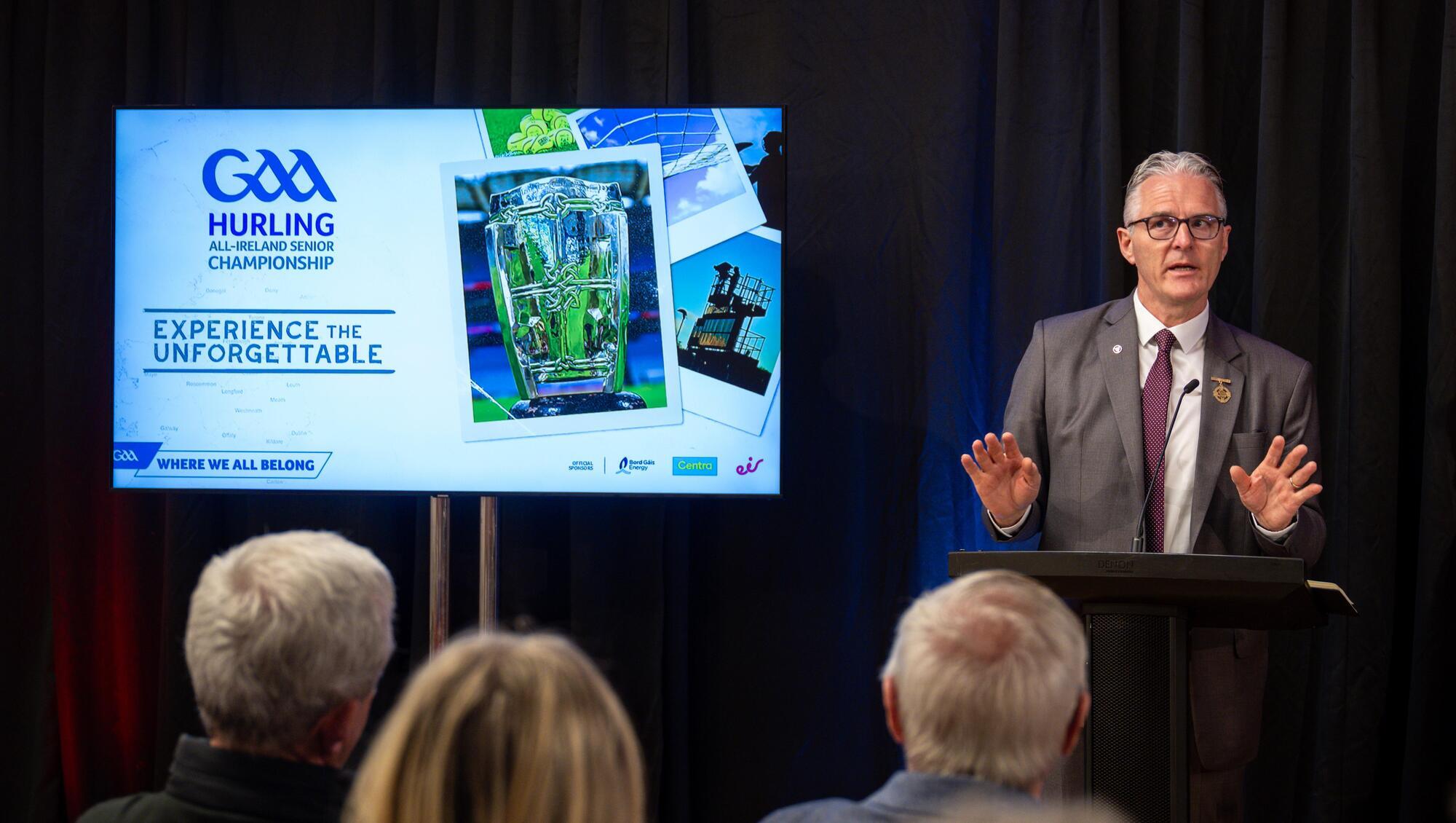
Gaelic Athletic Association Uachtarán Jarlath Burns addresses the audience during an All-Ireland Senior Hurling Championship media event hosted by Blarney GAA. Picture Chani Anderson
There are few sporting images more perfect than the one that greeted Jarlath Burns on the final Sunday of July 2024. Armagh had just won their first All-Ireland football title since 2002. The county of his birth was celebrating a triumph a generation in the making. His son, Jarly Óg, was on the field. The ball was in his hands when the final whistle sounded. And standing in the Hogan Stand, preparing to present Sam Maguire, was the president of the GAA himself.
For Burns, it should have been the defining image of his presidency. An Armagh man presiding over one of the proudest days in his county's history. A president embodying the qualities the office has traditionally represented: stewardship, continuity, service and respect for an institution larger than any individual.
Instead, as Burns enters the final year of his term, I suspect his presidency will be remembered for something else.
Intervention. That is not to say he has been a poor president. Nor is it to deny his many strengths. Burns is articulate, intelligent, passionate about Gaelic games and comfortable speaking on difficult issues. He is one of the most naturally gifted communicators the association has produced in a generation.
Yet those same qualities have arguably contributed to the central weakness of his presidency. He has too often mistaken visibility for leadership.
The office of GAA president is not an executive role. It is not the role of a chief executive, a political leader or a campaigner. It is, at its heart, a custodial office. The president represents the association. He is not supposed to become one of the protagonists within it.
Its authority derives from restraint. The president's influence comes precisely because he is expected to stand above many of the disputes that inevitably consume an organisation as large and complex as the GAA.
Throughout Burns' tenure, however, there has been a recurring tendency to place the presidency directly into controversies where it had little obvious business being.
The most significant example remains the Rory Gallagher affair. Reasonable people can disagree about Gallagher. They can disagree about safeguarding, about reputation, about second chances, about where the GAA's responsibilities begin and end. Those debates are legitimate and necessary.
What’s troublimg was not the debate itself but the intervention of the president. Once Burns involved himself in Naas GAA Club's proposed appointment of Gallagher, the issue ceased to be merely about one coach and one club. It became a question about the powers of the presidency itself.
Should the president of the GAA be able to influence who local clubs appoint?
If the answer is yes, then we are discussing powers that have never traditionally belonged to the office. If the answer is no, then the intervention should never have occurred.
The same pattern emerged elsewhere.
His involvement in the dispute between Mayo GAA and former benefactor Tim O'Leary was equally perplexing. Whatever one thinks of the merits of that disagreement, it was fundamentally a matter between Mayo and one of its former supporters. Yet once again the presidency found itself in the middle of a controversy that did not require presidential participation.
More recently came Burns' comments regarding the disciplinary controversies involving Jim McGuinness and Ger Brennan.
Again, one returns to the same question.
Why?
The GAA possesses disciplinary committees, hearings, procedures and appeals. Those structures exist for a reason. They are designed to protect both the integrity of decisions and the integrity of those holding office.
Once the president starts publicly explaining, contextualising or distinguishing disciplinary outcomes, he inevitably becomes associated with those outcomes. He ceases to be the guardian of the process and instead becomes part of the argument itself.
That is not where the presidency belongs.
I felt a similar unease listening to Burns recently discuss the commercial opportunities arising from integration and the future earning potential of the association.
Integration is undoubtedly the correct path. The merger of the GAA, LGFA and Camogie Association represents one of the most important developments in modern Gaelic games.
But I am less convinced that revenue generation should be a central theme of presidential leadership.
The GAA was not founded as a commercial enterprise. It was built by volunteers. It survived because communities believed certain things mattered more than profit. Financial sustainability is essential, of course. But there is a difference between managing finances and adopting the language of commerce as a guiding philosophy.
The more Burns spoke during his presidency, the more one was left wondering whether he viewed the office differently from his predecessors.
Previous presidents often appeared as custodians. Burns frequently appeared as an advocate, a participant and sometimes even a protagonist.
Perhaps that reflects the realities of modern media. Perhaps it reflects his own personality. Perhaps it reflects a sincere belief that presidents should be more active and interventionist than they once were.
The danger for any figurehead is to mistake a microphone for a mandate. Not every debate requires the president's voice. Not every controversy requires presidential guidance.Not every issue benefits from presidential intervention.
Sometimes leadership consists of speaking. Sometimes it consists of remaining silent. Often the harder task is knowing the difference.
As Burns approaches the final stretch of his presidency, I suspect history will judge him less by the positions he took than by the frequency with which he felt compelled to take them.
That is a pity.
Because on that glorious afternoon when Armagh finally reclaimed Sam Maguire, he was handed a moment that should have defined an entire presidency.
Instead, he spent much of the years that followed stepping down from the stand and into the arena.
The expanded World Cup was always going to attract criticism. Forty-eight teams. More matches. More commercial opportunities. More opportunities for FIFA to squeeze every possible cent from the most popular sporting event on earth. Much of that criticism remains entirely justified. Yet there is an uncomfortable reality emerging from the opening weeks of the tournament. The minnows are making the case for expansion better than FIFA ever could.
Take Cape Verde. A nation of little more than half a million people standing toe-to-toe with Spain and emerging with a draw. Or Curaçao, an island better known to many Europeans as a Caribbean holiday destination than a football nation, frustrating Ecuador after already experiencing the harsh realities of facing Germany. These are not football superpowers. They do not possess generations of World Cup pedigree, vast domestic leagues or billion-euro academies. They are exactly the kind of nations critics point to when arguing that a World Cup has become too large and too diluted. And yet they are among the tournament's most compelling stories.
Sport, at its best, is not merely a contest between the strongest. It is an opportunity for the unexpected. The World Cup's enduring appeal has always rested on the possibility that somebody from outside the established order might briefly disrupt it. For every inevitable mismatch, there is a Cape Verde. For every concern about bloated schedules, there is a Curaçao reminding us that football's map is far larger than the handful of nations that traditionally dominate it.
Perhaps FIFA arrived at inclusivity through commercial calculation rather than noble principle. Perhaps the accountants reached the right conclusion for the wrong reasons. Either way, the sight of small nations competing on the biggest stage remains one of the strongest arguments for the tournament's expansion. Football belongs to the world. The World Cup should, too.
I remain unconvinced by a championship structure that can allow a team lose twice and still find itself in an All-Ireland quarter-final. Yet Mayo are where they are, and Andy Moran will rightly point to that as evidence of a successful first season in charge. Perhaps it is simply Mayo doing Mayo things. For all the criticism, inconsistency and setbacks, they have somehow outlasted several fancied contenders, including Armagh.
Now, with a quarter-final place secured, they become an awkward proposition. Nobody will relish drawing them. Mayo may not have convinced many people, but they remain standing - and at this stage of the summer, that is all that matters.
If you're looking for something worthwhile to watch this week, make time for Goolagong. The BBC drama tells the story of Australian tennis great Evonne Goolagong Cawley, who rose from a small Aboriginal community in rural New South Wales to become one of the finest players the sport has ever produced. A seven-time Grand Slam champion and former world number one, Goolagong's achievements are remarkable enough. The obstacles she overcame make them extraordinary. The programme is not merely a sports story but a story about belonging, resilience and representation. More than half a century on, her journey remains inspiring, and deserves a far wider audience than it has received.