Jack Anderson: Why concussion means we all need to get our head in the game
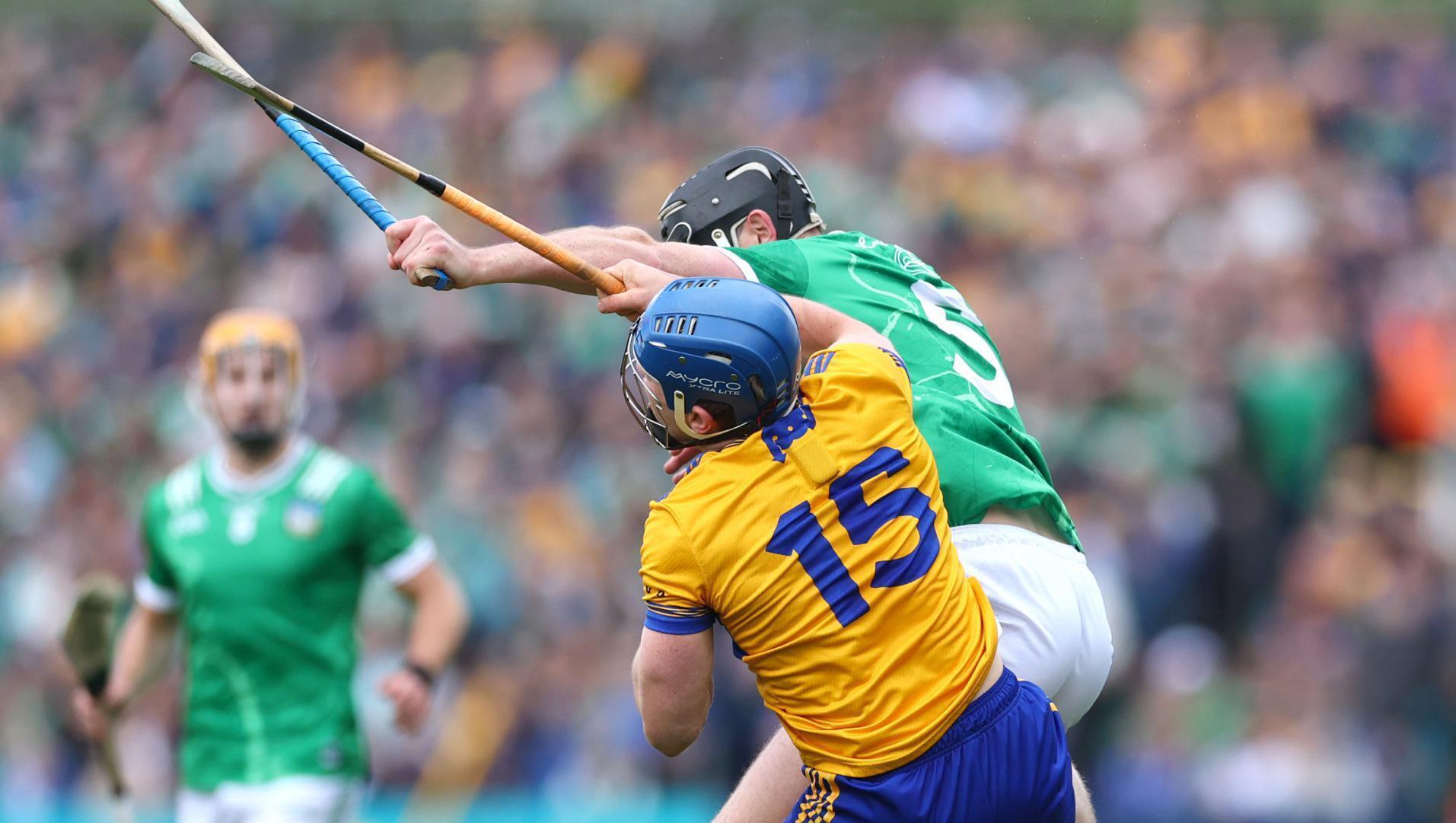
FULL ON: Clare’s Shane O'Donnell and Diarmaid Byrnes of Limerick collide in what was a full-blooded game in Ennis last weekend. Pic: INPHO/James Crombie

Last week the Oireachtas Joint Committee on Arts, Media, Communications, Culture and Sport held a hearing to consider the long-term effects of repetitive head injuries in retired athletes.
The standout expert evidence came from Colin Doherty, a professor at the school of medicine at Trinity College Dublin. He referred to research from Trinity and St James’s Hospital which showed that a number of retired athletes who suffered repetitive head blows while playing sport later demonstrated persistent disruption of the protective blood-flow barrier around their brain.
If that barrier is damaged or, as Doherty put it, leaks, it can lead to chronic cognitive impairment and behavioural changes in retired players. Put simply, it can result in chronic brain damage.
Doherty’s findings align with research globally. He suggested to the Committee that concussion in sport should now be seen as a matter of public health, and that greater governmental involvement was needed via the establishment and funding of clinical and policy groups to develop evidence-based, standardised guidance across all sports in Ireland.
Concussion in sport as a public health issue has been debated recently in Australia. In 2023, a Senate Inquiry issued a raft of similar recommendations such as a National Sports Injury Database and the development of standardised, evidence-based, and easy-to-access concussion and head trauma guidelines across Australian sport.
Increasing the public’s awareness of concussion in sport, guidelines etc is all welcome. The research by Professor Doherty and others at Trinity is global-leading and what is said next is not to undermine it nor the genuine interest of the Oireachtas Joint Committee. But conflating concussion in sport to a matter of public health carries with it the risk of letting individual sports off the hook.
Brain injury mitigation is a matter for the sports body that regulates the game that carries that risk of injury.
Inevitably, when a government is asked to get involved in any contentious issue, the ball and blame can quickly and facelessly pass to it alone: why isn’t the government issuing guidelines; why isn’t the government funding more research; why hasn’t the government established a sports concussion injury database; why shouldn’t the government fund a compensation scheme for injured players.
Of course, the government can play a role, and share services with sport, but fundamentally brain injury in sport is for sport to mind.
In Australia, the 2023 Senate report, while it led to some policy improvement, has otherwise been largely forgotten and in an era of budgetary instability, its recommendations have been placed in the “would be nice to have” folder.
That is not to say that individual sports in Ireland or Australia are not doing anything; of course they are – rule modifications, return to play protocols, sport-specific research etc; as lead by international sports federations such as World Rugby.
The critical and chronic focus remains on collision sports, particularly rugby. When you read about the Carl Hayman, the great All-Black prop, now in his mid-40s living with early onset dementia or Shane Christie a former Māori All Black who died last year aged 39 and who was later confirmed as being one of the first proved cases of chronic traumatic encephalopathy (CTE) in New Zealand professional rugby, you must take a moment.
As you must where you read, closer to home, about former Munster captain Donal Canniffe’s struggles with dementia or listen back to Fiona Hayes’s insights on a recent Off the Ball podcast when she said that at least once she played on when she probably shouldn’t have. And that’s the question now for those of us who love sports such as rugby, are we playing on when we shouldn’t.
In Australia, recent research suggests that two key stakeholders in the future of the game have already made up their minds – parents and insurance companies.
In March, research from the University of Melbourne found that one in three children had been prevented from playing a contact sport because of a parent’s concerns about concussion. One of the underlying reasons it seems is that parents are reading conflicting advice about the safety of contact sports. An example of this occurred last month when an AFL-backed company produced a helmet (a bit like a scrum cap) for players accompanied by various claims as to the level of protection wearing it could provide. Subsequently, on foot of a complaint to the consumer regulator, the company had to remove such claims from its website.
Parents are also concerned at the level of pitch-side assistance volunteer-coaches can give in recognising the symptoms of concussion in children. As a voluntary coach myself, it is a huge, draining responsibility. If in doubt, please, please sit them out.
Having been lucky enough to attend the Clare-Limerick game on Sunday, I saw that similar issues are also present in hurling.
Hurlers are now so physically strong and hit with such pace and power that head collisions and whiplashes are inevitable. There is however no excuse, as a recent report in this paper suggested – up to 86% of the players wearing helmets that do not comply with safety standards – for players not to be wear accredited helmets. It’s a chronic injury and a lawsuit waiting to happen.
The game and spectacle at Cusack Park were superb but the pressure the medical teams are under must now be huge. I saw the Clare medical team rush on to treat Shane O’Donnell after his early hit from Diarmaid Byrnes. How they can make decisions in such a cauldron is a tribute to them and sometimes you wonder whether they could do with extra support, as happens in other sports.
Losing the enthusiasm of parents for contact sports (be it rugby, hurling etc) would mean that a generation of children, who already have the most sedentary childhood in history, lose out on the benefits and sociability of community sport and physical activity.
For professional sport, the gathering storm is that of insurance, or lack thereof. From the beginning of this month, Zurich Australia has said that it will no longer provide total and permanent disablement (TPD) insurance for AFL-related brain injury including concussion and CTE. This means that from this month unless an AFL or AFLW player has their own private TPD insurance, they will need to look to the internal AFL or players association schemes for support.
It seems that Zurich’s actuaries have done the math and based on higher-than-expected volumes and quantum of claims (some running to seven figures), they have decided that such sports-related coverage is simply not viable.
Difficulties with insurance compensation has meant that players have resorted to the law. A class action involving a number of rugby union players, including former Irish internationals, continues to crawl along in the English courts but here in Australia a class action brought by former AFL players is set for court next year.
The AFL’s principal defence is that what happened to the players was the materialisation of an obvious risk in the playing of a contact sport. What the AFL will argue at court is that it must not be forgotten that the players agreed to play the game and assume its risks.
The players are countering (to good effect in the court of public opinion) that what should not be forgotten is that they, who brought such joy to so many, cannot now remember the game they loved nor those who love them.